For luxury brands that already enjoy global recognition, the role of the flagship store is shifting from a mere sales outlet to a space that carries brand experience and long-term customer relationship management.
"Luxe.Co Luxury Brand China Vitality Ranking 2026H1" (hereinafter referred to as the "Vitality Ranking") shows that in the first half of 2026, the overall activity of luxury brands in the Chinese market was at a four-year low. At the same time, brands' store strategies in the Chinese market are also changing, with the focus of competition shifting from the mere pursuit of scale expansion to greater attention on per-store quality and consumer experience.
The recent moves of German luxury luggage brand RIMOWA happen to offer a case worth observing. During the reporting period, RIMOWA rose 10 places on the Vitality Ranking, entering the TOP10 for the first time; on September 16, its first flagship store in mainland China officially opened at Shanghai Jing'an Kerry Centre.
For a suitcase with a long service life, the relationship between consumers and the brand is by nature not confined to the moment of purchase. Therefore, for RIMOWA, the flagship store is not only a new sales outlet, but also plays a role in strengthening brand experience and extending the consumer relationship. As the brand's fifth boutique in Shanghai, this new store of over 200 square meters introduces the RE-CRAFTED program in China for the first time, and also offers Crafted For You bespoke services.

RIMOWA Shanghai Jing'an Kerry Centre flagship store
More notably, the store does not confine "localization" to products or visuals. Around the global theme "For a Lifetime of Lives", RIMOWA invited writer and artist Jin Yucheng to present "Jing'an Temple" along with a message, and launched the "Shanghai, For a Lifetime of Lives — Coordinates of Jing'an's Historic Buildings" city culture guide map, incorporating more than ten historic buildings in Jing'an and the engineering details, historical materials and urban memories behind them into the brand narrative.
From Cologne to Shanghai, RIMOWA is trying to answer a more specific question: how can a global travel brand find local cultural coordinates for its brand theme in the Chinese market.

A Flagship Store That Is More Than a Bigger Boutique
While continuing the existing retail language, the most visible change at this flagship store is the addition of service offerings. The new store features a dedicated customer service area, an in-store repair center, and the RE-CRAFTED program, launched in China for the first time.
Among these, RE-CRAFTED deserves particular attention. The program centers on the collection, repair and re-crafting of RIMOWA aluminum-magnesium wheeled suitcases. Old cases meeting the program's criteria can be brought to the Shanghai Jing'an Kerry Centre flagship store and, after official appraisal, receive a RMB 2,000 RIMOWA voucher, usable on a single purchase of RMB 4,000 or more, limited to one voucher per order and two submissions per person per year.
RE-CRAFTED continues the long-term service system RIMOWA has built on its lifetime warranty. The brand is not only concerned with how long a product can be used, but has also begun to incorporate post-purchase repair, re-crafting and reuse into the brand relationship.
This is not an isolated consumer trend. In its "Future Consumer 2028" report, WGSN characterizes "The Restorers" as consumers who prefer to "buy less, buy better," placing greater value on durability, repairability, and craftsmanship and materials that accrue value over time. The report also suggests that brands need to provide more sustained "long-term companion support," so that products and services continue to play a role for consumers at different stages.

Visible repair center
Thus, RE-CRAFTED, the lifetime warranty and bespoke services together form different layers of this logic.
This shift also corresponds to a real question in luxury retail: when consumers are buying highly durable products with low repurchase frequency, how can brands stay connected after the purchase is complete? Rather than simply adding SKUs, repair, recycling and personalization further extend the product lifecycle.
The flagship store also offers Crafted For You bespoke services in mainland China for the first time. Designed and handcrafted by a newly established atelier at RIMOWA's Cologne factory, the service offers size customization for Classic series aluminum-magnesium suitcases, as well as personalized combinations of details such as letter engraving, leather, lining, color and lacquer finishes, with more than one million options, currently available only at the Shanghai Jing'an Kerry Centre flagship store. The store also exclusively offers two bespoke luggage tag embossing designs: Kerry Centre and Shanghai Yu Garden's Nine-Turn Bridge.

Crafted-For-You bespoke service area
What these elements point to together is not simply adding "Shanghai elements," but establishing a more direct relationship between the product and a specific city.
Since joining the LVMH group in 2017, RIMOWA has also continued to expand its product boundaries. With the launch of the Never Still collection of backpacks and accessories in 2020, the brand's product structure began to gradually extend beyond traditional suitcases. Against this backdrop, the flagship store naturally needs to accommodate not just more products, but accessories, customization, after-sales service and an increasing amount of brand content.

Exclusive luggage tag embossing design — Yu Garden
From the Cologne Origin to a New Shanghai Coordinate
If the service system answers "how to sustain the brand relationship," the space takes on another task: showing consumers how RIMOWA's brand history finds new expression in Shanghai.
The flagship store as a whole continues RIMOWA's clean, modern design language. The aluminum-magnesium installation at the entrance was created by the brand's dedicated architecture team, centered on the raw aluminum coils used in suitcase production, translating the manufacturing process from raw material to finished product into a spatial experience.
Displaying the manufacturing process is a familiar practice in luxury retail, and its value lies in letting consumers see the materials and craftsmanship beyond the finished product. For RIMOWA, which has built its identity on aluminum-magnesium manufacturing and precision craftsmanship, the raw aluminum coil is in fact the brand's most intuitive manufacturing starting point.

Iconic aluminum-magnesium installation
Another important design element in the store is the green display wall and the two sets of geographic coordinates on it. According to the brand, the wall's color is inspired by Cologne's Hohenzollern Bridge, its grooved structure echoes RIMOWA's classic case design language, and it also draws on the urban aesthetics of Cologne Cathedral; the wall juxtaposes the longitude and latitude coordinates of the brand's birthplace, Cologne, and Shanghai Jing'an Kerry Centre, creating a visual correspondence between the brand's origin and its new node in mainland China.
"Coordinates" thus become a natural brand language. It signifies departure and arrival in a journey, and also how a brand enters a new city from its own origin. In Shanghai, this concept takes on new meaning: if Cologne is RIMOWA's geographic origin, then Shanghai is beginning to become a new coordinate from which it continues to unfold its story in the mainland Chinese market.

Cologne-Shanghai dual-coordinate installation
The traditional craft demonstrations at the opening further place this brand language in a Chinese context. The store's curated works include artifacts restored by Jiang Daoyin, a national-level inheritor of intangible cultural heritage, using the traditional Chinese crack-filling (juci) technique, as well as artworks by metalwork artist Chen Yingze. In the porcelain pieces, silver filling and crack-filling staples preserve the object's historical traces while ensuring structural stability; the silverware presents the texture of materials and hand craftsmanship through forging.
These works connect with the repair and continuity emphasized by RE-CRAFTED and the lifetime warranty, and also echo the Hammerschlag hammered texture design of the flagship store's facade. Their significance lies not in simply placing different crafts together, but in the fact that they all point to the same specific proposition: how an object experiences time, leaves traces, and continues to be used through craftsmanship.

Curated masterpieces display wall
From a Suitcase to the Multiple Lives of a City
The most distinctive content of this Shanghai opening is the city culture initiative centered on "Shanghai, For a Lifetime of Lives — Coordinates of Jing'an's Historic Buildings."
RIMOWA invited writer and artist Jin Yucheng to open with "Jing'an Temple" and a message, and also collaborated with Shanghai architecture research team Dune Institute to trace the engineering narratives behind historic buildings, starting from the Jing'an area where the flagship store is located. The project does not treat the map as a mere city check-in guide, but further focuses on architectural details such as load-bearing structures, material tolerances and digital preservation, as well as the historical place of these buildings in the city's development.

"Shanghai, For a Lifetime of Lives — Coordinates of Jing'an's Historic Buildings" city culture guide map
The guide map links more than ten historic buildings and city landmarks, including Paramount, Zhangyuan, the Green House, Changde Apartments, Majestic Theatre and Kerry Centre, and sets up two threads — "engineering figures" and "history" — placing engineering data, restoration archives, historical context and humanistic narratives on the same narrative line.
Why architecture? One important reason is that it has a relatively concrete temporal relationship with RIMOWA's "For a Lifetime of Lives."
Historic buildings do not remain frozen at the moment of completion. They undergo restoration, relocation, renovation and functional renewal, continuing to remain in city life amid change; a RIMOWA suitcase likewise accumulates scratches, stickers and wear through long-term use, and enters its next life cycle through repair, re-crafting and reuse.
Thus, "For a Lifetime of Lives," which in the global theme originally discussed how a suitcase accompanies a person through different life stages, is further translated in Shanghai into how a city and a building experience time and continue to exist after change.

"Shanghai, For a Lifetime of Lives — Coordinates of Jing'an's Historic Buildings" city culture guide map
The significance of this translation lies in the fact that it does not change the brand theme itself, but switches to a larger vehicle. For RIMOWA, the discussion is about how objects transcend time; for Shanghai, it is about how a city transcends time. One extends product life through manufacturing, repair and re-crafting; the other extends urban memory through restoration and renewal.
The dual threads of "engineering figures" and "history" in the map also correspond to RIMOWA's own brand structure. On one side are materials, structures, manufacturing and engineering; on the other are people's lives, memories and city stories. This approach is more meaningful than simply layering on a few local symbols: a German travel brand that has built its identity on an industrial manufacturing tradition is still using its own language, and has begun to use that language to understand a Chinese city.

Writer and artist Jin Yucheng's message on "Jing'an Temple"
The opening further brought this content from the map into the store. Jin Yucheng's works such as "Horse 5," "Jing'an Temple," "Pulley" and "Secluded Bamboo Grove" were displayed together and transformed into limited-edition Shanghai-themed art stickers; the "Shanghai, For a Lifetime of Lives" city guide map was sent in advance to invited guests as part of the invitation. Meanwhile, the 12 bespoke trumpet pieces from the "For a Lifetime of Lives" short film series were made into vinyl records, available for listening in the store and at the party.
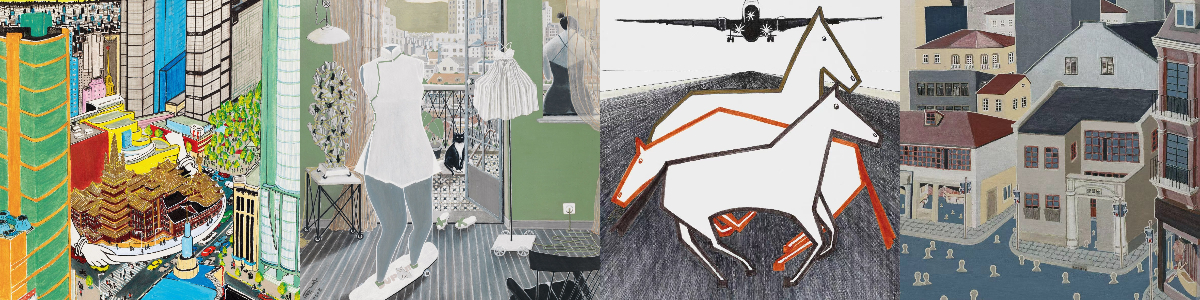
Jin Yucheng's works "Jing'an Temple," "Pulley," "Horse 5" and "Secluded Bamboo Grove" transformed into limited-edition Shanghai-themed art stickers
These elements make city culture no longer just a one-day display on opening day, but brand content that can be read, viewed and taken away. This also means the flagship store is beginning to take on a function beyond merchandise display: allowing consumers to enter the cultural context constructed by the brand through the space.

Left: collaborative works area with writer and artist Jin Yucheng; Right: RIMOWA "For a Lifetime of Lives" vinyl listening area
From a Series of Local Moves to a More Complete Chinese Context
Looking back over a longer timeline, the city culture initiative of this Shanghai flagship store is not RIMOWA's first attempt to expand this kind of cultural narrative in China. As early as 2023, during the Shanghai 125th anniversary exhibition, Luxe.Co observed that RIMOWA needed to find more emotional and cultural expressions for products known for engineering performance and durability. Three years later, this exploration has further extended to the flagship store space, product services and more locally grounded city culture content.
Since 2026, RIMOWA has launched multiple campaigns in the Chinese market around products, cities and people. The Chengdu "New Colors, Shu Charm" pop-up, based on new colors of the Essential collection, collaborated with the Chengdu Shu Brocade and Embroidery Museum and intangible cultural heritage inheritors to bring Shu brocade patterns and traditional craftsmanship into the brand space; the subsequent "Intersections, an Extraordinary Journey" campaign partnered with Jay Chou and Fan Zhendong, developing character narratives from the fields of music and competitive sports, and further extending the product story with bespoke accessories and an exclusive racket case.
This approach also continued into the communications for this Shanghai flagship store opening. The event invited brand friends, celebrities and creators from different fields, forming a content matrix covering diverse circles. Among them, Fan Zhendong, Zhao Jinmai and Greg Hsu are all RIMOWA brand friends, and the event also invited guests including actress Ma Yili, singer Cao Yang, trumpeter Xiao Wentao, pianist Zhang Haotian, supermodel and independent musician Chen Yu, musician and producer Lin Zihao, national-level intangible cultural heritage inheritor Jiang Daoyin and metalwork artist Chen Yingze to participate in the opening ceremony and party. Such a combination covers more areas of interest and further expands the ways the brand connects with Chinese consumers.

From this perspective, for a highly globalized luxury brand, the focus of local communications is not necessarily to keep adding "Chinese elements"; content that connects with the brand's own spirit can be found in the people, cities and cultural experiences familiar to Chinese consumers.
From the flagship store to a city, what "For a Lifetime of Lives" has gained in China is not a new visual symbol, but a new context: a suitcase can leave traces belonging to its user over time, and a building can preserve memories belonging to a city over time. It brings RIMOWA's various attempts in the Chinese market around products, people and cities together into a single scene.
This may be one of the most valuable ways for a global luxury brand to localize after entering a specific market — sticking to its original brand theme while finding local experiences that can truly correspond to it.
|Image source: RIMOWA
|Editor: Xiaoyue