
On September 2, global lifestyle apparel group Kontoor Brands, Inc. (NYSE: KTB) announced the long-term growth strategy and 2030 financial targets for the Norwegian premium outdoor brand Helly Hansen, which was officially brought under its umbrella in June last year.
The group's latest plan aims to drive Helly Hansen's global business expansion and significantly enhance profitability by 2030. As of fiscal 2025, Helly Hansen's full-year revenue was $675 million, with DTC revenue accounting for 25%.
Scott Baxter, CEO and Chairman of the Board of Kontoor Brands, said: "With 150 years of technical heritage and unique global growth advantages, Helly Hansen is a brand with tremendous long-term growth potential. The strong alignment between our teams has enabled a rapid integration, and we are directly seizing the immediate opportunities. Our continued investment in Helly Hansen will be the catalyst for the brand's next phase of growth, and we are confident in creating substantial value for consumers, employees, and shareholders in the years ahead."
At the Investor Day event, Joe Alkire, President and Chief Financial Officer of Kontoor Brands; Børre Hegbom, Global Head of Helly Hansen; Erinn Murphy, Global Head of Finance and Operations at Helly Hansen; and Mike Karapetian, Global Head of Brands, Operations, and Finance at Kontoor, elaborated on the strategy in sequence.
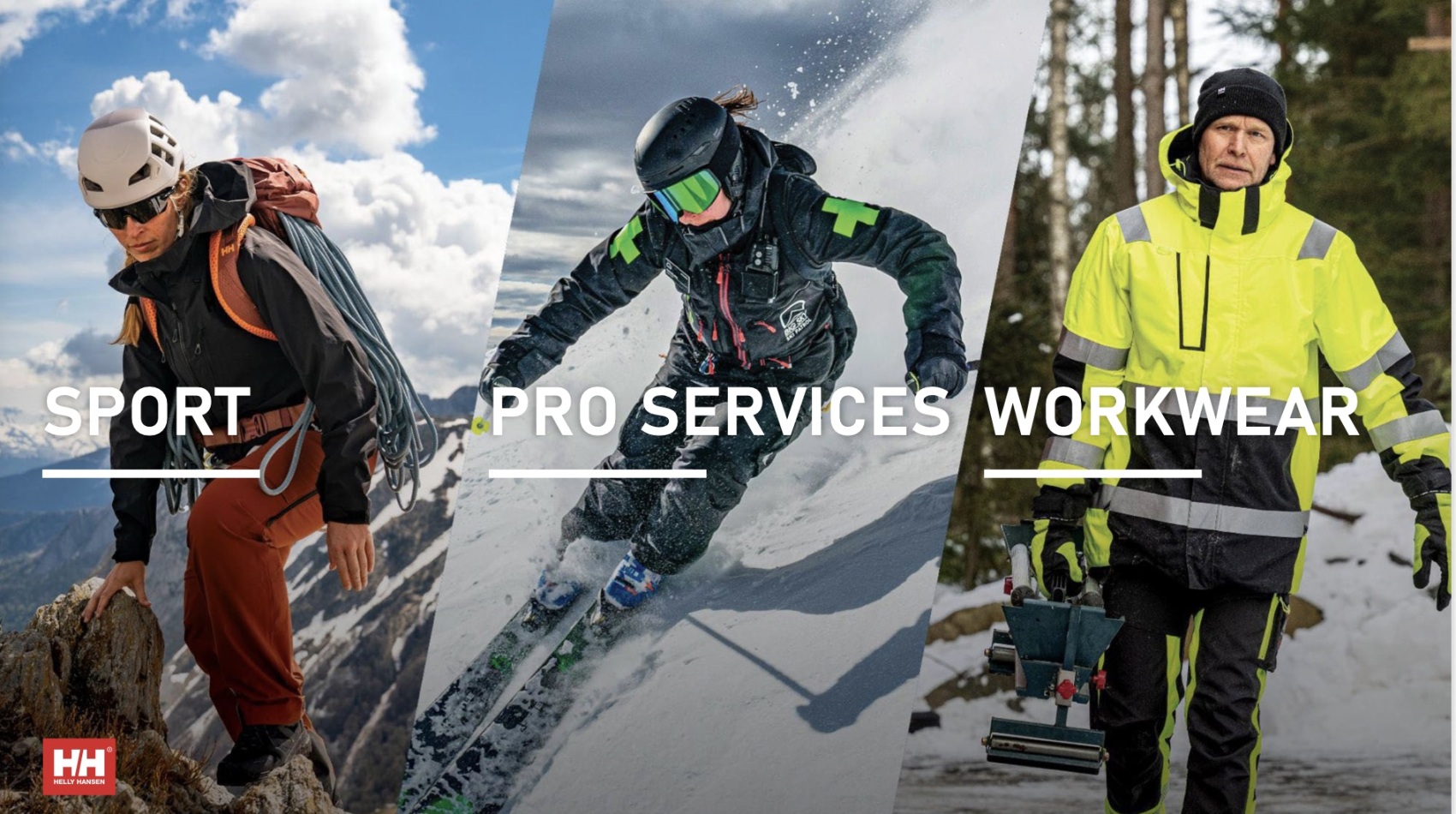
Driving Annual Revenue Beyond $1.1 Billion Over the Next Five Years
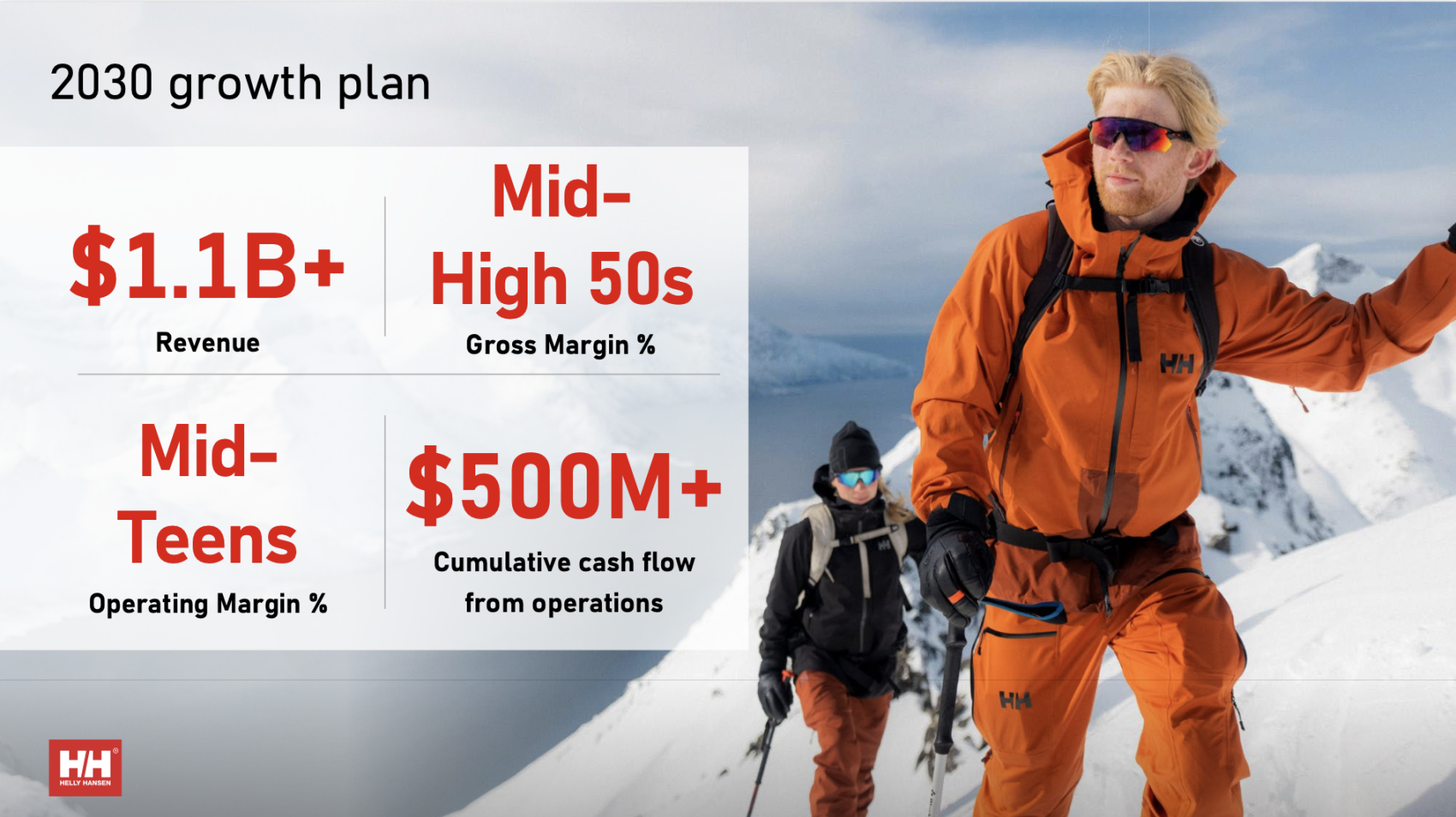
Kontoor Brands aims for Helly Hansen by 2030 to:
- Achieve revenue exceeding $1.1 billion, representing a compound annual growth rate of approximately 10% compared to the estimated $675 million in fiscal 2025
- Reach a gross margin in the 55%–59% range
- Achieve an operating margin in the 14%–16% range
- Generate cumulative cash of over $500 million by 2030
Joe Alkire, President and Chief Financial Officer of Kontoor Brands, said: "We believe Helly Hansen is one of the most attractive opportunities in consumer retail today. Helly Hansen is broadening its consumer base and category boundaries, and is poised for accelerated growth over the next decade. This growth, combined with margin expansion and consistent cash generation, will enhance Kontoor's profitability, support a balanced total shareholder return, and broaden our capital allocation options."
Going forward, Helly Hansen will focus on a focused growth strategy built around three strategic pillars:
- Strengthen the U.S. market: Drive balanced growth through strategic wholesale expansion and DTC, increasing brand awareness and distribution in Helly Hansen's most important incremental market.
- Win in premium outdoor: Compete in the premium outdoor market year-round, leveraging Helly Hansen's leadership in winter sports and sailing to expand into adjacent technical outdoor categories where the brand already has credibility.
- Empower the workwear business: Leverage Helly Hansen's professional-grade product strength and Kontoor's regional operational capabilities to expand the proven, profitable European workwear business into North America.
Joe Alkire noted that technical outdoor and workwear are the two core segments of Helly Hansen's business, where enormous opportunities lie. "We have built brand credibility and possess differentiated advantages to win. These three initiatives cover the vast majority of our growth sources in the five-year plan."
Joe Alkire further added that as "early investments begin to deliver scale effects," growth is expected to exceed 10% in the latter part of the five-year plan. He mentioned that operating margin expansion will come from "significant gross margin expansion, optimized operational control, and increased brand investment."
Anchored by the Dual Pillars of "Premium Outdoor" and "Workwear"
Børre Hegbom said: "Helly Hansen is transforming from a European technical brand into a leading global premium technical brand. We have brand credibility and consumer trust, the foundation to win, and the core focus now is scaling the business. We are deepening our U.S. presence, consolidating our position in the Alps, and growing in outdoor and workwear, where the opportunities are greatest."
Børre Hegbom noted at the event that Helly Hansen's core strengths stem from its brand heritage; the brand will celebrate its 150th anniversary in 2027. "We are one of the oldest brands in the industry today."
Secondly, another highlight of Helly Hansen is its innovation capability and Norwegian design. Børre Hegbom introduced that Helly Hansen was the first brand to launch synthetic insulated mid-layers in the 1960s and pioneered synthetic base layers in the 1970s.
Børre Hegbom said: "What sets Helly Hansen apart from competitors is the arena we play in. Most outdoor brands have been to the Antarctic, the Arctic, and Mount Everest—so have we. But we are one of the very few brands deeply rooted in the world's harshest environments—the ocean. That's an entirely different set of challenges. It's not just rain and snow testing the products, but relentless saltwater waves, which is why we create some of the industry's best products."
Erinn Murphy, Global Head of Finance and Operations at Helly Hansen, said the brand has the opportunity to further increase brand awareness and attract more potential consumers. She noted that aided brand awareness in the U.S. is around 30%, "far below global leading competitors in the same space; unaided awareness is only 3%."
Erinn Murphy pointed out that Helly Hansen's five-year plan includes doubling marketing investment by 2030, while shifting the marketing approach from a focus on product performance to brand building. "Before Kontoor's acquisition, on average 70% of our marketing budget went to product performance promotion; now we are reversing that ratio. The marketing model is also shifting from fragmented coverage of multiple categories and products to telling a complete brand story around categories. The marketing team structure is also being adjusted, splitting from a centralized team into two independent marketing teams for sport and workwear."

Based on consumer research, Erinn Murphy elaborated on Helly Hansen's growth potential in outdoor and workwear. Outdoor/sport accounts for 75% of Helly Hansen's overall business, workwear 25%.
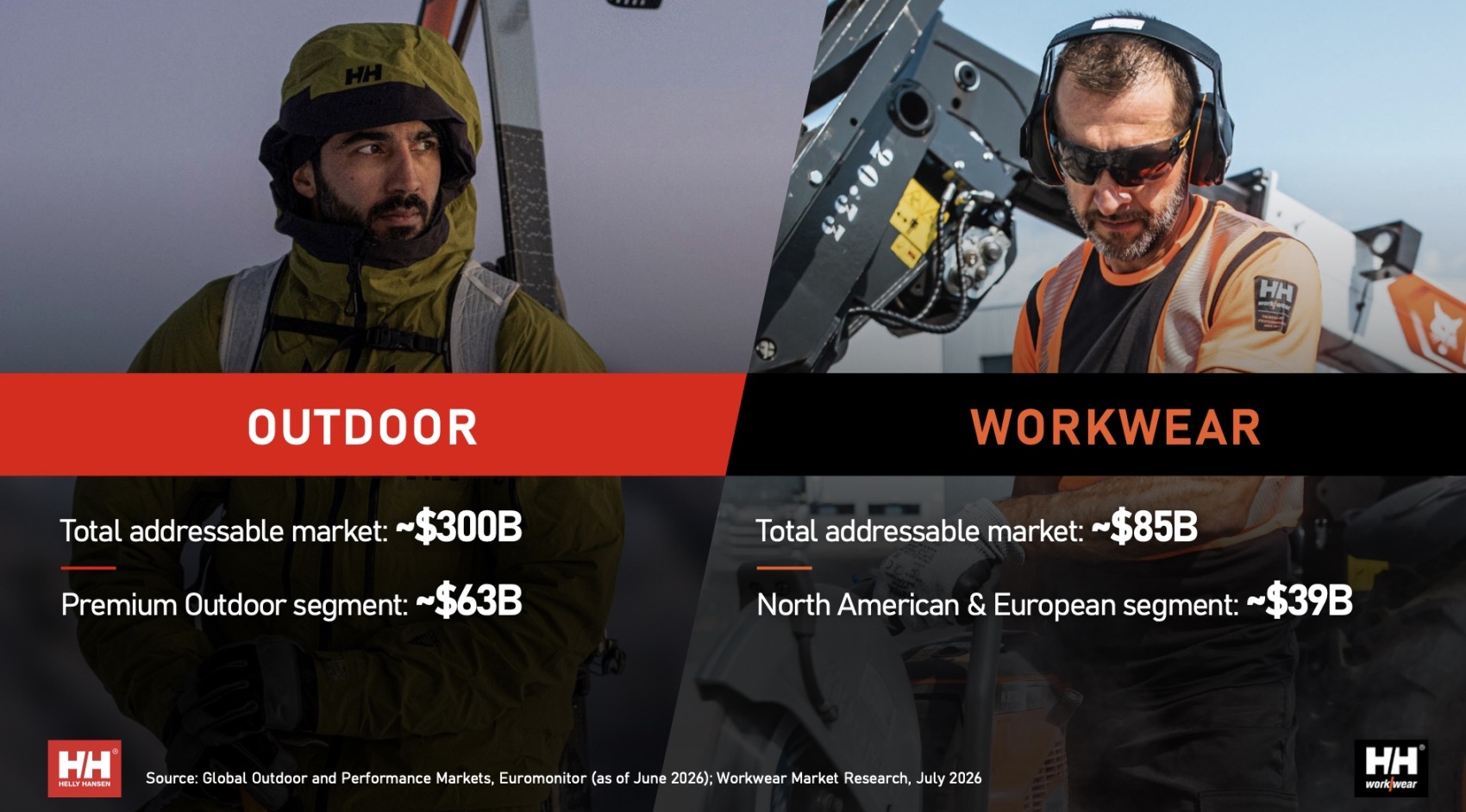
The global outdoor market exceeds $300 billion, with Helly Hansen primarily targeting the premium segment slightly above $60 billion. The global workwear market is $85 billion; Helly Hansen aims to gain a foothold in North America while continuing to grow in Europe.
Helly Hansen noted that the premium outdoor markets in the U.S., Europe, and China are $20 billion, $14 billion, and $9 billion, respectively, with Helly Hansen's market shares in these three markets at 1.2%, 2.6%, and 1.1%.
Erinn Murphy listed multiple structural tailwinds driving the technical outdoor segment: "First, the segment is innovation-intensive with premium pricing, offering substantial long-term margin potential. Second, it's a market built around sports activities—hiking, climbing, trail running, and other outdoor participation continues to rise, creating a global trend and a highly loyal repeat customer base. Third, it's the fastest-growing segment in the outdoor industry, with a projected CAGR of 6% through 2030. Finally, this segment helps us expand year-round wear occasions and deepen connections with consumers."
Extensive consumer research in Europe and the U.S. shows that Helly Hansen has attracted a "highly engaged sports enthusiast customer base." The brand has 55,000 professional partners, including athletes from the Norwegian Alpine Ski Team, fishermen, search and rescue personnel, mountain guides, and ski resort staff; 20% of core consumers learned about Helly Hansen through this group.
"Our customers value product performance. Professional performance is the top purchase criterion. As expected, users are sports enthusiasts: skiing more than 16 days per year on average and maintaining year-round activity habits. 75% of core consumers participate in at least three technical outdoor activities," Erinn Murphy noted.
Among them, 75% of core consumers hike, and over 50% participate in trail running.
Mike Karapetian said that over the past decade, by deepening its presence in skiing and sailing, Helly Hansen's outdoor business has doubled in size. "This strategy has worked, and today we hold 1% and 4% market share in the two segments, respectively, both at the top of their categories. Now we are building a third growth pillar."
Consistent with the logic in skiing and sailing, Helly Hansen will target professional audiences in trail running, hiking, backpacking, and climbing to penetrate the broader outdoor market. "The technical outdoor segment is about three times the size of the ski market; even a small market share gain can bring substantial revenue increment. Each 1 percentage point gain in technical outdoor market share corresponds to over $400 million in additional revenue, nearly equivalent to our entire global planned increment."
To capture the broad technical outdoor opportunity, Mike Karapetian mentioned two key actions: appointing Helly Hansen's first North American General Manager and continuing to invest in the product team and marketing. "In the short term, we will increase marketing spend to build brand awareness, then return to a reasonable investment level in the latter half of the planning period; wholesale and DTC channels will expand prudently in parallel, with moderate store expansion and increased digital investment. Pace is critical: talent and product first, then marketing, and finally channel distribution."
In workwear, Helly Hansen has already achieved great success in the Nordic market, with the workwear business growing rapidly in recent years and now roughly equal in size to the sport business. Referencing the Nordic playbook from a decade ago, Kontoor plans to appoint a dedicated North American lead for the workwear business to unlock U.S. workwear growth.
Mike Karapetian said: "We will replicate this model globally, prioritizing the U.S. A small market share gain in the U.S. workwear segment can translate into significant revenue. As with the sport business, talent comes first: build a dedicated workwear team, develop a product line tailored to the U.S. market to complement the existing global lineup, increase marketing investment, and upgrade the digital platform."
Meanwhile, in workwear, the North American and European workwear markets are expected to grow 6% over the next five years, and Helly Hansen will focus on these two markets.
"We have already built credibility in the extremely harsh Nordic market. The workwear segment also has strong tailwinds. As seen in the news, especially the U.S. workwear industry is undergoing a reshaping. With rising higher education costs, more people are forgoing college and choosing other paths; vocational and technical school enrollment waitlists often span years, and the construction industry is booming," Erinn Murphy said.
"In the sport segment, the short-term growth drivers remain the two core categories of skiing and sailing; as the new product matrix launches, growth in the broader technical outdoor business will gradually accelerate. In workwear, we will first complete team building and implement the innovative product roadmap, achieving steady and orderly growth in the coming years," Mike Karapetian further noted.

U.S. Market as the Core, Strengthening Global Growth
Currently, 30% of Helly Hansen's revenue comes from the U.S., with the majority of the remaining sales contributed by Europe. Børre Hegbom, Global Head of Helly Hansen, noted that U.S. market sales reach $150 million, "already our largest and fastest-growing country market." Although Helly Hansen has established a foothold as "one of the best-performing European outdoor brands in the U.S.," "compared to leading U.S. domestic players, our scale is still relatively small, which is exactly where we will focus our efforts going forward."
Børre Hegbom emphasized that 60% of Helly Hansen's growth over the next five years will come from the U.S. market. Overall, Kontoor expects Helly Hansen's U.S. business to reach at least $500 million by 2030, with a CAGR exceeding 20%; the rest of the global markets are expected to maintain mid-single-digit growth.
Mike Karapetian, Global Head of Brands, Operations, and Finance at Kontoor, said the group aims to grow Helly Hansen's U.S. business to "at least $500 million, with both premium outdoor and workwear contributing substantial revenue."
One new initiative to drive U.S. growth is the appointment of C.J. King as Helly Hansen's first North American General Manager. This executive spent the past decade in management roles at Arc'teryx North America, most recently as Vice President of Wholesale for North America.
Børre Hegbom introduced that Helly Hansen's U.S. channel structure is very healthy, with wholesale at 55% and DTC at 45%. The brand will not change this ratio but will expand both channels simultaneously; of the five-year growth, 45%–50% will come from wholesale and 50%–55% from DTC.
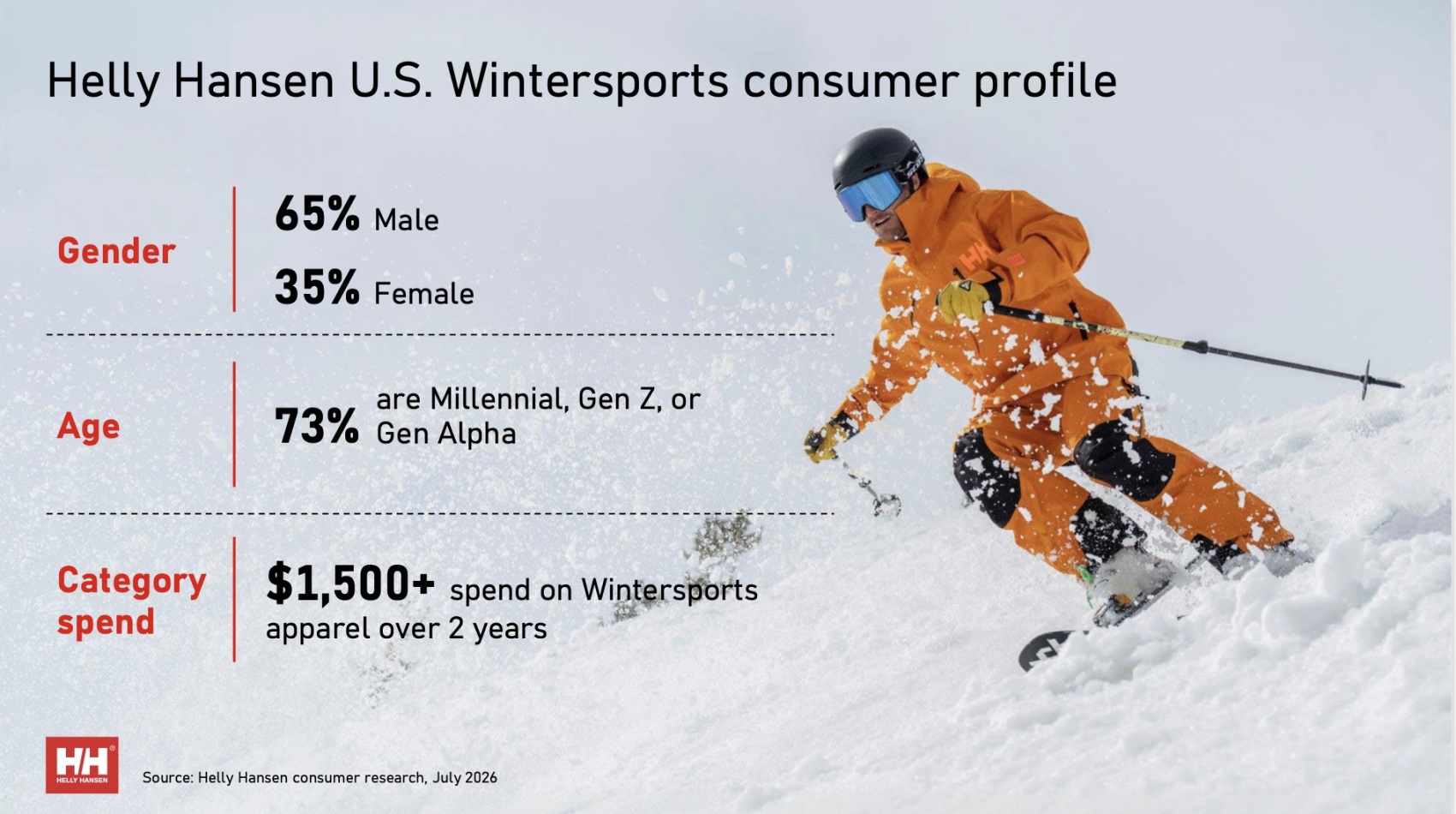
Kontoor's research shows that Helly Hansen's U.S. customer base is predominantly male, but female consumers also account for a considerable share. 73% of U.S. consumers are under 43, belonging to high-spending category consumers who spend an average of $1,500 on winter sports categories within two years.
The research targeted U.S. consumers who purchased winter sports gear in the past 24 months. Consumers prioritize four factors when choosing: product performance, trusted brand, warmth, and weather protection. Compared with other leading technical outdoor brands, Helly Hansen scores highest on trustworthiness and warmth. Erinn Murphy said: "The conclusion is clear. Although our brand scale is smaller than multi-billion-dollar peers, we have achieved high recognition on the purchase decision dimensions consumers value most—that is our confidence to win."
Børre Hegbom also mentioned that for the past decade, he has managed the U.S. business remotely from Norway. Now, Helly Hansen will deepen its focus on specialized niche partner accounts in the U.S. and increase its presence with key large accounts, namely national chain channels. The core idea is to raise brand awareness and win large channel customers. At present, Helly Hansen has a limited number of stores in U.S. chains, with a goal to increase store penetration to 25%–35%.
Helly Hansen plans to double its e-commerce business by 2030, with the core aim of turning its brand website into a "premium destination for full-price merchandise." "We will build a seamless omnichannel experience, strengthen capabilities, and increase repeat purchases, brand loyalty, and customer lifetime value. E-commerce is crucial for the U.S. market, which is already our largest e-commerce region," Børre Hegbom said.
In physical retail, Helly Hansen currently has 12 stores in the U.S., mostly located in ski and sailing destinations. Børre Hegbom noted: "We do not plan to open stores on a large scale in the U.S., but rather selectively open a small number of stores."
Børre Hegbom believes that Kontoor's acquisition of Helly Hansen will bring significant benefits to the brand. He recalled that during his 22 years at Helly Hansen, the brand's majority controlling shareholders were mostly private equity firms, which "were relatively conservative in investment." Even so, Helly Hansen achieved high-single-digit growth over the past 17 years, and he expects Kontoor to help the brand accelerate further in the future.
Speaking of Kontoor, Børre Hegbom said: "They understand this business, and we share the same philosophy. As a U.S. local expert, they can truly empower our U.S. market. We can access Kontoor's multi-brand platform, which is a huge advantage for us, and they understand that accelerating growth requires continued investment. I have worked here for 22 years, and this acquisition is truly a game-changing turning point for Helly Hansen and all employees—we are entering a new era."
Outside the U.S., Helly Hansen is focusing on the Alps region. "Why the Alps? It is Europe's largest outdoor market, with four-season business opportunities highly aligned with our positioning. It is Europe's number one ski market, and we have deep roots in skiing," Børre Hegbom explained.
Helly Hansen also noted that China is a market with untapped potential (Unlocking) and an additional growth driver for the brand. In 2020, the brand signed a ten-year cooperation agreement with local apparel group Youngor Group to establish a joint venture (50/50) to operate the local market. Initially positioned as a sailing brand, it has since expanded into outdoor. Currently, the brand's products are produced in China, with regional design centers in Korea, Osaka, and Shanghai; store count grew from about 90 in 2025 to over 130 in 2026.
In China, Helly Hansen maintains a premium positioning, with market pricing 30–40% higher than in Europe. Meanwhile, the brand states that China is a single-brand store, retail-driven market and has become an important growth engine. In 2025, the brand's China revenue was approximately $100 million, with revenue growth exceeding 80% in the first half of 2026.

|Source: Official press release, SGB Media
|Image Credit: Brand official website
|Editor: LuxeCO


