Alpine freeride is a distinctive sport full of uncertainty: you have to find a line on natural, un-groomed mountain terrain, traversing cornices, cliffs and steep chutes, completing jumps and high-speed turns. Speed, technique and terrain judgment are all indispensable, and every run differs because of line choice and personal style. And that is precisely its appeal: there is no single predetermined route; what each person leaves on the mountain is a track entirely their own.
Peak Performance, from the small town of Åre in northern Sweden, is an outdoor brand that began with alpine skiing. The town has hosted the Alpine World Ski Championships three times and is known for its vast forest trails, natural backcountry snowfields and changeable, harsh polar climate. In 1986, two ski enthusiasts founded Peak Performance here, hoping to create ski apparel that could handle the local climate while also offering a striking look and clean design. Starting from real outdoor needs and seeking a balance between technical performance and design aesthetics has been the brand's product philosophy ever since.
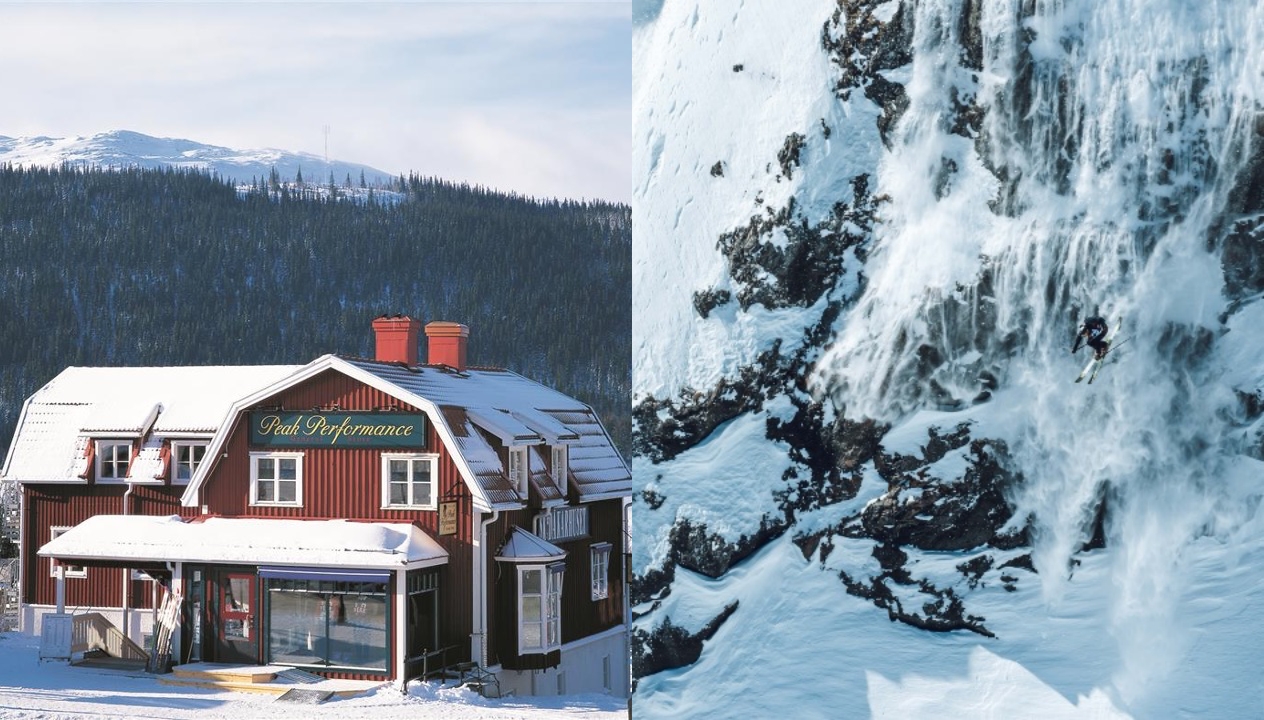
Peak Performance is rooted in the freeride spirit
In 2012, Peak Performance launched the iconic HELIUM lightweight down jacket, whose wavy quilting pattern was inspired by the fluid tracks freeriders leave on the snow when executing carving techniques, translating the dynamic lines of skiing into the visual signature of "stylish outdoor."
This year marks the brand's 40th anniversary. From October 17 to 25, Peak Performance is launching the "Born of Helium" HELIUM pop-up experience space at Zhangyuan in Shanghai, the brand's first offline immersive experience space in China. Using the HELIUM lightweight down family as the entry point, it brings technical products, design language and a long-term use philosophy into an urban setting.
Through this move, we can further observe how a brand with deep technical roots is responding to new changes in outdoor consumption: as gear increasingly becomes part of everyday dressing, how can technical expertise be translated into stronger brand recognition?
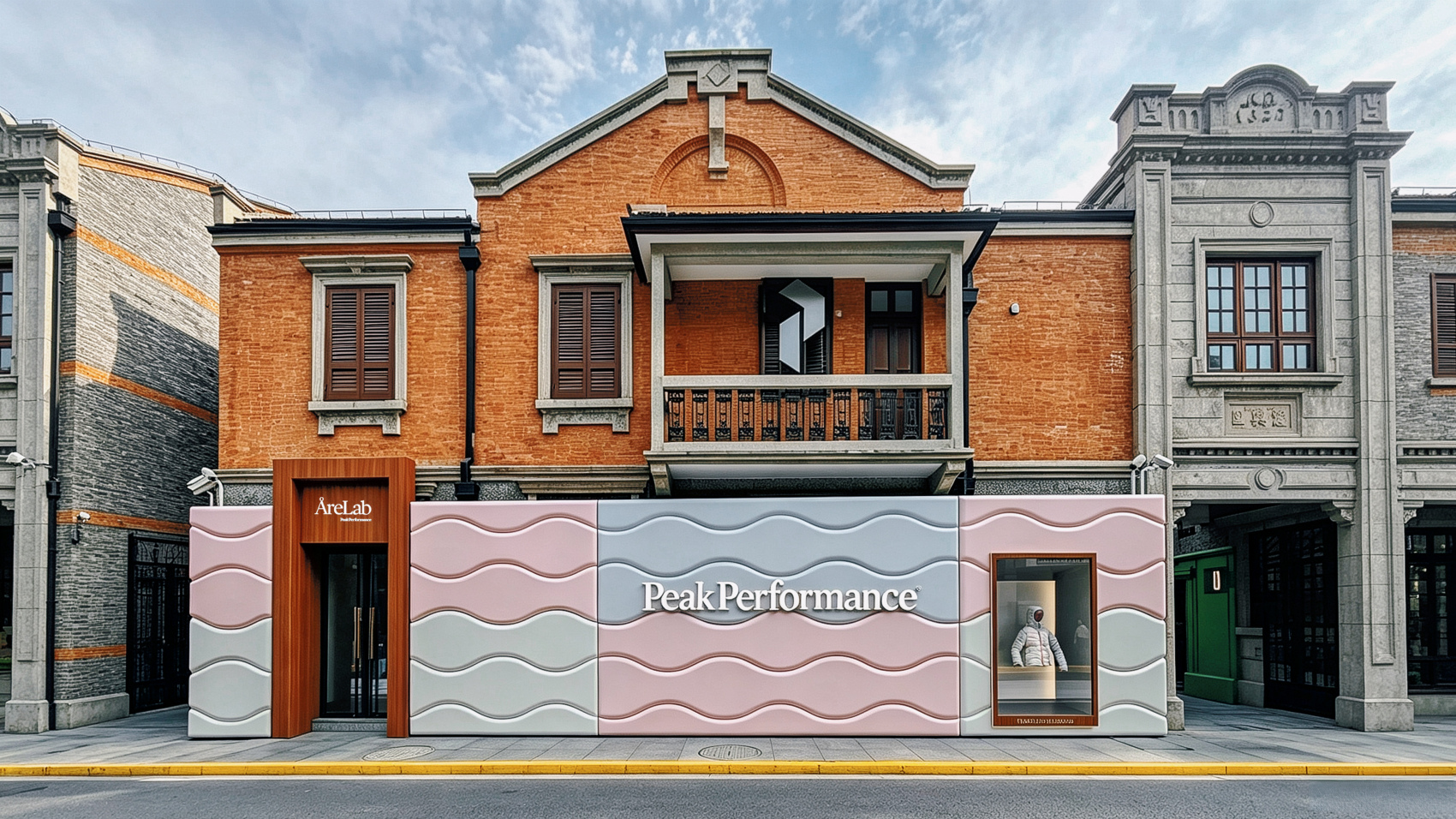
Peak Performance "Born of Helium" HELIUM pop-up space
How does technical expertise translate into real-world scenarios?
Since 2016, Peak Performance has maintained a long-term partnership with the world's top commercial freeride event, the Freeride World Tour (FWT), upgrading to principal partner in 2024. As freeride becomes an official event at the 2030 Alpine Winter Olympics, the brand continues to deepen its expertise in this niche.
Its global Tier 1 athlete roster includes multiple FWT overall champions: Olympic gold medalist Justine Dufour-Lapointe of Canada, Sweden's two-time champion Kristofer Turdell, and Norway's two-time champion Hedvig Wessel; in China, the brand has signed two-time FWT China overall champion Wang Yuxuan and Beijing Winter Olympics competitor Yang Shuorui.
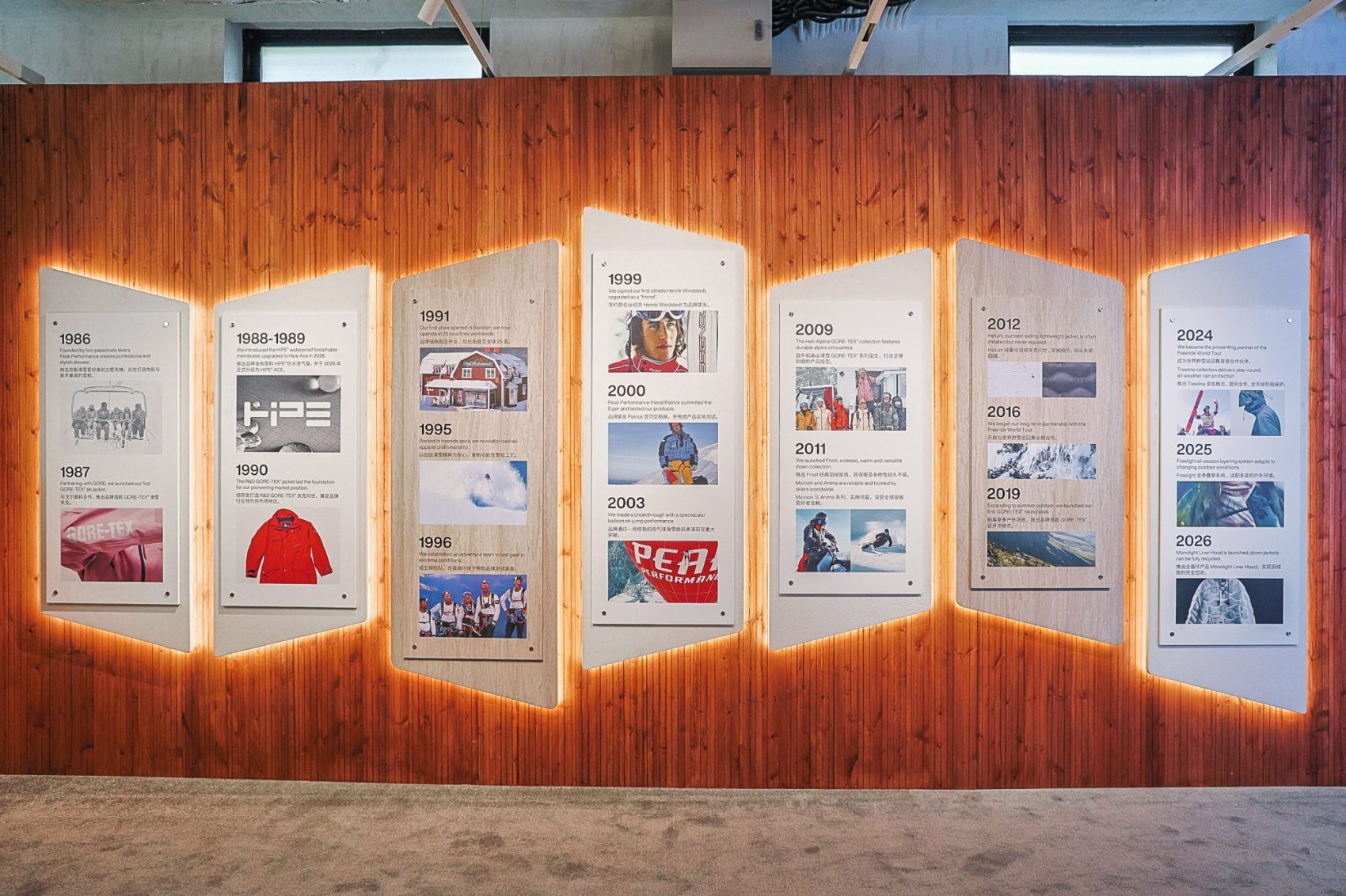
Peak Performance 40th anniversary brand timeline
For a brand rooted in freeride, lightweight down is first and foremost part of a technical gear system, not merely a fashion item.
In alpine outdoor activities, layering typically consists of a base layer, a mid insulation layer and a shell layer, responsible respectively for moisture management, warmth and wind/water protection. Only when the layers work together can they handle changes in activity intensity, temperature and weather. Peak Performance's product system built around fabric technology, insulation materials and layering starts precisely from these practical needs.
For outer protection, the brand's ski line uses technical fabrics such as GORE-TEX® Pro; its self-developed HIPE® waterproof-breathable technology has more than two decades of application history and was upgraded in 2026 to HIPE® ACE, offering two-layer, 2.5-layer and three-layer constructions to suit different activities.
According to technical materials provided by the brand, the relevant HIPE® ACE fabrics have a minimum waterproof rating of 20,000 mm and a minimum moisture vapor transmission rate of 20,000 g/m²/24h. Through different constructions and material configurations, the brand balances environmental protection with lightweight fabric and wearing comfort.
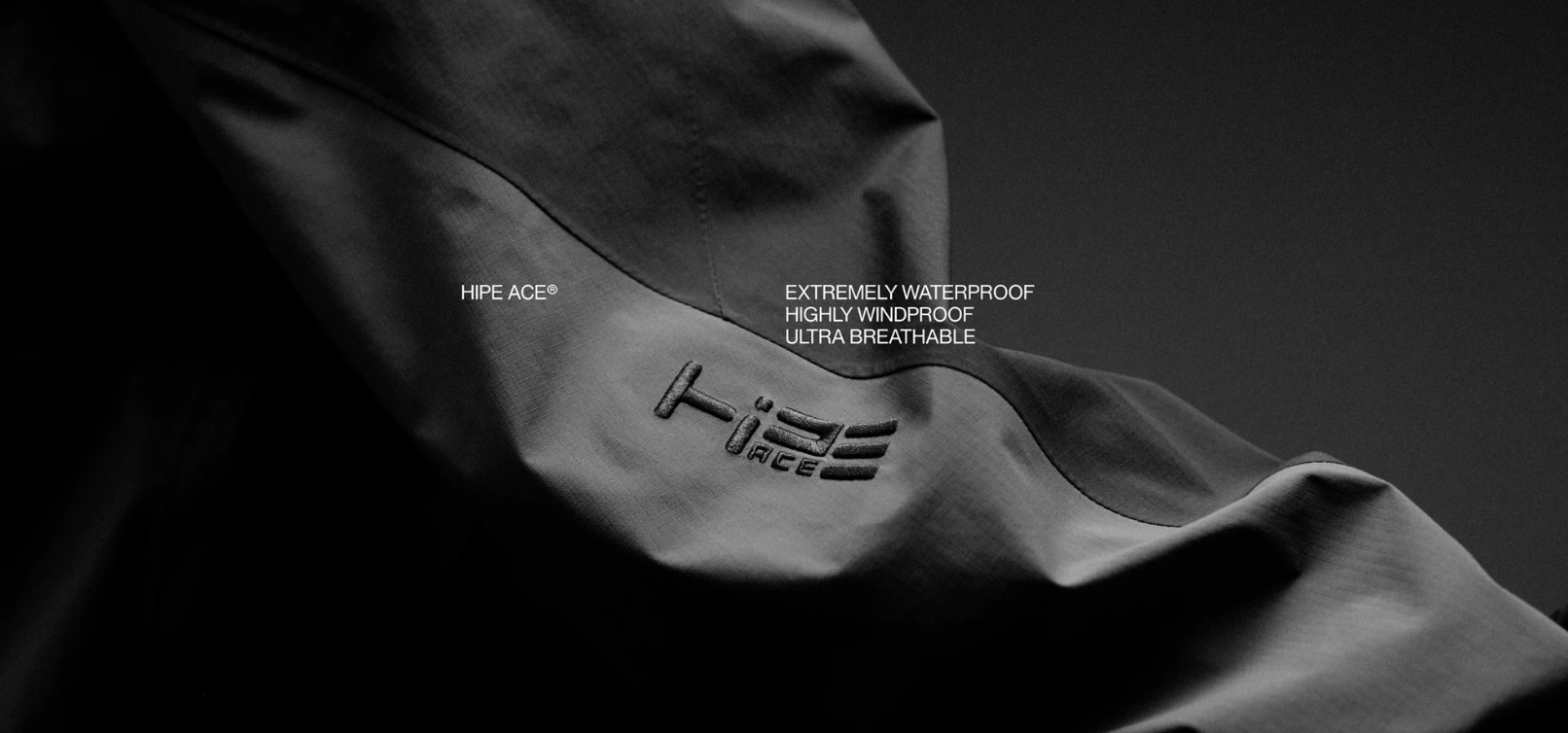
HIPE® ACE
The mid insulation layer takes on another role. POLARTEC® fleece, through its breathability and moisture-wicking performance, helps wearers maintain a relatively stable body feel during activity; PrimaLoft® synthetic insulation combines lightness with warmth, maintains relatively stable thermal performance in damp conditions and dries more easily. The brand's Freelight all-season layering system further offers options for dressing combinations under different outdoor conditions.
The Peak Performance HELIUM lightweight down family is the concrete expression of this layering logic in insulation products. The series is named "HELIUM" to emphasize lightness and portability. The products use 20D ripstop nylon fabric with a fill of 90% down and 10% feathers, using duck or goose down depending on the specific style, and also emphasize the reliability and traceability of the down source.
Beyond lightweighting, another important design element of HELIUM is packability and layering. The standard style can compress to about the size of an orange, while some Utility styles can be packed into their own pockets. In outdoor scenarios, it can be worn as a mid insulation layer with a hardshell; in urban daily life, it can also serve directly as a lightweight outer layer.
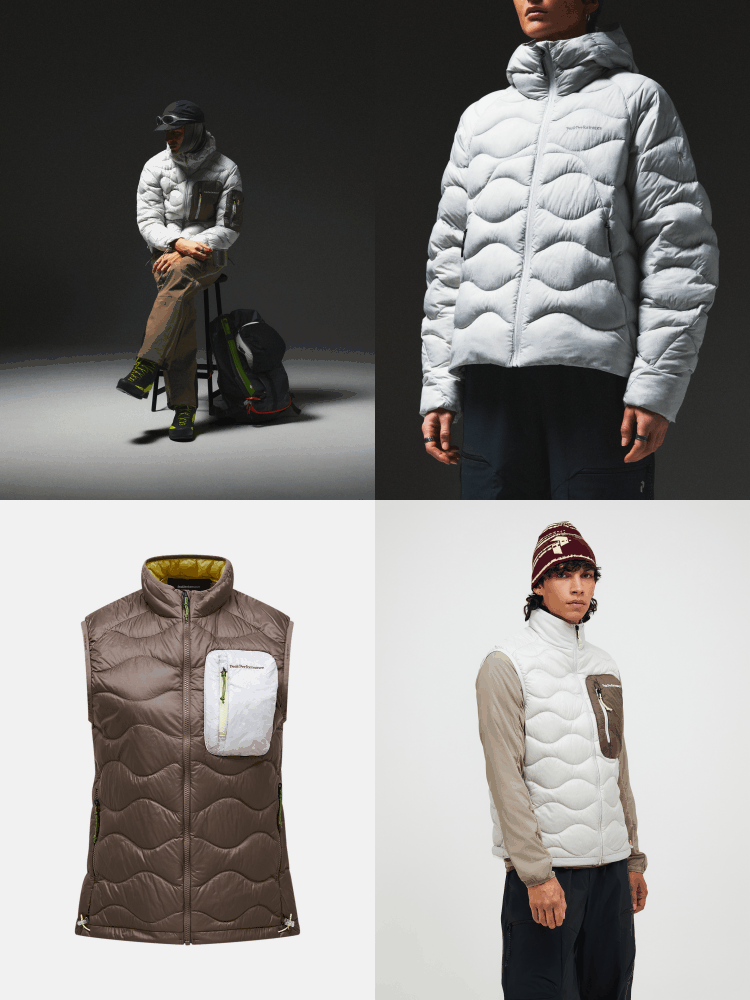
The Peak Performance Fall/Winter 2026 collection further enriches the product matrix. HELIUM Down Hood and Down Jacket offer classic lightweight down options; the Utility Down Hood, nicknamed the "toast jacket" by Chinese consumers, adds pockets on the chest and upper arms to reinforce functional attributes and features packable design; Utility Goose Down Hood expands the options with goose down fill; Utility Down Vest suits layering scenarios that require freedom of arm movement; Down Hybrid Hood enhances mobility through stretch-knit panels and helps wick moisture; and the Nova Jacket further enriches the series' silhouette options.
Judging from the structure and function of the different styles, HELIUM is not a product series supported by a single signature item alone, but one that seeks to respond to diverse needs in outdoor sports and everyday dressing through different cuts, fills and packing methods.
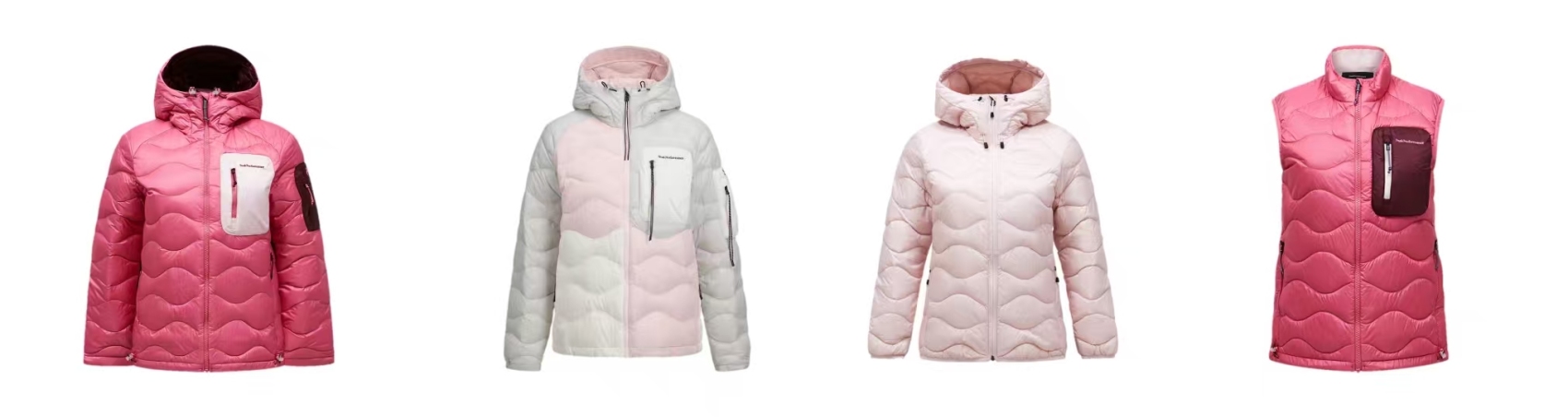
Helium lightweight down family (from left to right: HELIUM Utility Down Hood, HELIUM Utility Goose Down Hood, HELIUM Down Hood, HELIUM Utility Down Vest)
How does outdoor gear build a distinctive aesthetic identity?
In the FWT judging system, line choice, control, technique, fluidity, and aerial maneuvers and style together make up the evaluation of an athlete's performance. Style here is not just about whether the moves are visually appealing, but also about how the athlete understands the terrain, chooses a line and completes the run in their own way.
In the freeride context, "stylish" describes precisely this personal style built on technique. Peak Performance's emphasis on stylish outdoor can be understood from here as well: translating the sports culture originating in alpine freeride into a product design language, so that technical gear possesses both functionality and visual recognition.
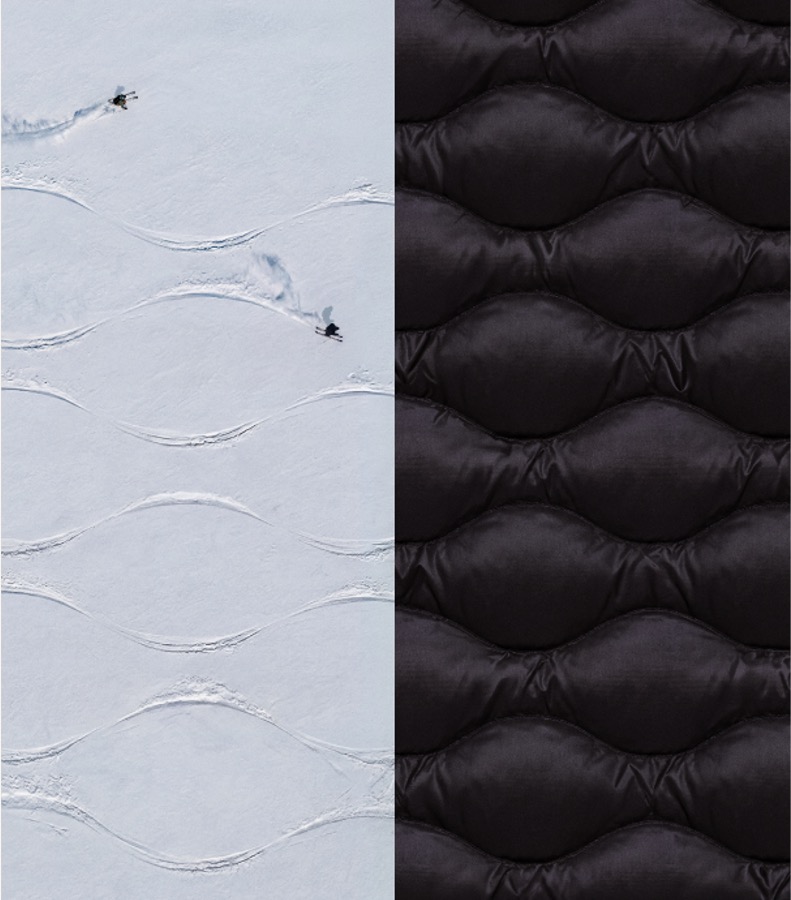
The quilting pattern of the HELIUM lightweight down series, inspired by carving tracks
The signature wavy quilting pattern of the HELIUM series is inspired by the curves freeriders leave on the slopes after executing carving techniques. The ski track thus becomes a design symbol on the garment's surface. This structure is not merely decorative; it also helps secure the down, reduce fill shifting and lower the possibility of cold spots forming at seams. Sports experience thus enters both the product's visual design and its insulation structure.
Color further reinforces this recognition. Continuing the Scandinavian design tradition, Peak Performance draws inspiration from natural landscapes such as the aurora, forests, lakes and glaciers, gradually forming its own color system. While keeping the overall silhouette clean, the brand builds more distinct visual layers through color blocking between pockets, zippers, outer layers and linings, as well as combinations of different color blocks.
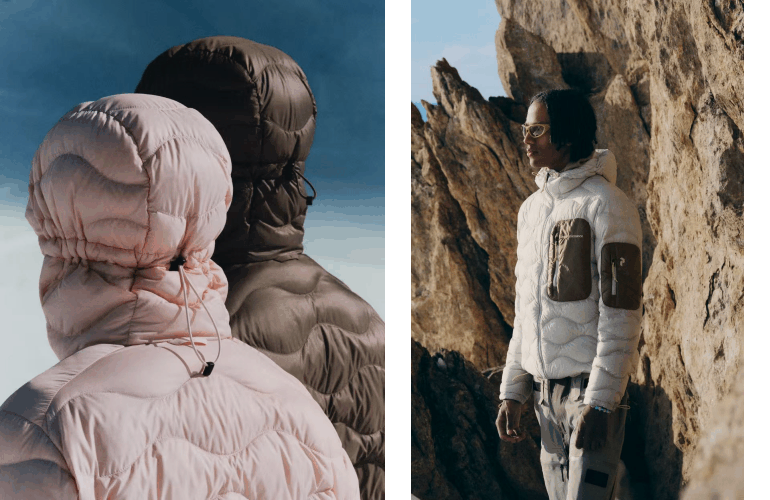
The HELIUM Utility series is a concentrated expression of this design approach. The pockets on the chest and upper arms, the proportional relationships between color blocks, and the contrast between inner and outer layer colors give the products a strong styling character while retaining functionality. The color-blocked style worn by brand ambassador Liu Wen brings this aesthetic language into a broader fashion consumer view.
On social media, Peak Performance has even been called the "ceiling of color blocking among outdoor brands." This assessment reflects consumers' intuitive perception of the brand's color recognition.
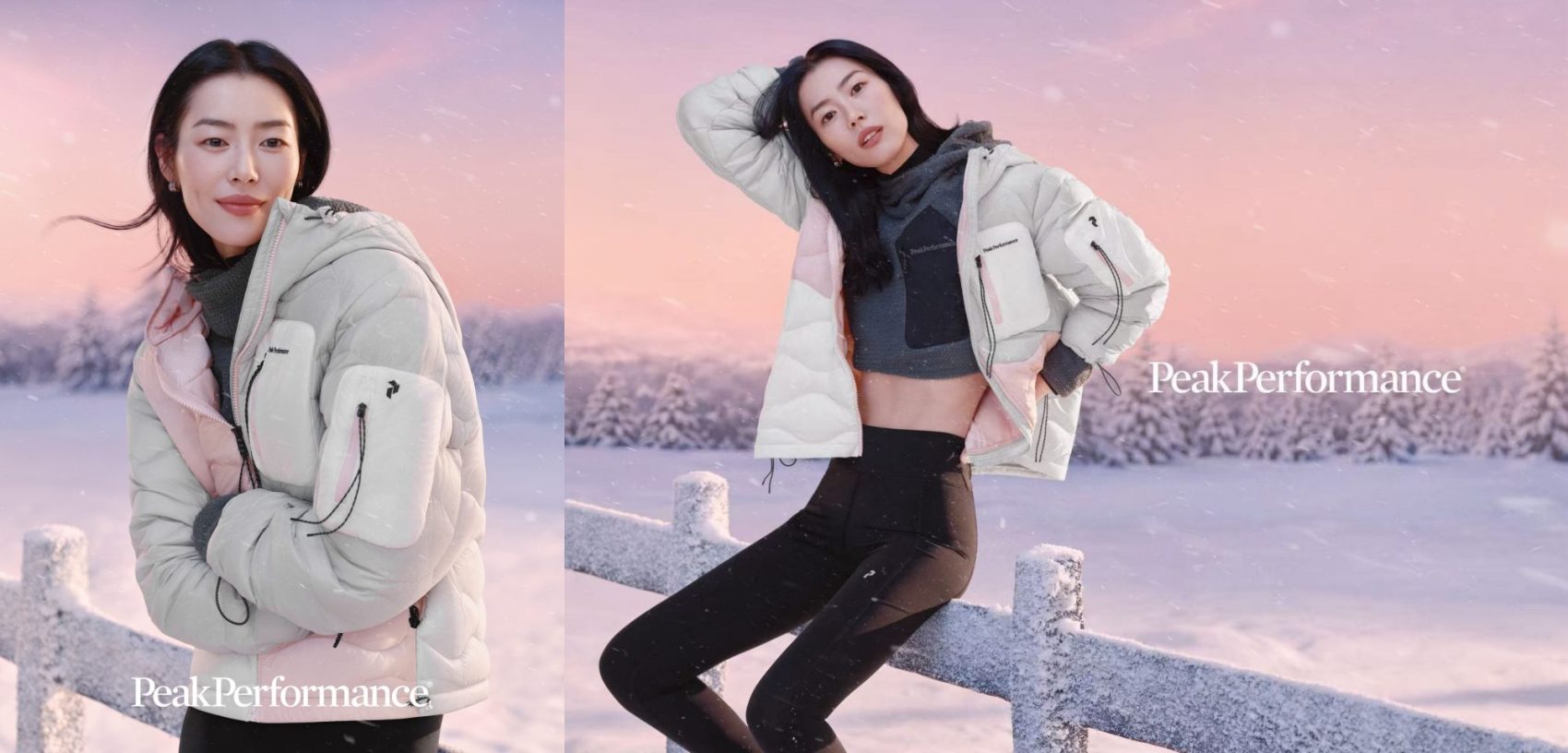
Peak Performance brand ambassador Liu Wen wearing the new HELIUM lightweight down family
From the tracks on the slopes to the curved quilting on garment surfaces, and then to natural colors and paneled design, Peak Performance seeks to bring the dynamic beauty of professional sports into everyday dressing. Professionalism and aesthetics are not an either-or choice; design builds a more intuitive connection between the two.
As outdoor consumption extends into urban life and diverse scenarios, consumers' demands for products are no longer focused solely on function, but also include wearing style, personal aesthetics and lifestyle. Whether a brand can establish a distinctive and consistent design language while meeting real outdoor needs is becoming a new dimension of competition.
Looking further, this is also a competition for category mindshare. Some outdoor brands have already formed relatively clear consumer perceptions in the Chinese market. For Peak Performance, what it needs to win is: when consumers look for an outdoor down jacket that combines technical performance with design sensibility, the brand can enter their priority consideration set.

How can brand philosophy be perceived by consumers through experience?
The "Born of Helium" HELIUM pop-up space at Zhangyuan in Shanghai is an attempt by Peak Performance to translate its brand philosophy into an offline experience.
Inspired by the brand's birthplace, the town of Åre in Sweden, the space connects the brand's development history through imagery of snowy mountains and wooden cabins, a brand history wall and a display stand for the 40th anniversary retro red-and-blue ski suit. The facade uses HELIUM's signature quilting pattern, with polar white and crystal frost pink creating a Nordic snowscape atmosphere; the red-brick texture of Zhangyuan's shikumen architecture echoes the "Falu red" of traditional Swedish buildings.
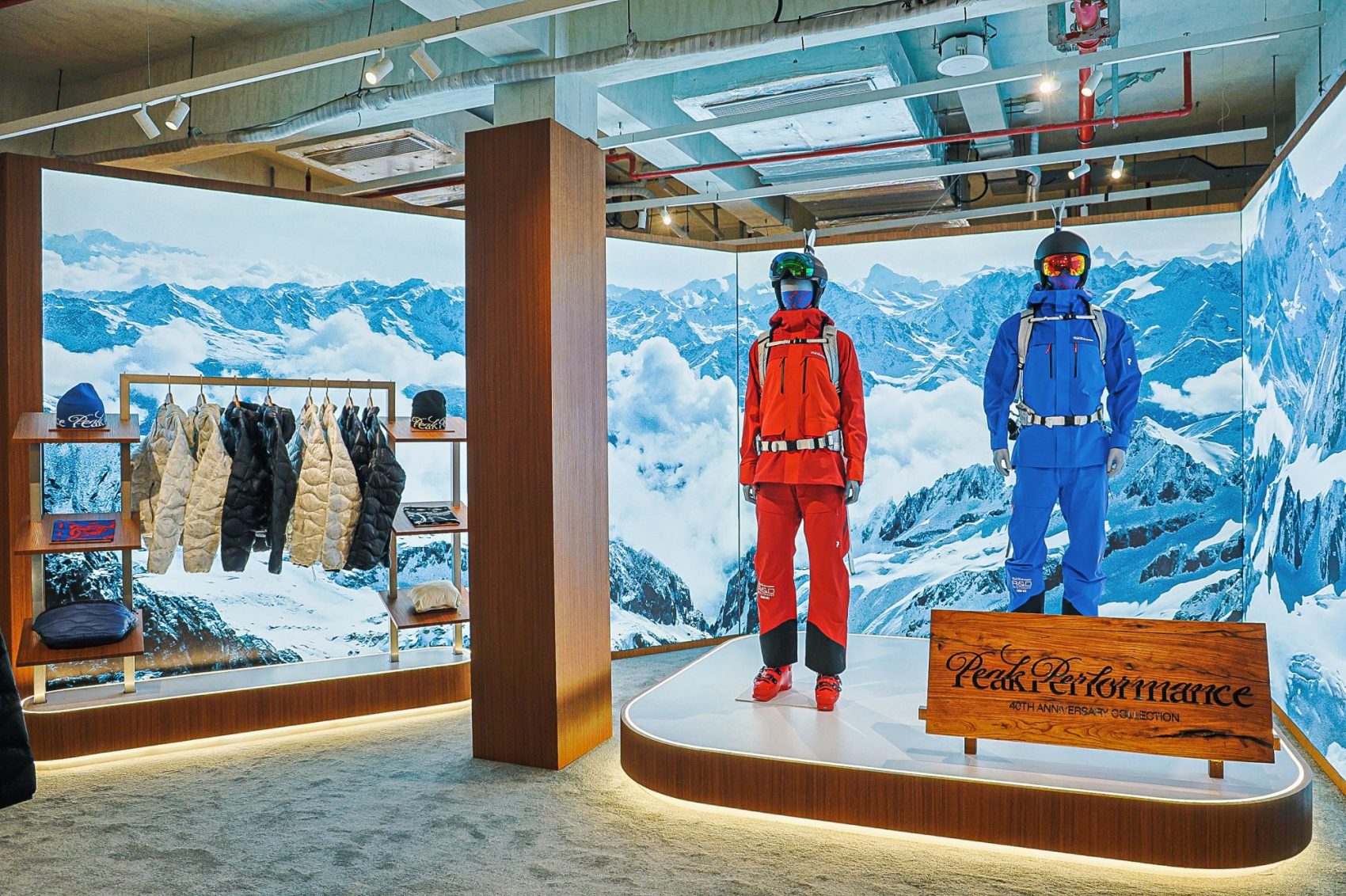
Peak Performance 40th anniversary retro red-and-blue ski suit display stand
The ÅreLab within the space shifts the focus from product purchase to the product lifecycle. As Peak Performance's repair and care system, ÅreLab works with professional tailors to provide repair services, with GORE-TEX products handled by certified specialist tailors; the brand also offers garment cleaning services through stores and professional partners, with some stores offering in-store care, and can adjust garment length or fit as needed.
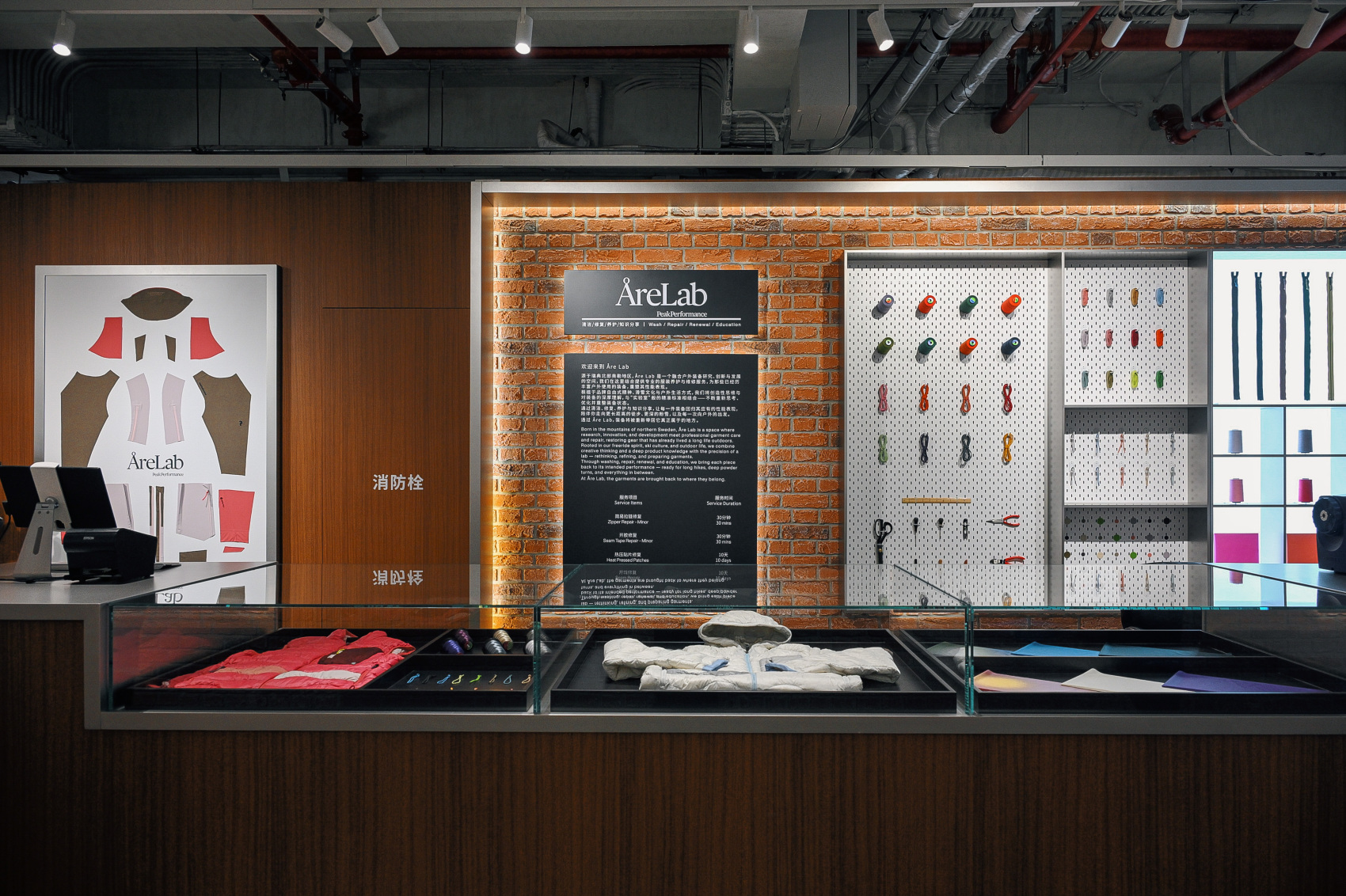
Peak Performance ÅreLab
HELIUM Utility products come with Fabric Left Over material to support future repairs. Through the connection between product design and after-sales service, Peak Performance hopes to convey a simple idea: functional clothing does not need to be replaced as soon as it wears out; with proper maintenance and repair, it can continue to be used.
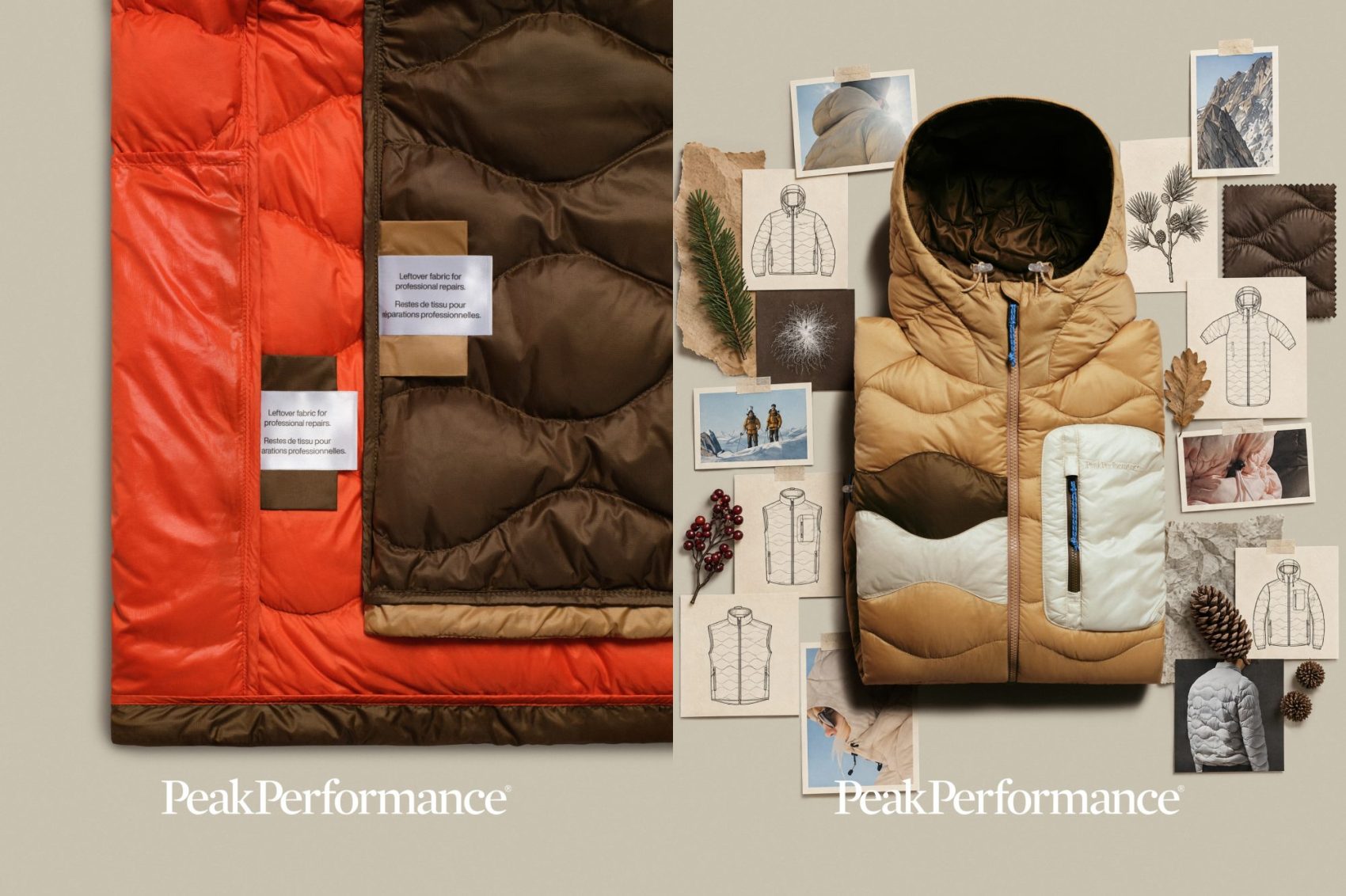
The HELIUM lightweight down family includes Fabric Left Over material in Helium Utility-related products
The five HELIUM down jacket repair cases exhibited on site further translate this philosophy into users' personal experiences. Among them, the story of Chinese freestyle skiing national team athlete Yang Shuorui is particularly concrete.
During the last training session before the Beijing Winter Olympics, Yang Shuorui landed hard on her head and briefly lost consciousness; after waking up, she still chose to compete. The HELIUM down jacket that accompanied her onto the jump bore the wear and tear of training and competition, and was later repaired at ÅreLab.
"Clothes are like people—new strength can grow where they've been hurt. It carries my experiences and continues to accompany me to the summit." That is how Yang Shuorui describes this jacket.
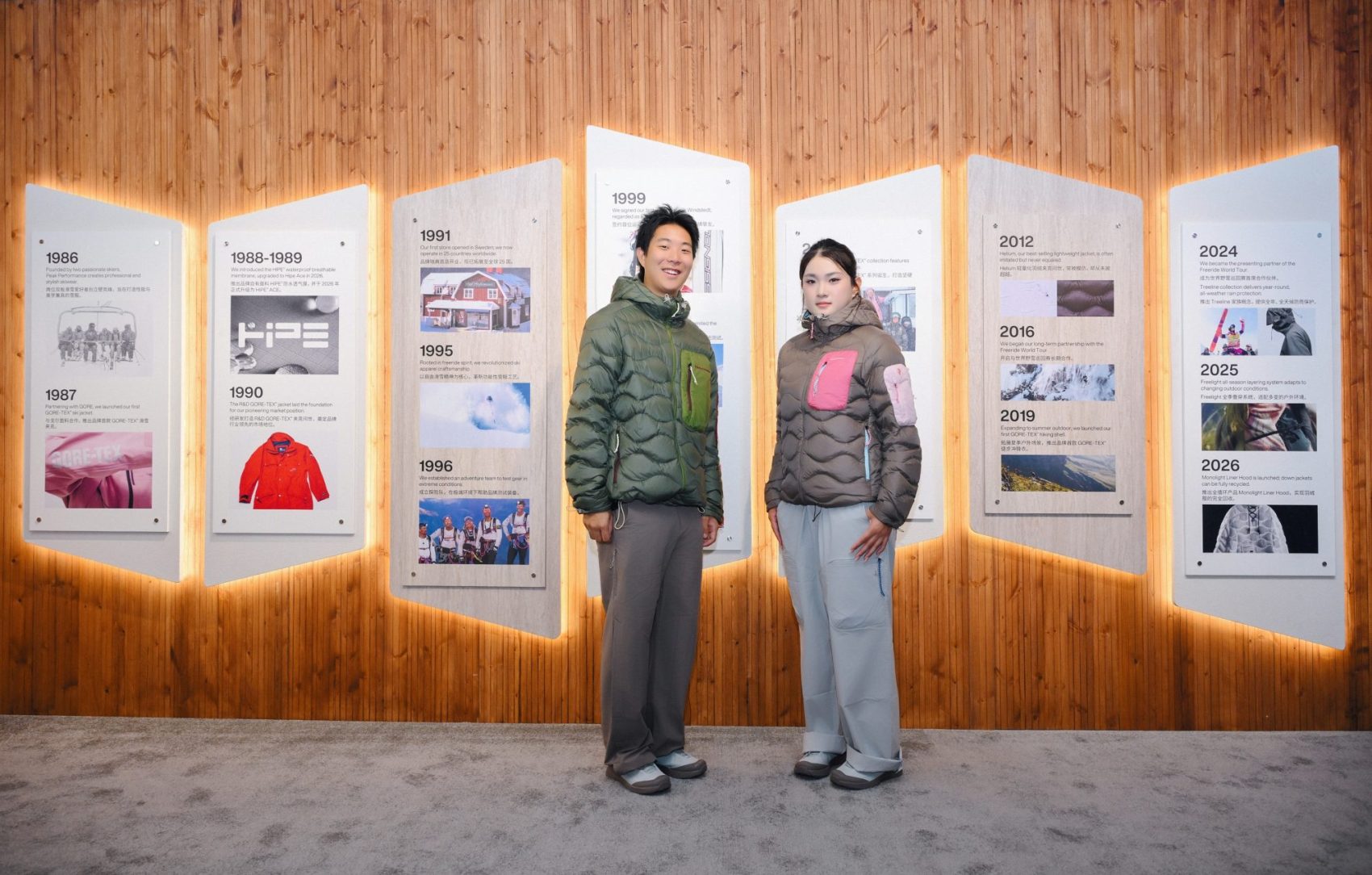
Brand-signed rider Wang Yuxuan and freestyle skier Yang Shuorui wearing the HELIUM lightweight down family
The value of repair lies not only in extending the garment's lifespan, but also in preserving the wearer's experiences. For outdoor gear, technical performance and durability determine whether it can continue to accompany the user forward, while the traces left by time give the product personal meaning beyond its original function and price.
This echoes Peak Performance's brand proposition, "THE BEST LINE IS YOUR OWN LINE." Freeride has no single predetermined route, and the value of gear need not be defined once and for all at the time of purchase; it gradually takes shape through the user's ongoing exploration and choices.
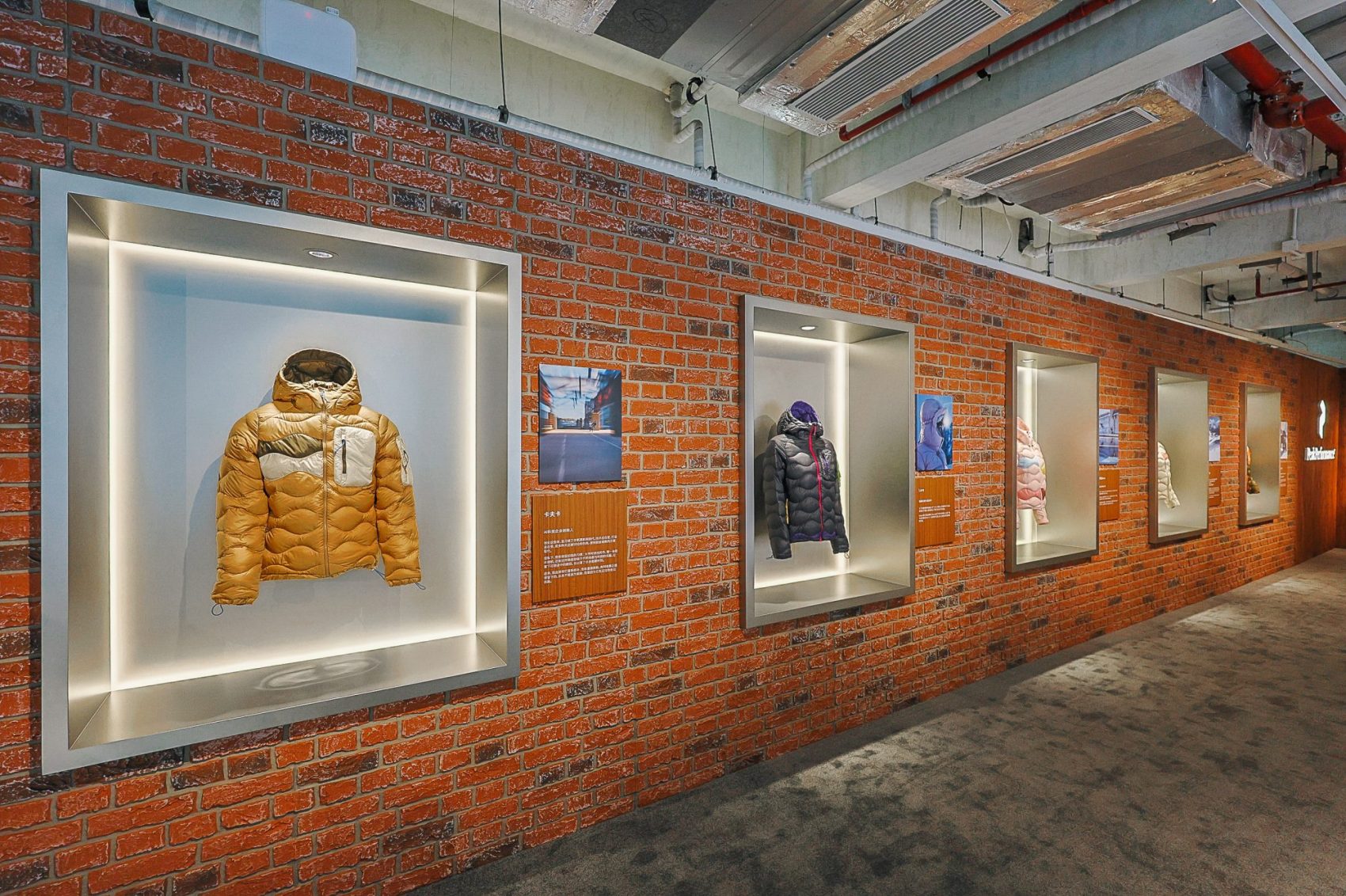
Repair cases from the Peak Performance HELIUM lightweight down family
From technical function to category mindshare: the value upgrade in outdoor brand competition
Returning to the outdoor industry, Peak Performance's practice presents a relatively complete value chain: its freeride heritage forms the technical foundation, HELIUM builds product recognition through lightweight construction, signature quilting and Nordic colors, and ÅreLab attempts to extend product value beyond the point of purchase. These elements are interconnected rather than independent brand communication themes.
For the Chinese market, this integration has practical significance. As technical performance gradually becomes the baseline for premium outdoor gear, brands must not only make consumers remember a distinctive design style, but also explain the functional rationale behind the design through fabric technology, product structure and real usage scenarios. Especially in the lightweight down category, whether a brand can balance lightness, warmth, packability and styling, and form a stable, recognizable design language, will affect whether it can move from single-product attention to category recognition.
From technical gear on snowy mountains to lightweight down in urban life, what Peak Performance explores is not letting aesthetics overshadow function, but rather, on a technical foundation, allowing design, usage scenarios and long-term value to form a more complete product experience. As industry competition shifts from a single-function contest to a contest of comprehensive value, what truly deserves attention is how a brand translates technical expertise into differentiated value that consumers can recognize, understand and keep choosing.
丨Image source: Peak Performance
丨Editor: LUXECO