
Global management consulting firm Kearney recently released "2026 M&A in beauty and personal care: volume over scale and value".
According to the report, in 2025, the number of M&A deals in the beauty and personal care sector reached a record 384, up 8% from 2024 and marking a new high for the third consecutive year.
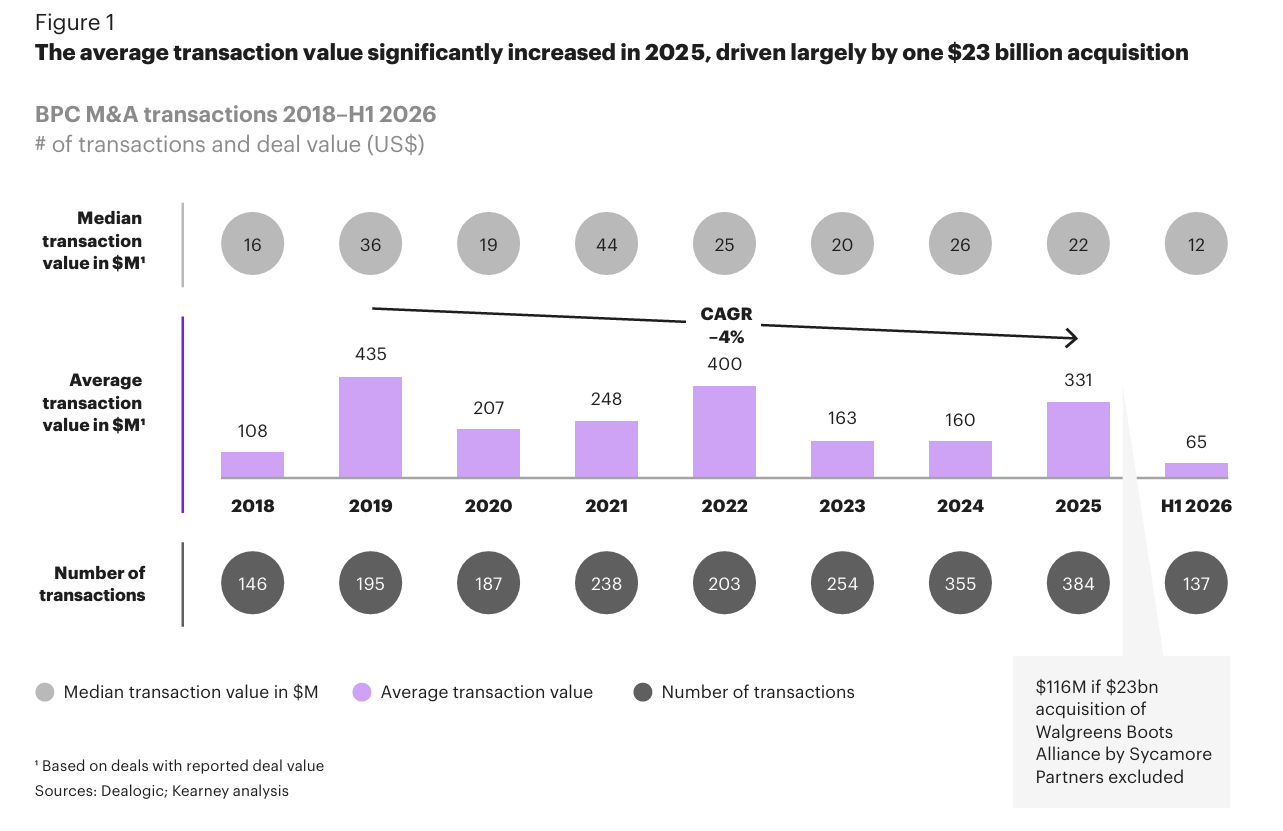
Among the roughly 30% of deals with disclosed consideration, the average deal value was about US$331 million. Excluding one exceptionally large transaction, the average deal value fell back to about US$116 million, below the 2024 level. The median deal value declined from US$26 million to US$22 million. In other words, 2025 delivered a recovery in deal volume, not in deal value.
However, the report notes that this growth momentum reversed in the first half of 2026. Weighed down by cooling corporate strategic acquisition activity, total M&A deal volume fell 11% compared with the first half of 2025, but deals by financial investors bucked the trend with a 33% increase, showing resilience amid the broader downturn.
Nevertheless, the report also states that it is not yet possible to determine whether the decline in the first half of 2026 is a genuine cyclical turning point or the start of another volatile year.
Chart below: Deal volume, average deal value and median deal value, H1 2018-H1 2026
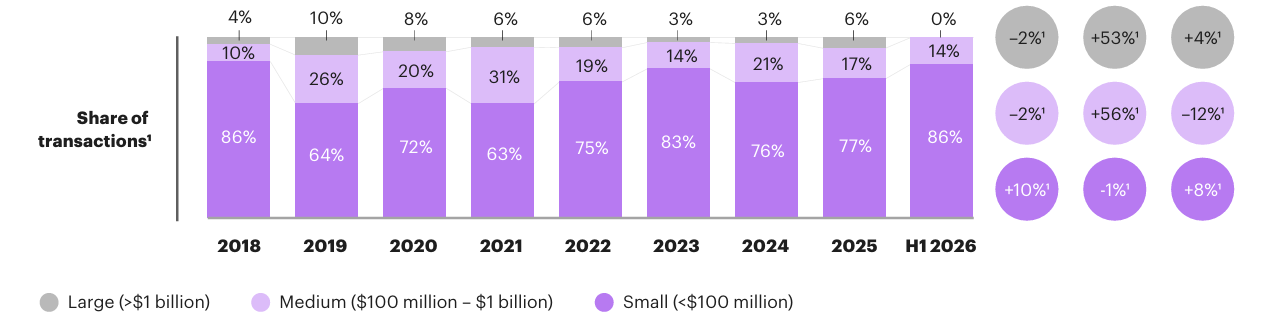
In terms of individual deal size, the share of large deals above US$1 billion climbed from 3% in 2024 to 6% in 2025, yet remained the smallest segment of the market. The share of mid-sized deals of US$100 million to US$1 billion fell to 17%, while the share of small deals below US$100 million edged up 1 percentage point to 77%.
The report says these figures show that market growth is concentrated in small targets and that the recovery in large deals is only temporary. By the first half of 2026, the share of small deals had risen further to 86%, with no large deals at all.
The report points out that the absence of mega-deals is constrained by the supply of capital: large strategic groups are restructuring their own businesses and asset portfolios and currently have no capacity for external acquisitions. Even when sellers try to bring assets to market, it is difficult to stir buyer appetite.
Chart below: Share of deal sizes, H1 2018-H1 2026
In terms of acquisition motives, in 2024-2025, scaling the portfolio remained the primary reason for companies to pursue M&A, accounting for about 30% of all corporate M&A deals, indicating that consolidating competitive position and expanding market share remain the core drivers of corporate M&A.
However, the share of deals aimed at growth acceleration by acquiring high-growth small brands fell sharply, from 30% in 2024 to 23% in 2025, and to just 16% in the first half of 2026, the lowest level on record.
This shows that with financing costs still elevated, companies are no longer blindly chasing pure scale growth.
Instead, value chain and capability acquisitions have taken their place. In the first half of 2026, these two categories together accounted for 36% of corporate M&A, up from 27% in 2025. Corporate M&A is no longer focused solely on scale and growth, but instead pursues vertical integration and the acquisition of technology and intellectual property.
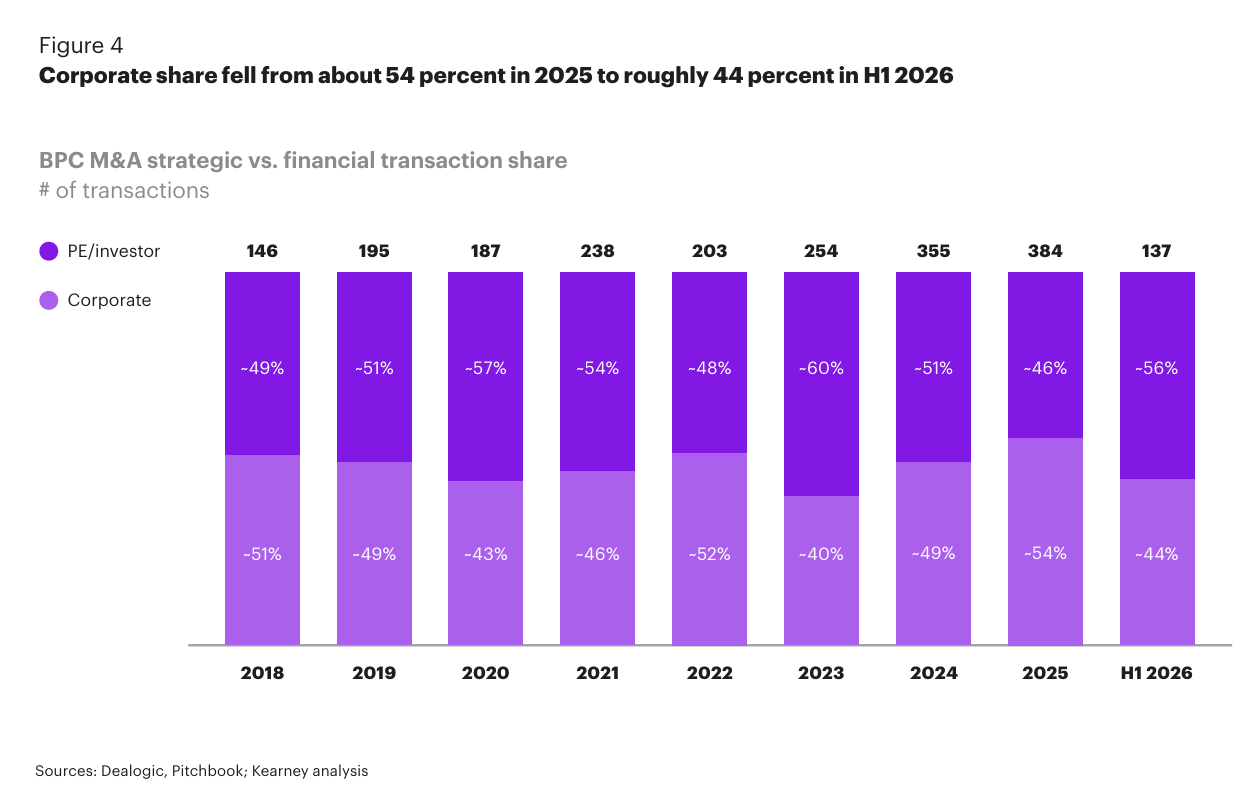
In 2025, growth came mainly from corporate strategic acquisitions, with deal volume up about 36% year on year, while private equity deal volume fell about 23%, reversing the trend of 2023-2024. In 2025, corporate strategic acquisitions accounted for 54%, the highest level in eight years. But the situation reversed in the first half of 2026, with financial investor deals accounting for 56% and corporate strategic acquisitions 44%.
The report notes that this shift means private equity funds are filling the gap left by strategic acquirers — large companies are busy with internal restructuring and digesting past acquisitions. Private equity funds are concentrating on small and mid-sized deals with manageable risk rather than making high-valuation bets on growth, which corroborates this point.
Chart below: Changes in the share of corporate strategic acquisitions and private equity acquisitions, H1 2018-H1 2026
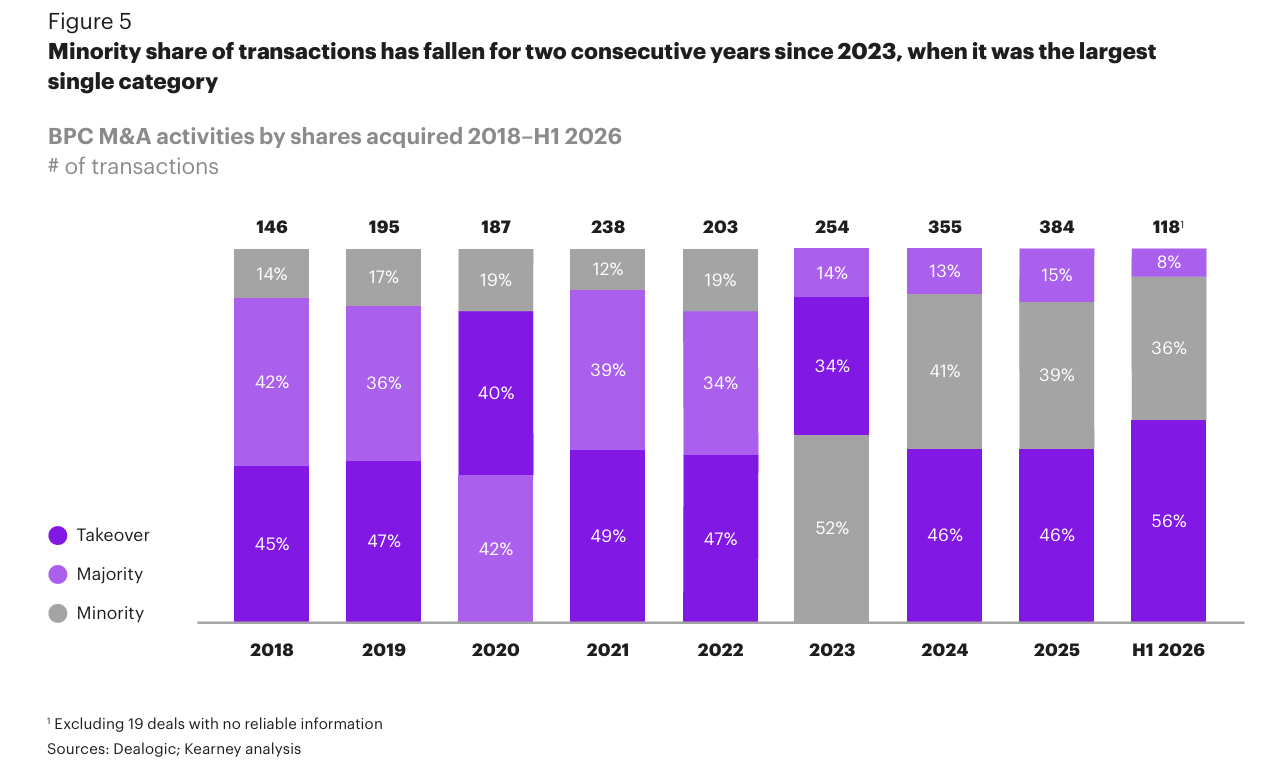
The share of minority equity investments has declined for two consecutive years since peaking at 52% in 2023, standing at 39% in 2025 and 36% in the first half of 2026.
In contrast, the share of controlling deals (full acquisitions + majority-stake acquisitions acquisitions) rose from 61% in 2025 to about 64% in the first half of 2026. Over the past eight years, the share of full acquisitions held steady at around 46% in six of those years.
The report argues that the market has clearly shifted from "securing future options" to "pursuing actual control". Buyers increasingly want to hold the initiative in integration, portfolio adjustment and operational value creation, rather than simply holding a stake and waiting for the brand to grow on its own. This has produced two parallel logics: minority equity investments are used more for early-stage or founder-led brands that require founder collaboration, while for mature assets with scalable potential, acquiring control has become the default path.
Chart below: Changes in the share of minority-stake acquisitions, majority-stake acquisitions and full acquisitions, H1 2018-H1 2026
By region, in 2025, Europe's share of M&A deals rose to 47%, ending a three-year decline and hitting an eight-year high, and it maintained a 47% share in the first half of 2026. After two consecutive years of share declines, the North American market rebounded strongly in the first half of 2026, with its deal share reaching 31%.
China's share of deals was 7% in 2024 and rose to 10% in 2025, but plunged to 2% in the first half of 2026. The change was mainly due to cooling M&A activity by both domestic and foreign buyers in China, while outbound M&A by Chinese companies has consistently been limited in number. Over the same period, Japan's share of deals rose from 9% to 12%.
The report concludes that the market window anticipated a year ago still exists, but is narrower than expected. Deal volume hit a record high, but value and scale did not rise in tandem. The sellers that will shape the next phase of the beauty and personal care industry are busy with two things: divesting non-core assets and digesting projects acquired in the previous cycle; restructuring and integration are consuming substantial resources, and both tasks are still underway.
Once large companies complete their internal adjustments and return to the market as active sellers, the pool of available deal supply will expand rapidly. Buyers that have genuinely honed their integration capabilities through small and mid-sized acquisitions in 2025-2026 will then be ready to strike.
| Source: Original report
| Image source: Original report
| Editor: LuxeCO


