
McKinsey & Company recently released the fifth edition of its Future of Wellness 2027 report, surveying more than 10,000 consumers across four countries—China, Germany, the UK and the US—to explore the drivers behind the global wellness market's explosive growth and its future direction.
The report notes that wellness is shifting from a niche trend into a consumer growth engine. Data shows that the global wellness market is currently worth US$2.7 trillion. The US market alone has surpassed US$700 billion, growing at 5%–10% a year, making it a powerful growth driver for the consumer sector.
Note: The report notes that the global wellness market size figure reflects both growth in the market itself and an expanded scope of measurement that now includes more wellness-related sub-segments, so it cannot be directly compared with last year's US$2 trillion estimate.
This momentum has drawn intense investor attention. Since 2021, the six largest health and wellness-related deals have all been announced or completed in 2025 or later, with a combined value of nearly US$89 billion.
On the other hand, wellness-related products have also proliferated. From January to September 2026, 33% of newly launched packaged consumer goods in the US carried wellness-related claims, up from just 24% in 2021. The number of new wellness products launched during those nine months has already reached about 95% of the full-year 2025 total. Meanwhile, among packaged consumer goods brands growing faster than 20% a year, 53% put health and wellness at the core of their value proposition—more than double the share among low-growth brands.
However, the report notes that consumer demand remains unmet. The survey shows that about 40% of consumers believe existing wellness products fall short in longevity, mental health and mobility. These gap percentages have barely changed since 2024, largely because consumers' bar for judging product "efficacy" keeps rising.
Based on how much consumers prioritize wellness and their purchasing behavior, the report identifies five consumer segments:
- Maximalist optimizers: digitally savvy, eager to try new products, and prioritize quality over price; they make up 25% of wellness consumers and account for 40% of wellness spending.
- Confident enthusiasts: passionate about fitness, actively research products, and are highly loyal once they find the right one; they make up 10% of wellness consumers and account for 15% of spending.
- Health strugglers: willing to improve their health but held back by stress and a lack of follow-through; they make up nearly 30% of wellness consumers and account for about 25% of spending.
- Health traditionalists: mostly older, prefer simple, proven products and dislike novel concepts; they make up 15% of wellness consumers and account for about 10% of spending.
- Wellness shirkers: do not prioritize health, buy only essentials and are highly price-sensitive; they make up 20% of wellness consumers and account for about 10% of spending.
Health and wellness have become one of life's top priorities
The survey found that health and wellness have become one of life's top priorities.
In the US, the share of respondents who rank wellness as a priority has risen year on year across most age groups. While Gen Z and millennials remain the core force driving the wellness market's expansion, older groups are also deepening their engagement. The shift is especially pronounced among baby boomers: the share ranking wellness as a priority rose 11 percentage points to 49%, while the average increase across all age groups was just 5 percentage points. Boomers who prioritize wellness buy across a broader range of categories, including hydration and electrolyte drinks, home fitness equipment and skincare products.
At the same time, people's aspirations for health and wellness keep rising.
About 30% of US consumers pursue "peak physical condition" rather than merely "staying healthy," and more than 40% are willing to "do whatever it takes to live as long as possible." Among the report's "maximalist optimizers" and "confident enthusiasts," 64% and 80% respectively are willing to go to great lengths in pursuit of longevity. Among all respondents in China, 42% want to reach peak physical condition and 55% are willing to do whatever it takes to live longer.
This is also prompting consumers to try emerging wellness products and lifestyles, such as GLP-1 drugs and digital detoxing. Even for wellness practices with relatively low penetration, such as lymphatic drainage massage, sound baths and longevity clinics, more than 60% of US consumers plan to maintain or increase how often they try them next year.
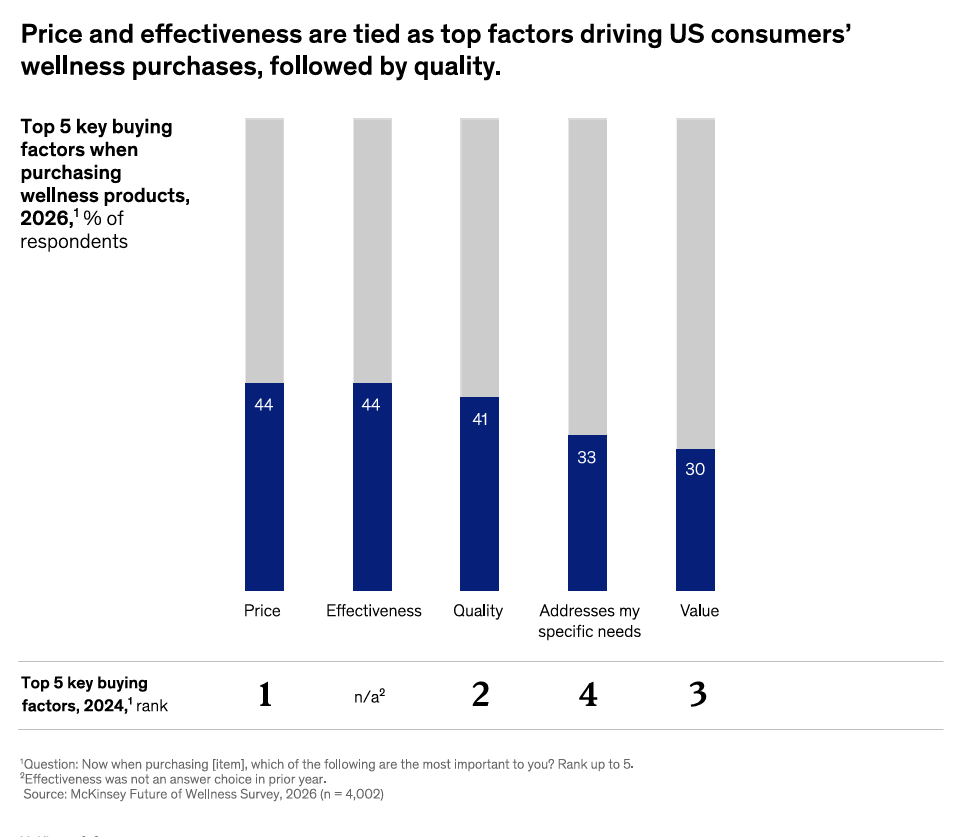
The report notes that when trying new products, "efficacy" and "price" are tied as the top consideration when choosing wellness products, followed by "product quality." Maximalist optimizers and confident enthusiasts value efficacy and quality even more than price. Efficacy can directly turn interest into purchases: an independent McKinsey Health Institute survey of New York residents found that when a longevity product comes with evidence of efficacy, purchase intent among high-spending consumers rises 11 percentage points.
Below: In 2026, the top five core purchase factors when choosing wellness products, with respondent shares as follows: price (44%), efficacy (44%), quality (41%), meeting a specific need (33%), value (30%)
Consumers use AI but still trust human expertise
The use of AI (artificial intelligence) is already widespread in wellness.
Some "datamaxxers" are building private AI dashboards that turn fragmented physiological data into a personal health coach, and wearable device makers are rolling out AI-powered data dashboards of their own.
But the report also notes that AI has not replaced doctors. Only 14% of respondents who use AI said an AI answer led them to skip seeing a doctor altogether. More often, people use AI to understand diagnoses and treatment plans they have already received—a behavior more common among UK consumers. Doctors' advice, science-backed formulations and third-party authoritative certifications still carry a lot of weight with consumers.
Beyond doctors, advice from ordinary people is also influential. When asked what influences their decision to buy a new wellness product, US consumers cited recommendations from friends and family first (35%), followed by advice from healthcare professionals (30%), with AI at just 8%. Social platforms also matter, including YouTube (16%), well-known medical experts on social media (14%) and influencers (9%). Younger groups are more susceptible to social channels: for Gen Z, YouTube and healthcare professionals are tied at 26%, and the share influenced by influencers is about 10 percentage points above the overall average.
AI use and trust vary by market. In China, for example, both usage of and trust in AI wellness guidance are high, consistent with McKinsey's findings from a survey six years ago: Chinese consumers are willing to provide personal data in exchange for personalized wellness experiences, and the same holds in other categories such as beauty.
Three emerging trends in the wellness market
Consumers are no longer merely managing illness passively; they are actively optimizing their own health. The report identifies three emerging wellness trends from the past year:
Recovery is the lowest-barrier entry point for ordinary people looking to optimize their physical function. Therapies once used mainly by professional athletes, such as cold plunges and contrast therapy, are reaching a growing user base; the rise of "social saunas" reflects the blending of wellness and socializing.
In the US, penetration of such practices currently ranges from high single digits to high teens, but among those who have tried them, 75% plan to maintain or increase their frequency next year. In Germany, 34% of consumers have tried or currently use saunas, baths and similar methods—nearly double the US rate (18%).
Biohacking—pushing physical optimization further through self-monitoring, dietary supplements and self-experimentation. The survey found that 18% of consumers have actively tried biohacking, rising to 28% among Gen Z. Some of these practices remain niche: only 6% of respondents have tried peptide injections, but 71% of those who have plan to maintain or increase their use. Other biohacking behaviors are going mainstream, including "maxxing"—deliberately increasing intake of specific nutrients or supplements. Compared with last year, more respondents said they plan to increase their intake of protein, creatine and dietary fiber next year.
Finally, consumer diagnostics, including at-home test kits, advanced imaging and biomarker testing packages, let consumers bypass doctors and interpret their own health data. More than half of respondents who bought such products or services in the past year plan to increase related spending next year.

Five strategies: turning industry tailwinds into market share
To turn industry tailwinds into long-term growth, the report offers five reference strategies for brands, retailers and investors:
1. Make wellness a core growth engine. Companies should not treat wellness as a simple extension of existing businesses or a marketing gimmick, but should put it at the strategic level, with dedicated resources and a development roadmap.
For brands, this means identifying user needs they can genuinely meet and product selling points, investing in R&D and marketing, and building a differentiated position. On this point, the report argues that wellness products and services deeply integrated with everyday life scenarios—including dining, travel, beauty and community—have an edge.
For investors, this means making wellness credibility part of due diligence rather than just a marketing label. Focus on whether companies can provide efficacy data and traceable, high-quality ingredients, while building brands that genuinely resonate with consumers emotionally.
2. Look beyond fixed, stereotypical consumer profiles when developing products. Many brands still focus only on the digitally savvy core consumer group, overlooking other groups whose engagement is steadily rising, such as baby boomers and health strugglers, whose prioritization of and spending on wellness are increasing. Reaching these groups requires more than putting older people in ad imagery; products and services must genuinely match their actual needs. For example, gyms can add recovery, mobility and metabolic health classes—areas that older groups and health strugglers particularly care about.
3. Use AI to simplify wellness information, not complicate it. Brands need to build connected ecosystems linking products, services and partners, with AI then integrating user data to deliver personalized insights and recommendations. Brands that use AI well will reduce consumers' cognitive burden rather than add to it.
4. Win trust through transparency and real efficacy. The wellness sector is noisy, with concepts proliferating, so earning consumer trust is crucial. Winners will be credible and transparent: verifiable product efficacy, backing from professional credentials and evidence of efficacy. Retailers can curate their assortments and set clear standards for the products they carry, helping consumers make sense of product claims.
5. Adapt to fragmented consumer decision journeys. Consumers' purchase journeys now span AI conversations, social platforms, influencers, experts, retail advisors and offline experiences. Brands need to boost visibility and influence across the entire journey—for example, ensuring their products make the shortlist in search engines and when retail advisors make recommendations.
|Source: original report
|Image source: original report, McKinsey official website
|Editor: LuxeCO


