“The greatest luxury is time—time to plan, and time to sit down and talk with colleagues.” That was the remark of Board Chairman Johann Rupert at the recent H1 FY2027 earnings call of Swiss luxury group Richemont.
During the call, an analyst noted that Richemont had not raised prices significantly since its increase last September. In response, Johann Rupert reiterated the group's consistent logic over the past two decades: a global uniform pricing policy for high-value, small-batch products to prevent customers from shifting purchases across regions, while safeguarding the "relationship between price and value" to ensure that Cartier and Van Cleef & Arpels retain their value at auction houses such as Christie's and Sotheby's.
He stated that the group had not, unlike some competitors, overdraw on customer trust after the pandemic: "Customers have long memories. We have pricing power; we simply don't want to become greedy."

At the call, Johann Rupert, CEO Nicolas Bos and CFO Burkhart Grund also responded to topics including the distribution of growth in the jewellery division, future growth expectations and the importance of the product committee.
—— Jewellery Division: Volume and Value Rise Together Across All Price Points
As Richemont's largest core segment, the jewellery division (including Cartier, Van Cleef & Arpels, Buccellati and Vhernier) grew 14% year on year at constant exchange rates in the second fiscal quarter, building on a high base of +17% in the same period last year.
Nicolas Bos said: "A slowdown in growth is not what we are facing," and did a two-year calculation on the call:
For brands with more than a century of history, cumulative growth of nearly 30% over the past 24 months is quite remarkable.
In response to some analysts' questions about whether jewellery growth relies on price increases and is overly concentrated in a few classic collections, Nicolas Bos made clear that monitoring growth in volumes (more customers, more units sold) is particularly central to the group, and that in the first half the jewellery division achieved simultaneous growth in volume and value; Burkhart Grund also confirmed that the lower price segment below €5,000 had previously grown more slowly, but in the current period volume growth was achieved across all price points.
On product collection structure, Nicolas Bos noted that classic collections and new creations are not mutually exclusive: Cartier Love, Trinity, Juste un Clou and Van Cleef & Arpels Alhambra continue to gain market traction through new iterations (such as Cartier's Love bracelet with coloured gemstone setting and Van Cleef & Arpels' pink enamel Alhambra collection launched in September), while newer lines such as Van Cleef & Arpels Perlée and Cartier Clash also maintain high growth; Vhernier, which has been part of the group for two years, has reshaped its product matrix around core collections such as Abbraccio, Calla and Freccia after completing initial integration.
Asked by analysts about the revenue share of high jewellery versus "aspirational jewellery," Johann Rupert said:
"We don't make 'aspirational jewellery.' I find that term highly insulting. What we create is 'welcome jewellery.' We don't do aspirational products; we do welcoming products."
Nicolas Bos further explained that at Buccellati, Cartier or Van Cleef & Arpels, from an Alhambra pendant to the most expensive high jewellery, the same level of craftsmanship, detail and gemstone quality is used, forming a continuity; for some customers who save for two to five years to buy an entry-level piece, it is likewise an important milestone in their lives, and the company does not artificially grade its products internally.
Recently there has been market talk of weakening US consumption, yet Richemont's Americas market grew 23% year on year at constant exchange rates in the first half, recording double-digit growth for the 11th consecutive quarter. Johann Rupert said at the call: "Some of our competitors have shown weakness in hard luxury; we have not. None of our iconic collections is under pressure."
—— Refusing to Give Quantitative Growth Guidance: "We'd Rather Stick to What We've Always Done"
When analysts asked about the group's long-term "growth algorithm," Johann Rupert declined to give quantitative growth guidance and explained the supply ceiling in terms of the time threshold on the manufacturing side.
Citing professional watchmaking as an example, he noted that for a watchmaker to be allowed to work on certain highly technical timepieces, senior colleagues require them first to accumulate 12 to 16 years of experience; and 16 years ago the industry did not have today's demand or apprentice pool. The same applies in footwear—Johann Rupert mentioned that during a recent visit to the workshop of the group's Italian footwear brand Gianvito Rossi, he observed that the founder and his daughter had reached the third generation and that each pair of shoes requires more than 100 production steps: "Even if they wanted to make more, they could not produce shoes of the same quality at a much larger volume; they must train artisans themselves."
Johann Rupert therefore explicitly denied that Richemont is deliberately withholding supply to exploit the "Veblen effect" (the conspicuous-consumption effect whereby a high price itself stimulates demand):
"This is not a deliberate restriction of supply, and we don't do it to push prices higher—purely because we don't have enough qualified skilled craftspeople."

In his view, given the maximum deliverable quantity under high quality standards, forcing linear growth forecasts and pressuring subordinates is dangerous: "If I told you we were going to grow at X, Y, Z rates, and then we couldn't make it and I pushed colleagues to deliver, we would end up like some competitors passing off PVC as leather. We'd rather stick to what we've always done."
Product development cycles likewise span multiple fiscal years. In the Q&A, Nicolas Bos and Johann Rupert revealed that the pipeline in the brands' workshops and design studios gives management confidence for years to come—Johann Rupert said management at the product committee "is already looking at 2029 products." He even suggested inviting one to three analysts each year to spend a week or two observing the full cycle from concept to prototype, because "the intuition and design from concept to shelf cannot be explained by an AI agent packed into a phone."
—— Future Success Depends on Whether the Product Committee Functions Well
Johann Rupert noted that Richemont's future success depends on whether the product committee functions well—under the executive leadership of CEO Nicolas Bos, whether the board chairman and the Cartier, Van Cleef & Arpels and watchmaking brand teams can maintain a high degree of trust and rapport when reviewing products three or four years out. "If you spend all day chasing next year's numbers, you won't have that freedom."
This requirement to stay steady on the product side is most directly reflected in the restructuring of the specialist watchmakers division. Sales in the division accelerated to 12% at constant exchange rates in the second quarter of this year (against a base of +3% last year). Reviewing the ups and downs of the watch business in recent years, Johann Rupert said at the end of the call:
"A few years ago selling watches was just too easy, and we drifted away from the true DNA of watches. We recognised our hubris at the time, and that experience taught us and our colleagues a great deal of humility. Now colleagues have returned to their core strengths, sales have clearly improved, and market demand is recovering."
—— On Capital Allocation, Control and M&A Choices
On capital allocation and control, Johann Rupert reiterated that the Rupert family's payout ratio has never exceeded 35% to 40% of earnings, leaving ample funds to reinvest in the business; the multiple voting shares established at the time were also created at the request of institutional shareholders. He also criticised the short-termism of private equity (PE) over the past 20 years for weakening the competitiveness of Western companies.
He then used a merger proposal pushed by outside voices five years ago as an example: had the group followed that short-term advice and pursued the merger, the combined total value of the two companies today would be roughly equivalent, but Richemont's equity share in the combined entity would be far below what its independent development now corresponds to.
Regarding recent media reports on M&A activity, Johann Rupert responded that the group has not made any decision on potential acquisitions, and that "any investment we might make in the diamond sector would not have a material impact on our balance sheet or P&L."
—— Johann Rupert's Son Takes On "Chief Future Officer" Role
On 9 September 2026, the Richemont board announced the appointment of Johann Rupert's son, Anton Rupert (pictured below), as Non-Executive Co-Vice Chairman, specifically responsible for overseeing the operation of the strategic product and communications committees of the group's brands.
Responding to questions about Anton Rupert's new role and the family's long-term role, Johann Rupert described his son as his idea of a "Chief Future Officer."
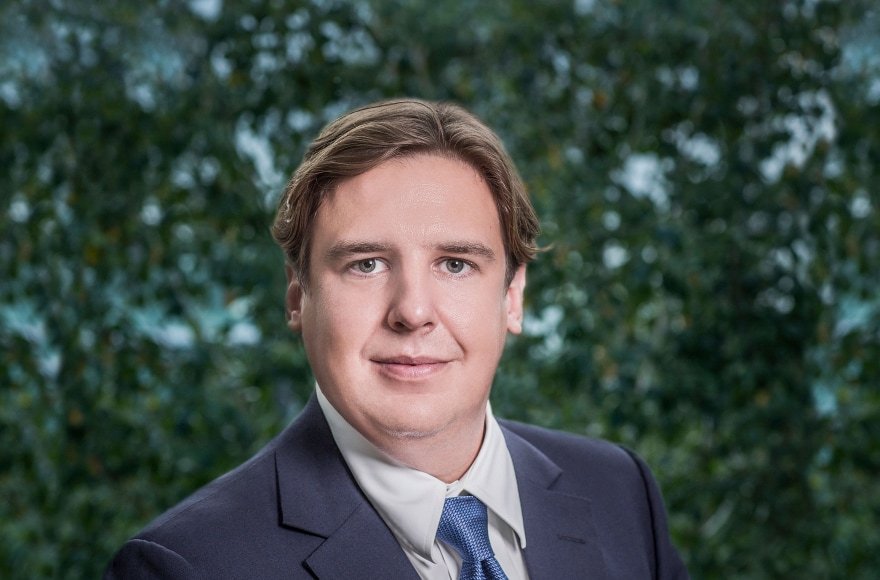
Anton Rupert was born in 1987 and has served as a Non-Executive Director of Richemont's board since 2017; he is currently a member of the Strategic Security Committee; before April 2022 he was a member of the Nomination Committee; from July 2018 to December 2019 he served as a director of the group's watch e-commerce platform Watchfinder.co.uk. He is currently also a Non-Executive Director of Remgro Ltd. and a partner of the family holding company Compagnie Financière Rupert.
丨Source: Richemont H1 FY2027 earnings call, financial reports
丨Image source: Richemont official website, LuxeCO historical reports
丨Editor: LuxeCO