According to a September 10 report by Bloomberg, the luxury brand Louis Vuitton, owned by French luxury giant LVMH, was hit notably hard in the Chinese market in July and August this year.
On one hand, China's luxury market as a whole remains in a phase of demand adjustment; on the other, a trademark dispute between Louis Vuitton and local tea beverage brand Molly Tea sparked considerable controversy on social media, further amplifying market pressure.
Citing the latest data from independent US equity research firm JL Warren Capital, Bloomberg reported that Louis Vuitton's sales in the Chinese market fell about 30% year-on-year in July, with the decline narrowing to about 20% to 25% in August. The firm's core research focus is "China-related listed companies and the China operations of multinational companies." Its head, Junheng Li, said the August decline remained in double digits but improved from July.
It should be emphasized that this is not official sales data published by LVMH or Louis Vuitton. JL Warren's estimates are mainly based on its on-the-ground observations at about 15 shopping mall stores in China, and are therefore better regarded as market tracking data rather than official brand financial data.

On June 29, 2026, the Suzhou Intermediate People's Court in Jiangsu Province issued a first-instance ruling in the case, finding that Shenzhen Molly Tea Catering Management Co., Ltd. and the stores involved had infringed the exclusive rights to seven registered four-leaf floral graphic trademarks held by Louis Vuitton. The court ordered Molly Tea to stop the infringing acts and pay Louis Vuitton 10 million yuan in economic losses and 300,000 yuan in reasonable enforcement costs, totaling 10.3 million yuan; it also required the company to publish a statement on its official website and on its official accounts on Weibo, WeChat, Xiaohongshu, Douyin and other platforms to eliminate the impact of the infringement. Molly Tea founder Zhang Bocheng subsequently said he would appeal.
The core of the controversy is the high degree of similarity between the four-petal flower graphic used by Molly Tea and the four-leaf floral graphic in Louis Vuitton's classic Monogram system.
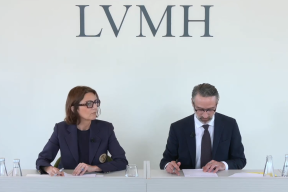
The ruling triggered widespread public discussion on Chinese social media. In response, LVMH Chief Financial Officer Cécile Cabanis said on the July 27 earnings call: "Intellectual property is an absolutely critical asset for us, and we always diligently protect our brands. Our brands regularly handle trademark infringement matters in many countries, including China but not limited to China. This case has received media attention and is still in legal proceedings, so I will not comment further."
The incident comes as China's luxury market is already undergoing a demand adjustment.
In the first half of 2026, LVMH's total revenue fell 3% year-on-year to 38.6 billion euros, up 2% year-on-year on an organic basis; among this, the Fashion & Leather Goods division, which houses Louis Vuitton, posted revenue of 18.146 billion euros, down 5% year-on-year and down 1% year-on-year on an organic basis. However, the division returned to 1% organic growth in the second quarter. LVMH also said that revenue in Asia (excluding Japan), including China, grew 6% year-on-year on an organic basis in the first half, making it the group's best-performing region and accounting for about 29% of total group revenue.
Related LuxeCO reading: LVMH Releases Latest Results: Q2 Organic Growth Accelerates to 3%, Asia Led by China Best-Performing Region in First Half
For LVMH, the Chinese market is especially important. According to UBS estimates cited by Bloomberg, Louis Vuitton contributes about a quarter of LVMH's sales and about 60% of its EBIT. Separately, UBS estimates cited by Reuters show that Chinese consumers, including spending abroad, account for nearly 30% of sales in LVMH's Fashion & Leather Goods business.
According to people familiar with the matter cited by Bloomberg, Louis Vuitton Chairman and CEO Pietro Beccari and Deputy CEO Damien Bertrand visited the Chinese market in late July, though the company did not release any public information about their China trip.
Meanwhile, Louis Vuitton is continuing to adjust its store network in China: in August it announced the closure of its Guiyang store, the only one in Guizhou province; in early September it opened a new store at Changchun MixC.
JL Warren believes that as public attention fades, Louis Vuitton's sales decline in China may narrow further, with a year-on-year drop of about 13% expected in September.
丨Sources: Bloomberg, Reuters
丨Image source: Louis Vuitton Xiaohongshu
丨Editor: LuxeCO