On September 17, Amer Sports (NYSE: AS) held its second Investor Day since listing on the New York Stock Exchange in Annecy, France. The focus of the event was the Salomon brand.
Annecy is the headquarters of Salomon, and the day marked the brand's 79th anniversary. The previous Investor Day was held in Vancouver, Canada in September 2025, when the focus was the Canadian outdoor brand Arc'teryx.
Amer Sports Chief Executive Officer James Zheng said at the event that by 2028, "we want to make Salomon a $3 billion brand." Salomon Brand President and CEO Guillaume Meyzenq said, "Our revenue will exceed $2.5 billion in 2026."
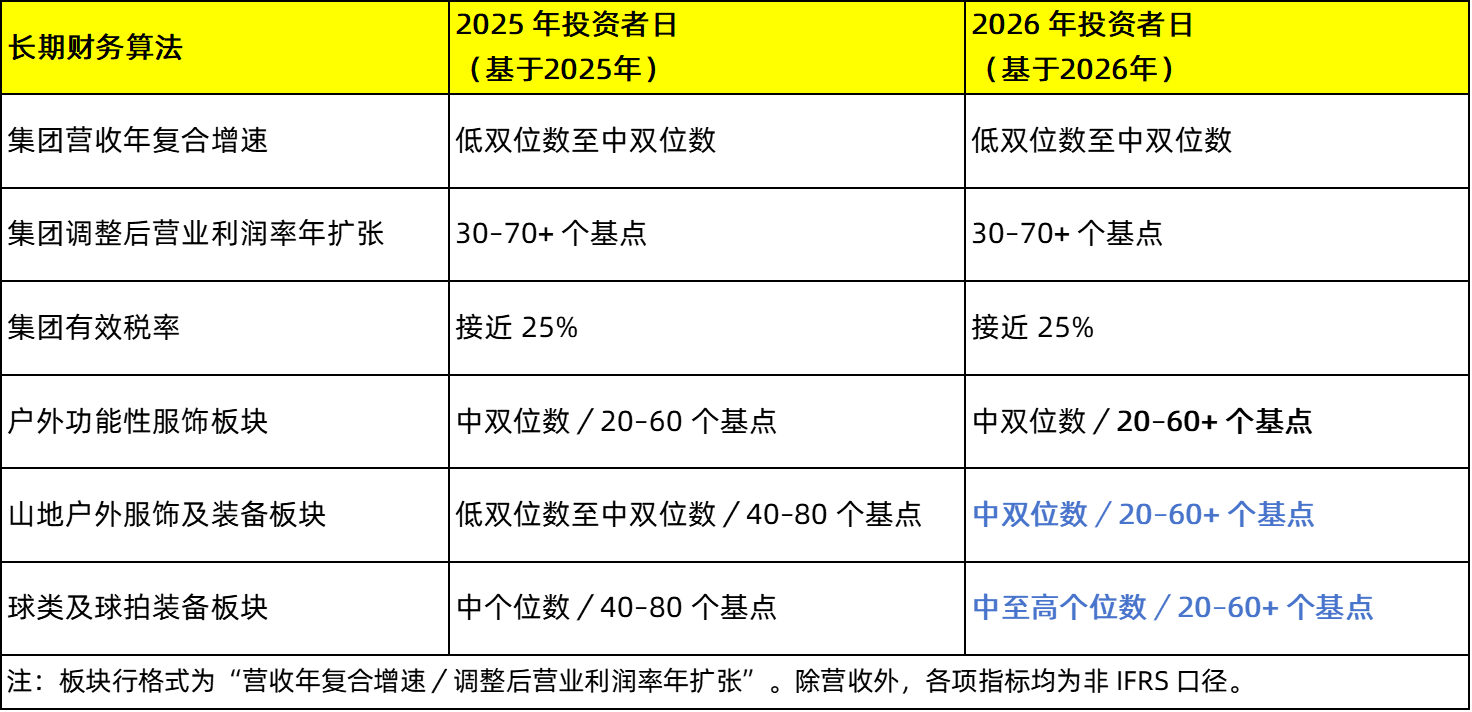
The day before Investor Day, Amer Sports updated its long-term financial algorithm and raised its guidance for the third quarter of this year. Comparing the two Investor Days, LuxeCO found that the group's three long-term targets remained unchanged, while segment-level targets were adjusted. (The base year for the long-term financial algorithm has been rolled forward from 2025 to 2026, with a horizon of more than five years.)
For Outdoor Performance, the segment that includes Salomon, the target for annual compound revenue growth was raised from "low-to-mid teens" to "mid-teens"; Ball & Racquet was raised from "mid-single digits" to "mid-to-high single digits." At the same time, the annual expansion range for adjusted operating margin in both segments was adjusted from 40–80 basis points to more than 20–60 basis points.
For third-quarter guidance, Amer Sports raised its expected year-on-year revenue growth from 18%–20% to 20%–22%, and expects adjusted operating margin to be slightly above the upper end of the original 13.5%–14% range. Chief Financial Officer Andrew Page said the group's confidence comes from three growth engines: Arc'teryx, Salomon Softgoods and Wilson Tennis 360.
On the China market, Zheng said Salomon "will soon reach a sales scale of $1 billion" in China. The brand currently has 350 stores in China, up from fewer than 100 in 2024. Zheng also said Salomon needs to win in its home market of Europe, accelerate its business in Greater China and the wider Asia-Pacific region, and build a larger presence in North America—which he described as "the world's largest sneaker market."

Guillaume Meyzenq marked 30 years at the company this year, having started as an intern; before becoming Salomon Brand President and CEO, his last role was Chief Product Officer of Footwear. He explained that Salomon's footwear business began 35 years ago with a cross-country ski boot line, with the technical path shifting from "rigid boots that protect the ankle" to "very light, low-cut shoes with full protection"; the brand then moved from endurance sports into trail running, and its latest product direction has expanded to gravel running, i.e., running on mixed surfaces.
According to figures provided by Guillaume Meyzenq, Sportstyle footwear currently accounts for 40% of Salomon's business, performance running shoes for 30%, winter sports for 15%, and head-to-toe apparel and bags together for about 15%.
Sportstyle refers to the brand's technical shoes with street DNA, combining outdoor and indoor design with all-weather comfort. Zheng called it "a weapon that unlocks huge potential," especially among younger female consumers. Guillaume Meyzenq said Salomon is "still a pretty small player" in this category, but "it's the only place where the cool kids are." He also said Salomon wants to continue growing in performance categories and maintain technical innovation, while sportstyle represents a much larger market.
Guillaume Meyzenq listed five major drivers of Salomon's growth:
1) Outdoor participation
2) The share of fitness within community experiences
3) Widespread health concerns
4) Lifelong participation in sports
5) The combination of function and style in footwear
He said the last is undergoing "one of the biggest shifts," and is the reason modern outdoor sneakers are starting to have a greater impact on the market:
"All of a sudden, consumers don't want to choose anymore. In the past, the world was a bit black and white—you either chose style or you chose function. But unfortunately, if you chose function, you might have to make trade-offs. Now nobody wants to make trade-offs anymore."
He said consumers want footwear with excellent performance that can be worn from sports settings all the way to urban environments without needing to change shoes.
As for the path to the $3 billion target, Guillaume Meyzenq summed it up as category management: defend core categories, accelerate in running by scaling up, investing in events and maintaining an innovation pipeline; continue advancing the Sportstyle business and growing the "modern outdoor sneaker" segment; increase the share of head-to-toe categories; and expand beyond EMEA (Europe, the Middle East and Africa), currently its largest region. He said China is Salomon's second-largest growth region, and North America still has substantial room for expansion.

| Source: Press release
| Image credit: Company website
| Editor: LuxeCO