On October 8, the Swiss contemporary art fair Art Basel and UBS jointly released the "Survey of Global Art Collecting 2026."
The research was carried out by Arts Economics, an art economics research firm based in Dublin, Ireland, and the report was written by its founder, Dr. Clare McAndrew. The survey covers 2025 and the first half of 2026 and involved 3,100 high-net-worth individuals across 10 global markets; respondents' average personal net worth in 2026 (excluding real estate and private business assets) was approximately $15 million.
The report notes that sentiment in the global art market has turned optimistic, with the market returning to positive growth in 2025, when total sales reached approximately $59.6 billion, up 4% year on year, and the market continued to recover in the first half of 2026, extending the recovery that began last year.
Breaking respondents down by age, the report found that in 2025 and the first half of 2026, Gen Z collectors (ages 20–29) had the highest average spending on art, more than double that of any other age group surveyed.
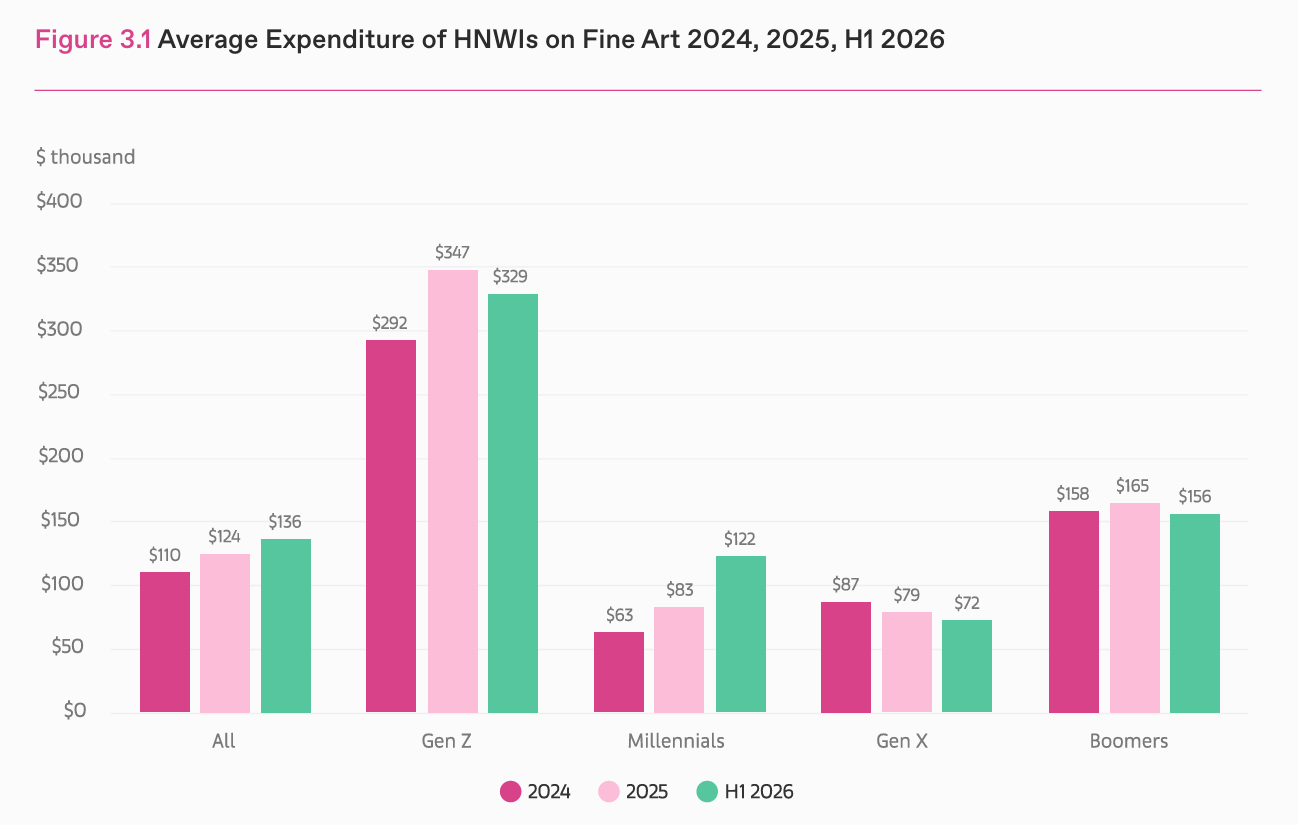
Above: Average spending on art by high-net-worth individuals in 2024, 2025 and the first half of 2026
In 2025, Gen Z collectors spent an average of $347,460 each, up 19% year on year, while the average across all respondents was $124,265, up 13% from 2024. In the first half of 2026, Gen Z collectors' average spending already exceeded their full-year 2025 level, and their spending was still more than double that of the other groups surveyed.
The second-highest spenders were Baby Boomers aged 62–80, with average spending of $165,000 in 2025 and $156,000 in the first half of 2026; Millennials (ages 30–45) followed, with average spending of $83,000 in 2025 and $122,000 in the first half of 2026.
Generation X (ages 46–61) were the most frugal in their art spending, with average spending of $79,000 in 2025 and $72,000 in the first half of 2026.
This result contradicts a long-standing concern in the industry: there had been frequent worries that Gen Z lacks interest in art collecting. Report author Clare McAndrew said: "Many people say young collectors aren't very interested in art, aren't very engaged, don't pay attention to art and just buy a bunch of other things. But this survey presents a completely different picture: they are among the most engaged of all age groups, and their spending is quite remarkable."
In 2025 and the first half of 2026, only 1% of collectors purchased artworks priced above $1 million, and nearly half of those buyers were Gen Z. In the first half of 2026, Gen Z collectors also had the highest share whose total art spending exceeded $1 million, at 13%, compared with only 3% of all respondents.
Among all respondents, transactions were mostly concentrated in lower price ranges: in the first half of 2026, 77% of respondents spent less than $50,000 in total, and 84% of respondents spent less than $100,000.
Moreover, in almost every sub-category, Gen Z was the highest-spending group, with outlays more than double those of other generations on art and most collectible categories. In jewelry and gemstones in particular, Gen Z spent an average of $151,310 per person, more than five times the second-highest group, Generation X ($29,500).
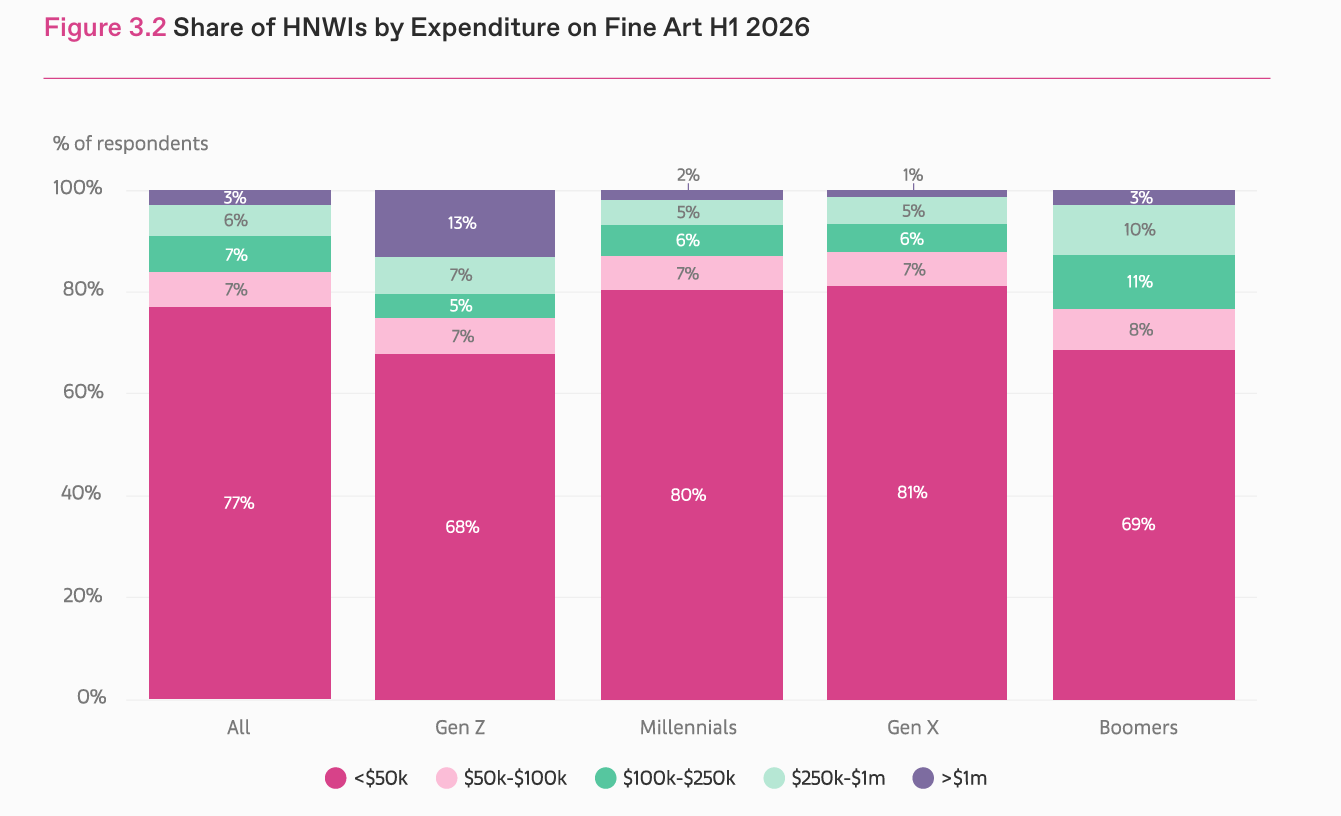
Above: Share of spending by art price bracket in the first half of 2026
The survey also explored in depth the original reasons respondents entered the collecting field. Family influence was the most common, at 28%, and this factor was especially prominent among younger collectors, with nearly 40% of Gen Z respondents citing family ties as their entry point.
The second-largest driver was offline cultural experiences, at 22%. In mainland China in particular, visiting museums, galleries, art fairs and other venues to view art in person was the most common trigger for collecting locally, at 37%, while family factors accounted for 23%.
14% of collectors initially entered collecting out of financial investment considerations. Although socializing and connections continue to drive collectors' purchases, only 13% of respondents first encountered collecting through friends or peers. Another 13% discovered collecting on their own through online channels or social media.
Notably, the share of Gen Z collectors who entered collecting through online channels (10%) was actually lower than that of Generation X (16%), overturning the assumption that "young collectors are more likely to enter the collecting market through digital channels." Despite the growing popularity of digital channels, the results show that intergenerational inheritance and in-person experiences remain crucial for attracting young collectors.
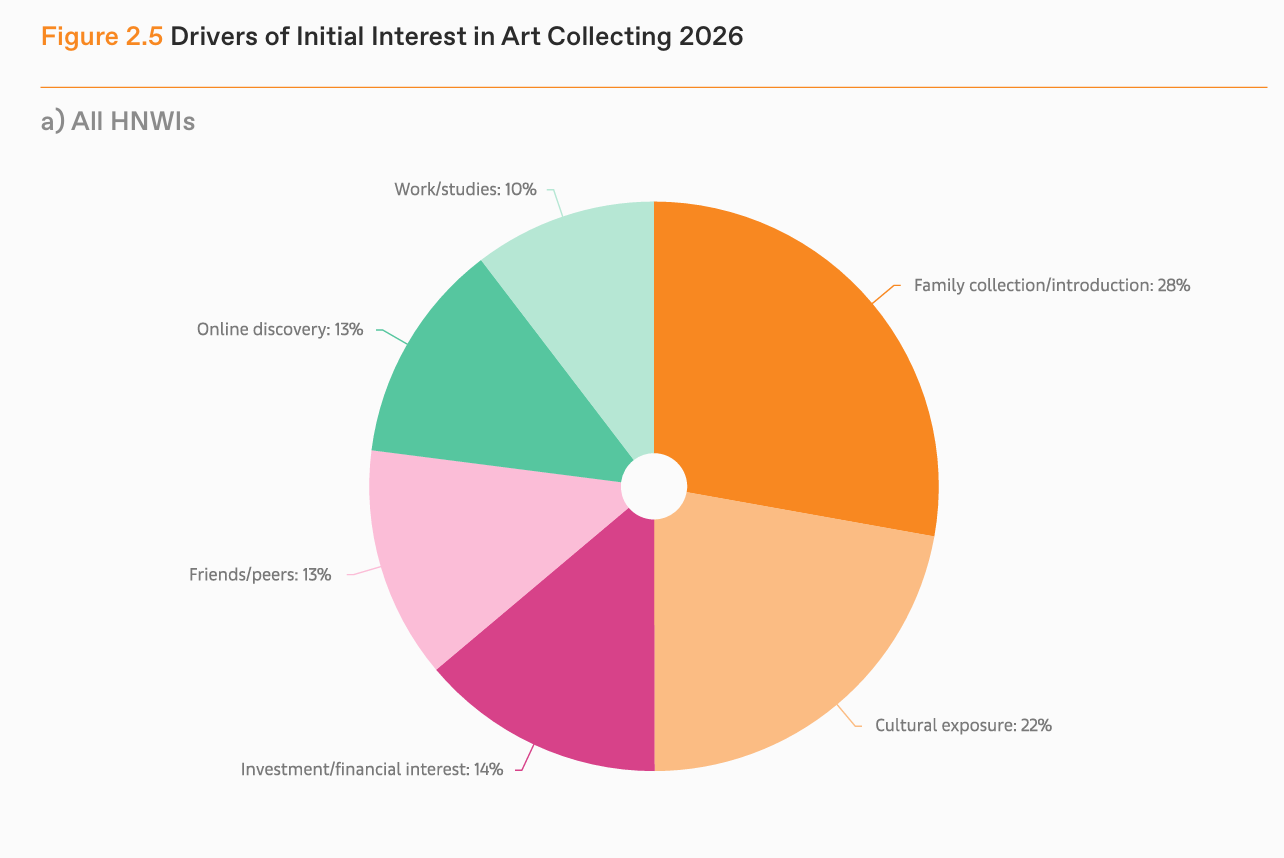
Above: Share of drivers for high-net-worth individuals starting art collecting in 2026
Collectors' entry points into art vary, but the survey found that most still start with established traditional categories. 43% of respondents listed paintings among the top three categories in which they first collected, followed by antiques (27%) and sculpture (25%).
By age, Gen Z and Millennials mostly started with paintings and sculpture, while Generation X and Baby Boomers started mainly with paintings and antiques. Among Gen Z, only 7% made digital art their first acquisition, and among Millennials the share was just 4%. Compared with younger collectors, Baby Boomers were more inclined to start collecting with jewelry and gemstones.
It is worth noting that across all age groups, luxury handbags (10%) and sneakers (9%) ranked relatively low among the categories in which respondents first began collecting. The report notes that luxury goods are widely assumed to be a gateway to broader collecting, but in this high-net-worth sample, there is almost no evidence that luxury goods are the first step into art collecting.
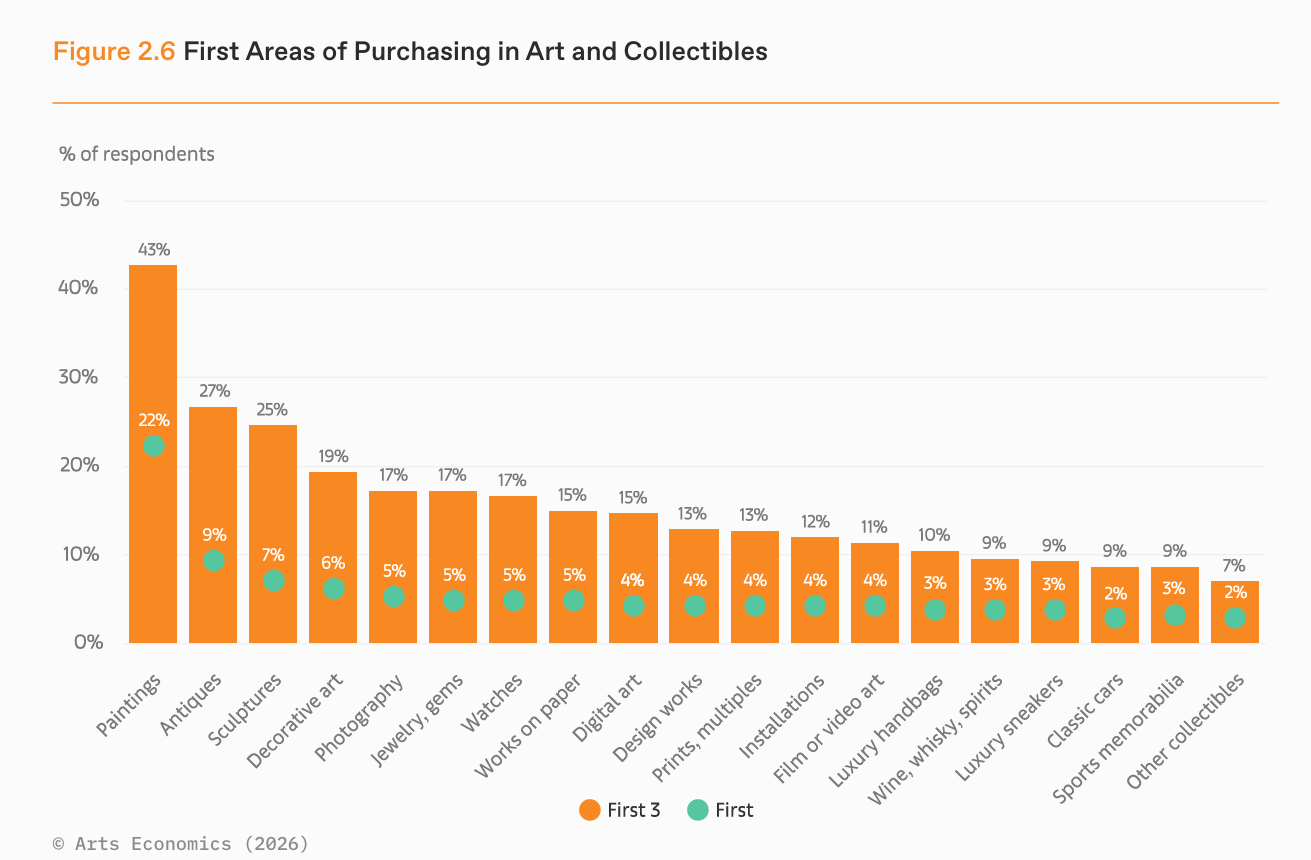
Above: Categories in which respondents first entered art and collectibles (green dots indicate first purchase; orange bars indicate top three)
The report concludes that the art market still relies heavily on various offline events. According to the report's multi-year survey results, in 2019 high-net-worth collectors attended an average of 41 art-related events; attendance fell sharply in 2020–2022 and gradually recovered over the following two years, with an average of 49 events in 2023, 48 in 2024 and 46 in 2025.
By age group, Baby Boomers attended the most events in both 2025 and 2026, leading in multiple categories including museum exhibitions, gallery exhibitions and artist studio visits. Gen Z collectors ranked second overall in attendance, while Millennials attended the fewest.
Regional differences in attendance were particularly striking. Collectors in the UK and the US attended significantly more events than those elsewhere, roughly three times the number for collectors in mainland China or Germany. Mainland Chinese collectors had the lowest total attendance, at 24 events in 2025.
| Source: Original report
| Image source: Original report
| Editor: LuxeCO