To boost market demand, Italian luxury brand Gucci, owned by France's Kering group, has cut prices on some handbags, footwear and ready-to-wear products.
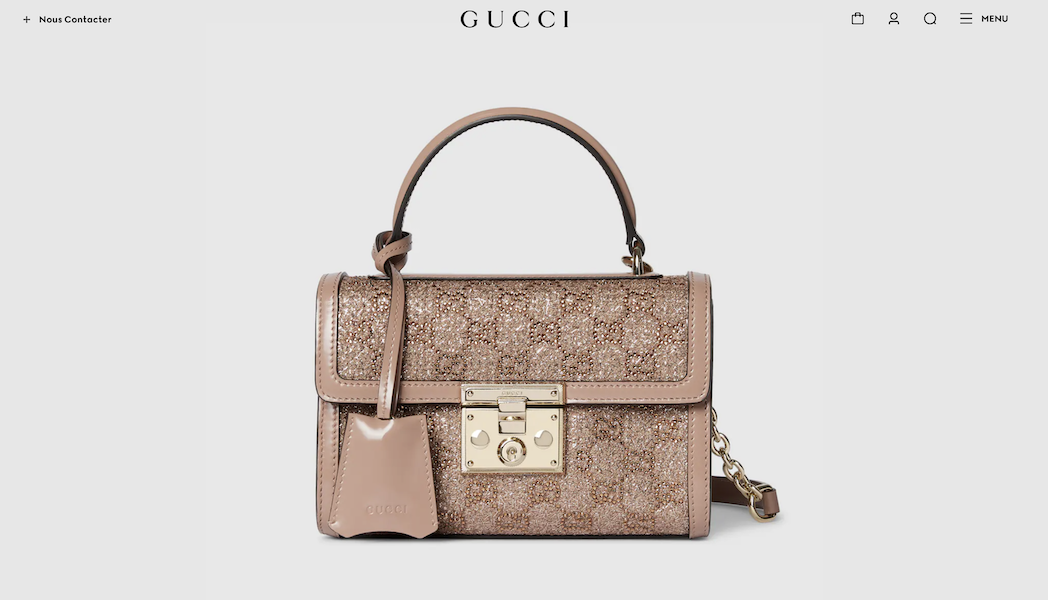
In a recent study, Luca Solca, managing director at international asset management firm Bernstein and global head of luxury goods research, noted that Gucci's small Padlock handbag with crystal embellishments is now 30% cheaper in the French market. The bag sold for 3,500 euros in France in July and now sells for 2,450 euros, and this is the regular price of the product on sale, not an end-of-season promotional discount.
In fact, Gucci quietly completed several rounds of price adjustments over the summer, covering handbags, footwear and ready-to-wear collections. The Mercato tote was cut by about 20%–25%; several sneaker styles were reduced from 800 euros to a range of 560–595 euros.
At the same time, Gucci is expanding its entry-level product line by launching more new products. The brand's US website has added 16 new handbag styles, all priced under $2,000. Earlier reporting by LuxeCO showed that Drip, the first sneaker designed for the brand by new artistic director Demna, launched this summer at about 800 euros in Europe and about $1,000 in the US, lower than many other Gucci shoe styles. Notably, due to production technology requirements, this shoe is "Made in China."
Related LuxeCO reading: Gucci launches its first "Made in China" sneaker
Kering says the price cuts are a targeted correction on overpriced products, and the scope of the adjustments is limited, and do not represent the start of large-scale repricing by the brand.
Previously, group chief executive Luca de Meo said on the first-half earnings call in July that Gucci's new collections would launch at "competitive prices." The group's third-quarter results presentation mentioned "continuing to reshape the product and pricing system, with targeted price adjustments centered on the handbag category, to enhance the perceived value of products."
Kering's turnaround plan for Gucci includes: clarifying the creative direction, strengthening the leather goods category, building a more consistent and higher-quality product matrix, and streamlining distribution channels.
The price adjustments come as third-quarter results showed Gucci's revenue fell 4% year on year to 1.291 billion euros, down 6% on a comparable basis. Previously, the brand's first-quarter comparable sales fell 8% year on year, and the decline narrowed to 2% in the second quarter.
Affected by declining foot traffic, Gucci's directly operated store sales fell 9% year on year in the third quarter, with foot traffic in mainland China and Japan particularly hard hit; however, conversion rates, average selling prices and average transaction values rose.
After the third-quarter results were released, Kering abandoned its goal of returning to revenue growth in 2026, retaining only the target of improving its recurring operating margin; at the same time, it raised its full-year net store closure target from 100 to at least 125.
Luca de Meo said when releasing the results: "Reviving Gucci remains our core top priority."
How to re-attract the aspirational consumers of "entry-level luxury" remains a major challenge. Bernstein data shows that this middle- and high-income consumer group accounts for more than half of Gucci's and Louis Vuitton's sales, but this group's willingness to spend on luxury has contracted, including in the Chinese market.
For luxury brands, cutting prices on existing products carries risks: it weakens the brand's sense of exclusivity and scarcity, and hurts existing customers who previously bought the same products at higher prices.
Louis Vuitton is also weighing its pricing strategy, but is unwilling to directly cut prices on existing products. Goldman Sachs estimates that Louis Vuitton's third-quarter sales fell about 8% year on year.
LVMH group chief financial officer Cécile Cabanis said on a recent investor call that management has been "discussing some more aggressive, immediate actions, such as price cuts."
However, LVMH still believes that cutting prices for its flagship brand Louis Vuitton and other brands is not wise. Last year, when an analyst asked Cécile Cabanis whether Louis Vuitton should adjust prices to drive growth, she directly rejected the idea: "We don't do price tiering. We are not Coca-Cola."
On the pricing issue, the luxury industry as a whole has roughly split into three approaches:
- Direct price cuts. Currently, Gucci is the only leading luxury brand to cut list prices on core classic styles. Years of declining sales performance have already weakened the brand's pricing power, and price cuts will further undermine that pricing power.
- Adding lower-tier product lines. Dior, Chanel and Burberry have chosen this path. They leave classic bestsellers untouched and instead add lower-priced items below the product matrix. Chanel's Spring/Summer 2026 pre-collection introduced more handbags under 5,000 euros; Dior expanded items under 1,000 euros. Burberry kept the entry price of its leather goods at $190 while raising its top price from $2,750 to $3,260. Luxury industry consultant Robert Burke noted that Louis Vuitton is likewise expanding its product line downward through new products while keeping prices of core classic bags unchanged.
- Maintaining prices and continuing to raise them. Hermès is still raising prices. The brand's customer base is mainly the top tier of high-net-worth individuals, whose spending power is stable.
Behind this is a structural industry backdrop. Boston Consulting Group estimates that the size of the luxury industry's core customer base is shrinking. Its research shows that about 35% of aspirational luxury consumers of entry-level luxury have reduced or paused luxury spending, with some shifting their money toward financial investments and personal wellness.
Bain and Altagamma data show that the luxury consumer base is under pressure, with another 20 million to 30 million consumers potentially reducing luxury spending at any time. At the same time, accessible luxury and mass-premium brands are gaining market share.
Currently, growth in the luxury industry is concentrated at the two extremes of income. Boston Consulting Group data shows that about 700,000 ultra-high-net-worth individuals, just 0.2% of all luxury customers, contribute 24% of the industry's sales.
|Sources: The Wall Street Journal, Forbes, past LuxeCO reports
|Image credit: brand official websites
|Editor: LuxeCO