On August 25, EEKA Fashion Holdings Limited (HK:03709) released its 2026 interim results for the period ended June 30: group revenue fell 12.14% year-on-year to RMB 2.727 billion, while net profit attributable to shareholders edged down 0.14% year-on-year to RMB 287 million.
As of the close on the day the results were released, EEKA Fashion's share price fell 2.6% from the previous day to HK$5.05 per share, down about 30% over the past year. Its latest market capitalization is approximately HK$3.4 billion.

——By brand:
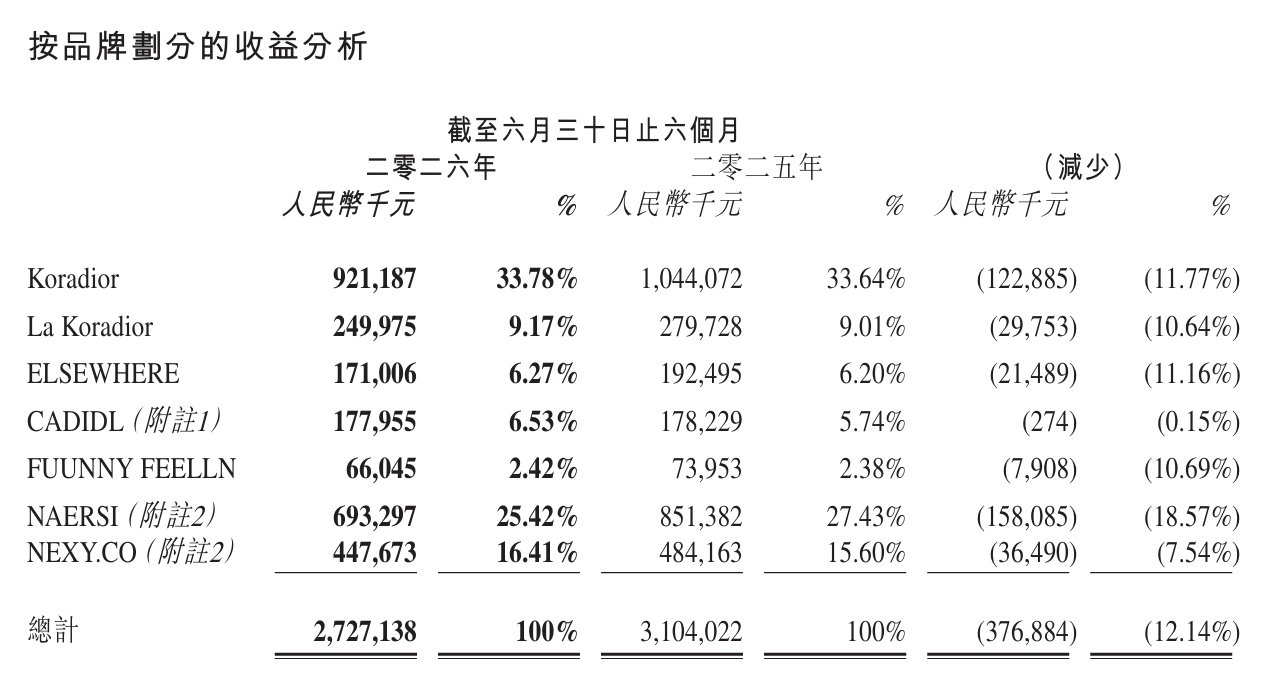
In recent years, EEKA Fashion has built a multi-brand group comprising 7 proprietary brands through self-creation, acquisitions and other means, including:
- Own brands: Koradior, La Koradior, ELSEWHERE, FUUNNY FEELLN
- Acquired brands: CADIDL, NAERSI, NEXY.CO
During the reporting period, revenue of all the group's brands declined. Among them, revenue of the high-end womenswear brand La Koradior fell 10.64% year-on-year to RMB 250 million. Revenue of the two main brands, Koradior and NAERSI, declined 11.77% and 18.57% year-on-year, respectively.
——By channel:
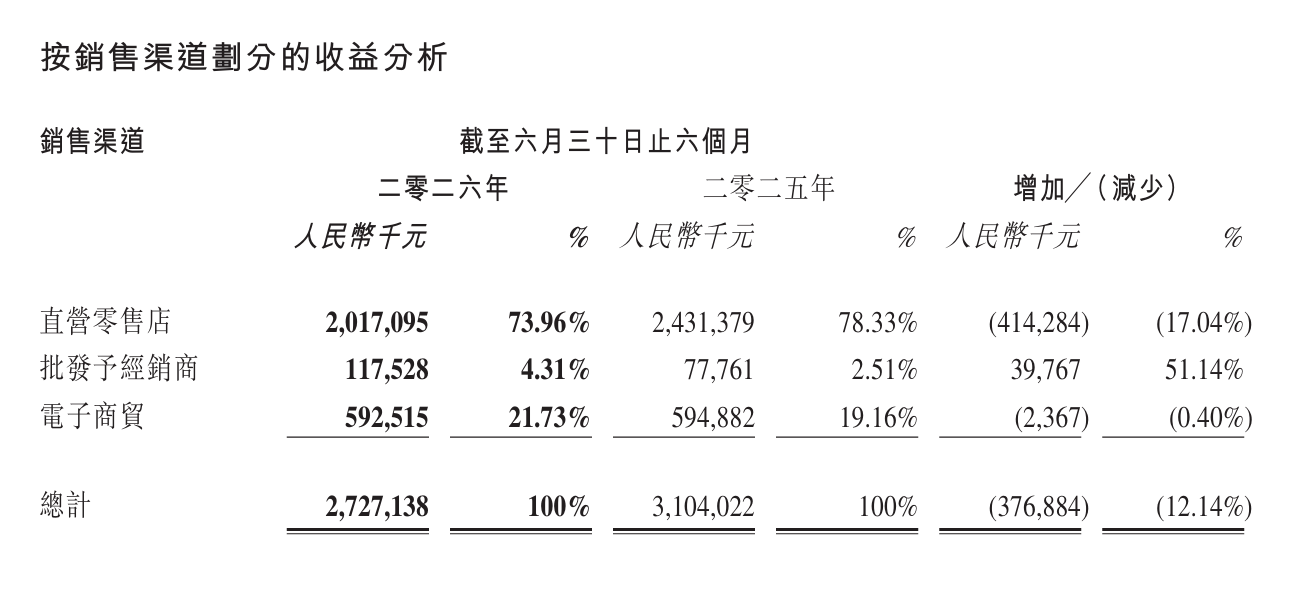
- Directly operated retail stores: Revenue fell 17.04% year-on-year to RMB 2.017 billion, with the decline mainly due to lower sales at existing stores. As of the end of the reporting period, the group operated 1,276 directly operated retail stores.
- Wholesale to distributors: Revenue rose 51.14% year-on-year to RMB 117 million. The company said the growth was due to a recovery in market confidence and consumer demand. As of the end of the reporting period, distributors operated a total of 397 retail stores.
- E-commerce: Revenue fell 0.4% year-on-year to RMB 592 million. Among this, sales on the Douyin platform grew 53.13% year-on-year to RMB 177 million, and sales on the WeChat Channels platform grew 53.63% year-on-year to RMB 85.51 million; sales on the Vipshop platform fell 35.75% year-on-year to RMB 157 million, while sales on the Tmall platform fell 10.67% year-on-year to RMB 115 million.
——Channel performance by brand in the first half:
- Koradior: Continued to upgrade its offline network, opening multiple brand flagship stores, large boutique stores and airport stores, entering more high-end shopping malls, and, guided by the design concept of "Romantic Bloom, Enchanting Space," creating a high-quality affordable-luxury atmosphere and offering an immersive sensory experience. As of the end of the reporting period, Koradior operated a total of 647 stores in China.
- NAERSI: Continued to upgrade store image and design, expand store area, adjust store locations, and open new airport stores, while deepening consumers' understanding of the brand's style and philosophy through large-scale fashion shows, themed pop-up events and offline interactive promotional activities, further strengthening its affordable-luxury positioning. As of the end of the reporting period, NAERSI operated a total of 487 stores in China.
- La Koradior: Continued to optimize store image and strengthen interaction with consumers through collaborative fashion shows, in-store events and online customization services, striving to build a "top brand" with "top service" and "top quality." As of the end of the reporting period, La Koradior operated a total of 41 stores in China.
- NEXY.CO: Continued to advance its strategy of "improving store quality and raising store efficiency," stepped up entry into high-end shopping malls, and deepened its strategic cooperation with the China Resources MixC system. While opening airport stores, it actively carried out offline touring exhibitions and pop-up store projects. As of the end of the reporting period, NEXY.CO operated a total of 212 stores in China.
- ELSEWHERE: Continued to refresh its store space image, using "an art salon returning to nature" as its inspiration to create a gallery-like humanistic setting. As of the end of the reporting period, ELSEWHERE operated a total of 117 stores in China.
- CADIDL: In the first half, the brand opened new stores at Changsha MixC and Wuhan Qunguang Plaza. As of the end of the reporting period, CADIDL operated a total of 127 stores in China.
- FUUNNY FEELLN: Actively enhanced the image of its offline directly operated stores through store displays, spaces and pop-up stores. As of the end of the reporting period, FUUNNY FEELLN operated a total of 42 stores in China.

Outlook
In the second half, the group said it will further enhance brand awareness and recognition, consolidate the professional and collaborative capabilities of its platform-based operation as an "affordable-luxury brand management group," and steadily advance its full-year operating targets.
- Brand promotion: With omnichannel integration at the core, build a complete closed loop covering terminal store image, display standards, major event marketing and consumer research.
- Product operations: Release the group's standard operating procedure manual for merchandise operations and the EEKA Dictionary. We will fully implement standardization to unify operating procedures at the foundational level.
- Channel expansion: Offline, improve the operating efficiency of directly operated stores through specific measures including expanding large stores, establishing benchmark stores and building stores with annual sales of over RMB 10 million. Online, empower growth through event planning and omnichannel communication.
- Supply chain management: Release material plans quarterly, coordinate the allocation of R&D materials, and strictly select high-end raw materials. At the same time, gradually implement systematic management across the entire value chain, officially entering a new stage of systematic, digital and intelligent management.
- AI empowering business scenarios: In the early stage, prioritize tackling key pain points and adopt a "pilot validation, gradual rollout" strategy to ensure that every AI application scenario has clear business value and quantifiable metrics. In the later stage, build an enterprise-level "intelligent think tank" and "intelligent employees" with actual execution capabilities, driving AI to evolve from the "suggestion layer" to the "execution layer" and fully empower business development.
|Source: Official financial report
|Image source: Official financial report, group official website
|Editor: LuxeCO