As the global luxury industry enters a historic trough, the importance of Chinese consumers and the local market continues to grow. The most telling signal: since the second half of last year, a number of heavyweight international luxury brand executives have traveled to China to visit stores in core cities and have spoken at length with financial analysts about what they saw at their annual earnings briefings.
Clearly, in a Chinese luxury market that is entering maturity, major brands all face a series of new challenges — from brand communications and product planning to store deployment and operations. To win tomorrow, they must significantly improve the sophistication of their management and their local market insight.
As the most important “dashboard” of the Chinese luxury market, Luxe.Co's “Luxury Brand China Vitality Ranking” (launched in 2021) (link, hereinafter referred to as the “Vitality Ranking”) has consistently relied on a solid proprietary data and analytical framework to systematically present the degree of proactivity, investment intensity and strategic layout of major brands in expanding in the Chinese market, while revealing the health and latest trends of the Chinese luxury market. It provides brand and commercial property managers with a unique and valuable reference for grasping the pulse of the Chinese market, understanding the competitive landscape, and learning industry best practices.
On the eve of the Spring Festival in the Year of the Horse, Luxe.Co held an online briefing on the 2025 “Luxury Brand China Vitality Ranking”, which attracted enthusiastic participation from professionals in fields including luxury brands, fashion brands, commercial real estate companies, securities firms, private equity funds, major internet companies and international PR agencies.
Based on the 2025 “Vitality Ranking” scores and the latest research from LuxeCO Intelligence, at this briefing Luxe.Co Founder/CEO Yu Yan and Senior Vice President and Director of LuxeCO Intelligence Wang Qiong shared 10 latest insights on the Chinese luxury market:
- Overall activity of international luxury brands is the lowest in four years
- The top-tier brands show the highest commitment and stability in the Chinese market
- High-end jewelry brands are the most resilient, with their share of the Vitality Ranking Top 10 increasing year by year
- Local luxury brands break through, with Laopu Gold leaping to No. 3 on the Vitality Ranking
- Luxury brand store expansion efforts fell by about 30%, with non-first-tier cities more affected
- “Stores” remain the top priority for expansion and upgrading
- “Quiet luxury” is in full swing, with three representative brands expanding accordingly
- Chinese culture and Eastern aesthetics have become key elements in winning over local high-end consumers
- Hong Kong and Beijing have become new hotspots for luxury brands' store layouts and events
- Four “hard strengths” are the solid foundation for luxury brands to move against the wind
Vitality Ranking Insight 1:
Overall activity of international luxury brands is the lowest in four years
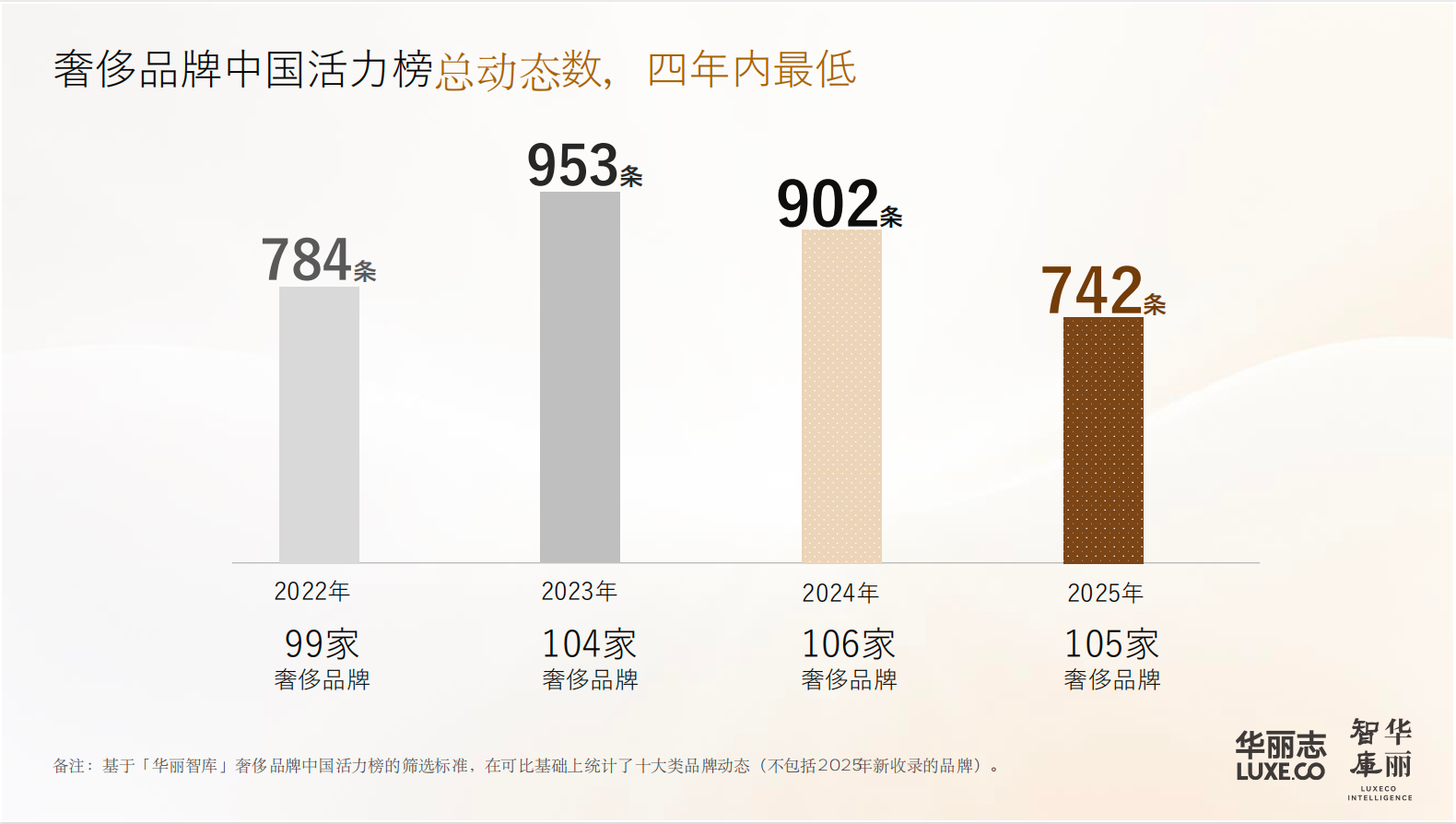
The 2025 “Vitality Ranking” recorded a total of 742 developments involving 105 luxury brands in the Chinese market, the lowest in the past four years, even lower than 2022 at the tail end of the pandemic.
Even Bernard Arnault, Chairman/CEO of LVMH Group, who has weathered multiple economic cycles, lamented that the luxury industry is in a cold “winter.”
Related reading from Luxe.Co: LVMH Chairman: “I think we will get through this winter,” Arnault family's stake to rise above 50%
Vitality Ranking Insight 2:
The top-tier brands show the highest commitment and stability in the Chinese market
Despite the deep winter, the highest-status “top-tier” brands in the luxury world have maintained their commitment and activity in the Chinese market: Louis Vuitton, Dior and Hermès have all made the “Vitality Ranking” Top 10 for three consecutive years.
Among them, Louis Vuitton, the world's highest-selling luxury brand, has topped Luxe.Co's “Vitality Ranking” for three consecutive years.
Jean-Jacques Guiony, former CFO of LVMH Group, once commented: “There have always been questions (from the outside) about Louis Vuitton's ability to develop further... and it has always been able to achieve new breakthroughs.”
Related reading from Luxe.Co: LVMH Group CFO: Chinese customers are now the hardest to predict!
Looking at the dimensions of brand activity shown in the “Vitality Ranking” (chart below), Louis Vuitton's investment in China is highly diversified, more so than most ranked brands. This shows that what sustains Louis Vuitton's continued growth is not a “one-trick pony” but a persistent, efficiently operating complex system, from which those earth-shaking bold innovations (such as the “Louis” in Shanghai) are born.
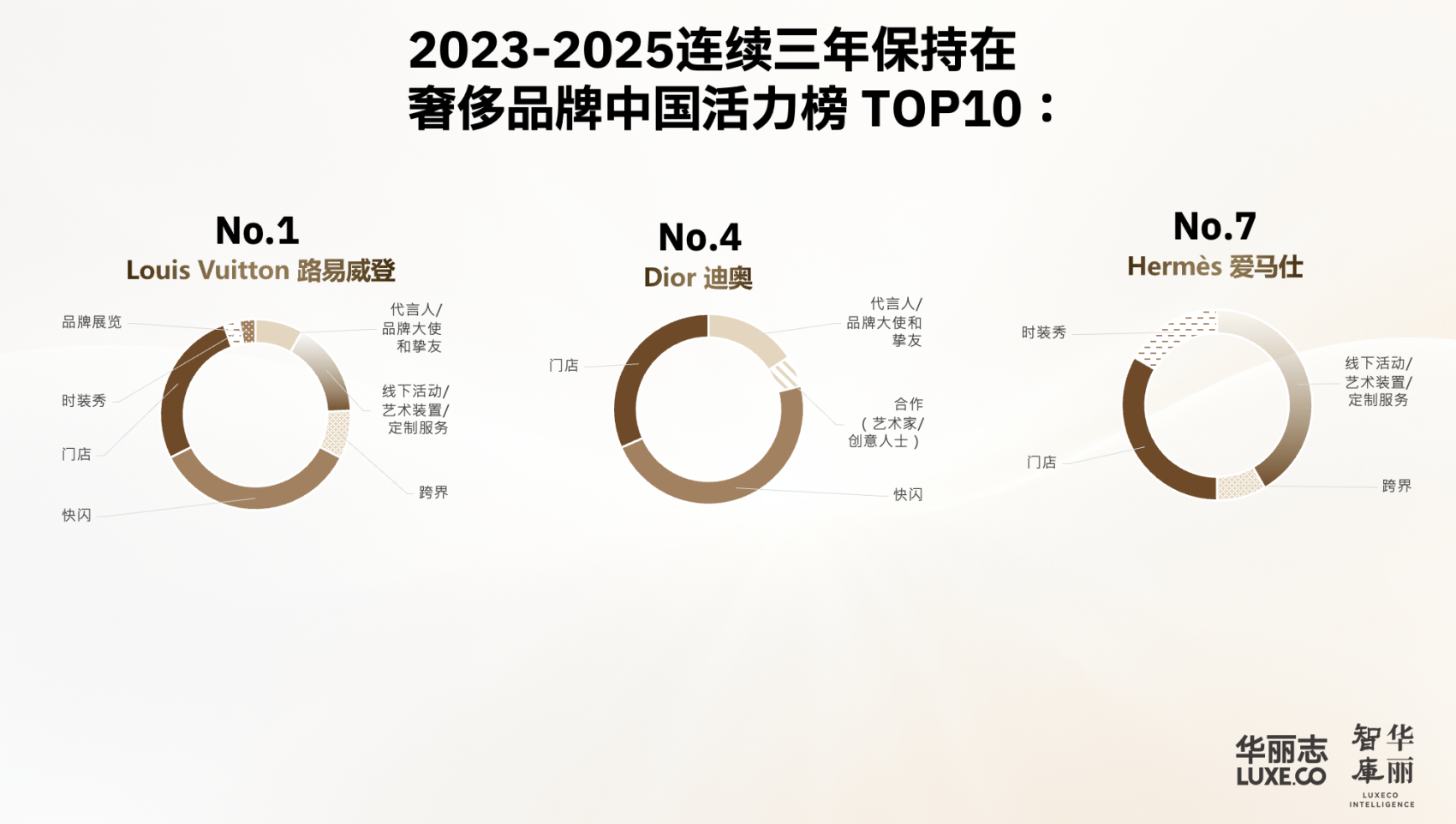
Dior underwent a round of intensive creative and management changes in 2025, with J.W Anderson becoming the first “all-round” creative director responsible for all of the brand's collections since founder Christian Dior. During the transition, the brand's activity inevitably declined; according to “Vitality Ranking” data, Dior's number of developments in the Chinese market was only about half that of Louis Vuitton.
By contrast, Hermès puts “stability” first, as always. As Hermès Executive Chairman/CEO Axel Dumas said: “In recent years, we have not canceled a single project (in China). We continue to advance our plans according to the established guidelines... We have 32 stores in China today, maintaining a fairly stable state. It will grow at our pace, slowly. What is certain is that we take a long-term view. We are not stop-and-go.”
Vitality Ranking Insight 3:
High-end jewelry brands are the most resilient, with their share of the Vitality Ranking Top 10 increasing year by year
Precious materials, classic designs, exquisite craftsmanship and a certain degree of investment value all make high-end jewelry an easier luxury purchase choice in the current economic environment, making it arguably the most “resilient” category. Compared with somewhat subdued apparel and leather goods brands, jewelry brands' investment and activity in the Chinese luxury market have climbed steeply.
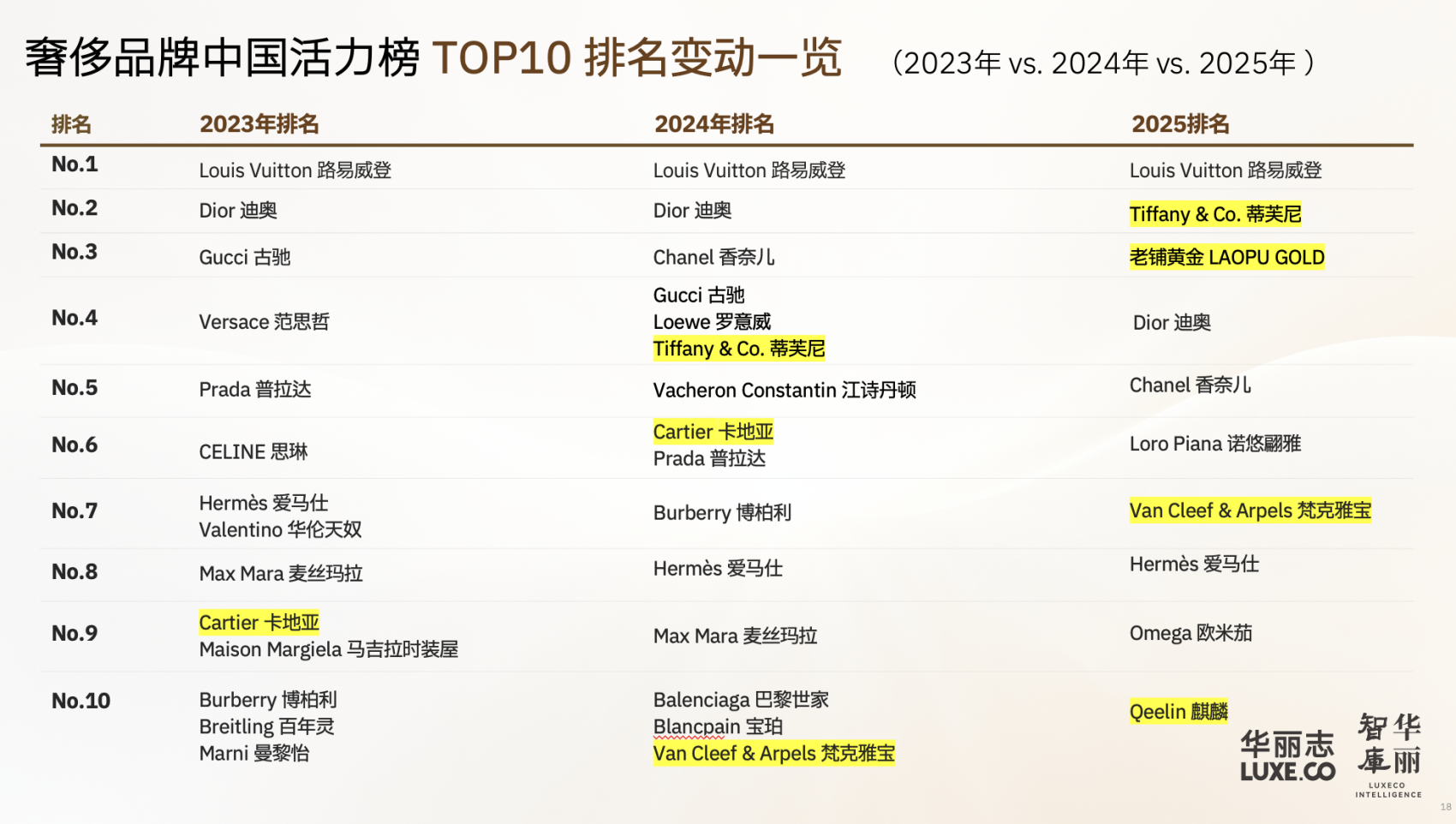
Over the past three years, changes in the Luxe.Co “Vitality Ranking” have directly reflected this trend: the number of high-end jewelry brands in the TOP 10 grew from 1 in 2023 to 3 in 2024 and 4 in 2025 (Tiffany & Co., Laopu Gold, Van Cleef & Arpels, Qeelin).
Vitality Ranking Insight 4:
Local luxury brands break through, with Laopu Gold leaping to No. 3 on the Vitality Ranking
2025 can be called a year of “breakthrough” for Chinese local luxury brands, with two major jewelry brands (Laopu Gold, Chow Tai Fook) entering the Luxe.Co “Vitality Ranking” for the first time.
Chow Tai Fook formally entered “Haute joaillerie,” making its mark with Eastern aesthetics in a segment long monopolized by top international brands. Laopu Gold (LAOPU GOLD), meanwhile, completed the milestone of establishing a presence in all ten of the country's major “heavy luxury” malls; its outstanding performance has put enormous pressure on international peers and made a number of international financial institutions sit up and take notice of the strength of Chinese local luxury brands.
As the luxury brand that expanded most aggressively in the Chinese market in 2025, Laopu Gold, upon first being included in the “Vitality Ranking,” jumped to third place on the strength of an exceptionally high score in the “stores” category. In the future, we look forward to Laopu Gold and more Chinese brands making a bigger splash in other marketing dimensions.
Vitality Ranking Insight 5:
Luxury brand store expansion efforts fell by about 30%, with non-first-tier cities more affected
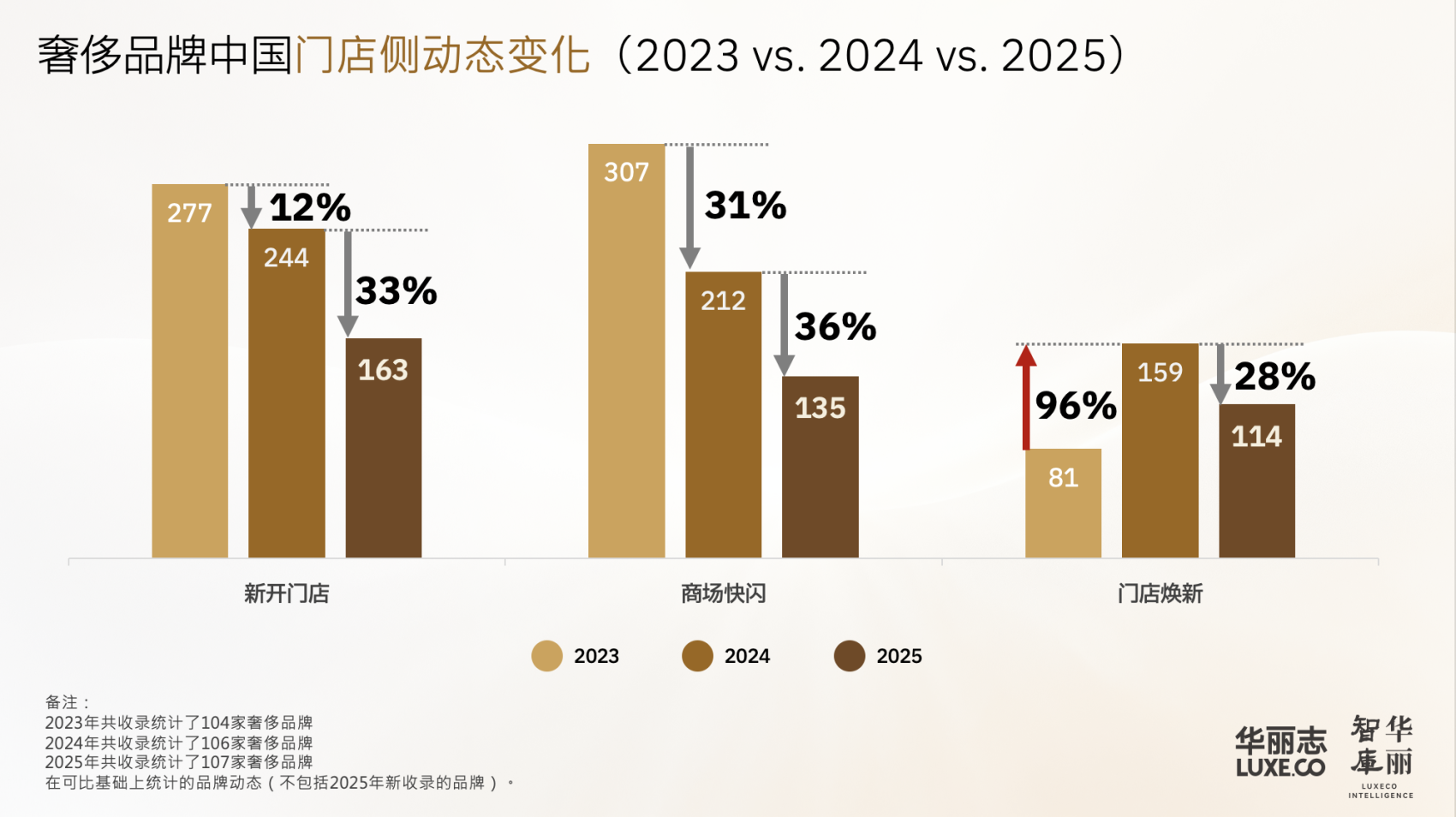
According to “Vitality Ranking” data, in 2025 the total number of new stores opened by luxury brands fell 33% from 2024, the total number of mall pop-ups fell 36%, and renovated stores fell 28% from a high base in 2024.
Clearly, after nearly 20 years of rapid expansion, luxury brands — especially established names with a large existing store base — are better optimizing their store networks by adjusting city and mall locations, and even store positions within malls, and cutting unnecessary expenses to ride out the trough.
As the head of Zegna Group put it: “ZEGNA's large store base in China has instead become a burden in the current environment, which is why the brand is now focused on 'slimming down.'” By closing some underperforming stores, the brand will carry out a “rationalization” of its China store network so as to concentrate resources on delivering a better customer experience.
Related reading from Luxe.Co: Zegna head discusses the China market and discloses that the ZEGNA brand will close 10 stores
Such adjustments are believed to continue in 2026, and high-end malls/commercial districts will inevitably remain under pressure; which brands will fill the vacant spaces left by luxury brands' store closures is worth watching.
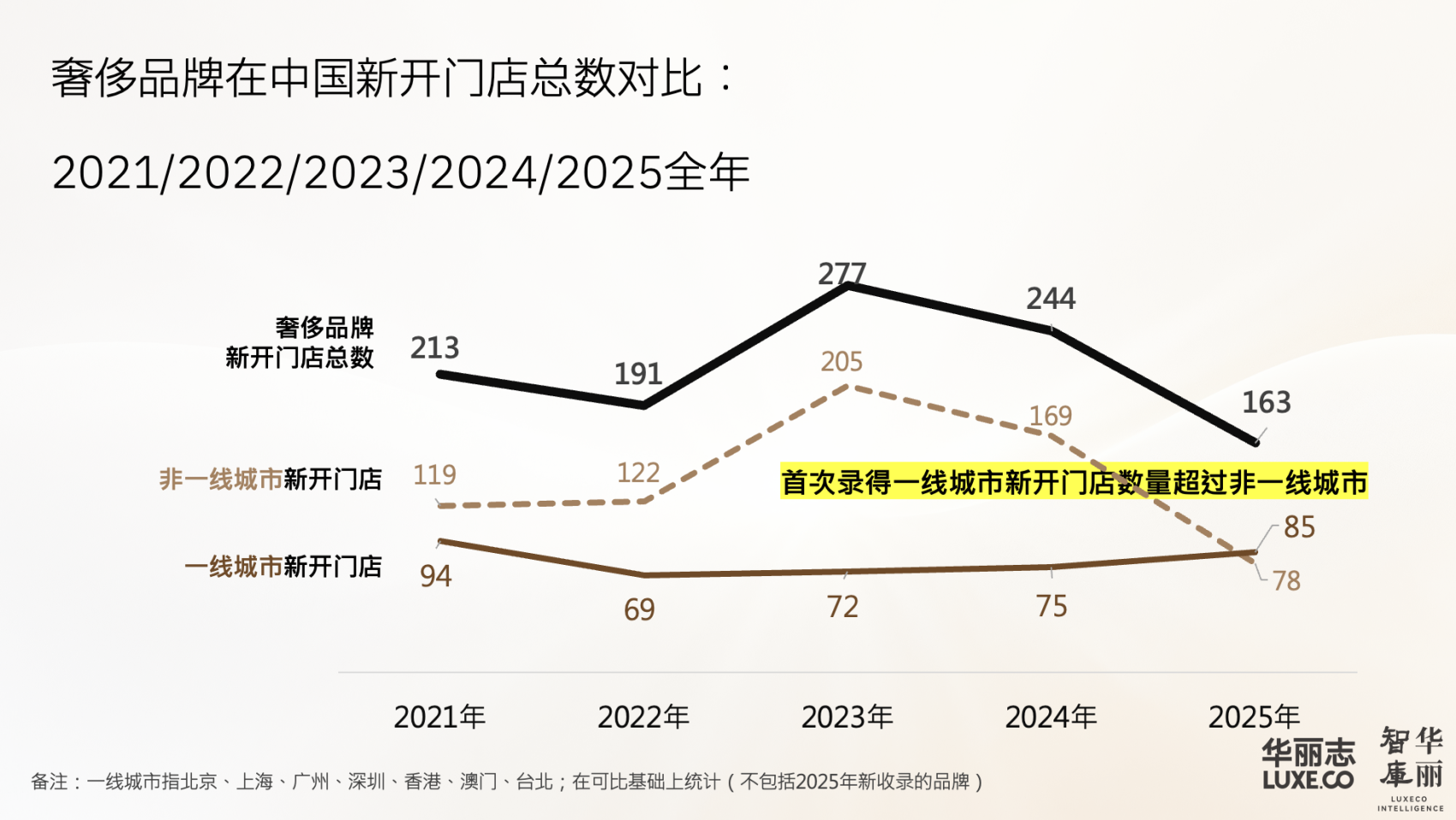
It is worth noting that for the first time in the past four years, the Luxe.Co “Vitality Ranking” report recorded more new luxury brand stores opened in first-tier cities than in non-first-tier cities.
This also shows that luxury brands are paying more attention to the input-output ratio of stores, concentrating their efforts on discovering top-tier cities and commercial districts that may achieve higher sales per square meter. For example, even though the ZEGNA brand is about to close 10 stores in China, it still plans to open a new store in Shenzhen Bay because “(Shenzhen) is an important city.”
Vitality Ranking Insight 6:
“Stores” remain the top priority for expansion and upgrading
According to data in the “Vitality Ranking” report, in 2025 “stores” remained the focus of many leading luxury brands. And through store developments, we can observe which brands are stepping up efforts to seize market share during the market trough.
Take Tiffany, which jumped to No. 2 in the 2025 Vitality Ranking: last year the brand completed 8 new store openings and renovations in the Chinese market. In fact, since LVMH Group completed its full acquisition of Tiffany in early 2021, store upgrades and renovations have always been a top priority.
On the significance of this work, Stéphane Bianchi, CEO of LVMH Group's Watches & Jewelry division, noted: “By the end of 2025, (Tiffany's) new-concept stores will account for about one-third of the total store count and contribute 42% of sales, up from 31% previously. The performance gap between new- and old-concept stores is about 15 to 20 percentage points. So this is very promising for the future.”
In addition, in 2025, behind Canada Goose's sharp rise in the Vitality Ranking (up 27 places from 2024), the brand opened 7 new stores, and its direct-to-consumer (DTC) channel in the Chinese mainland led core global markets.
Vitality Ranking Insight 7:
“Quiet luxury” is in full swing, with three representative brands expanding accordingly
In recent years, “quiet luxury,” or the so-called “old money” style, has been favored by Chinese high-end consumers. Quiet luxury brands have accordingly stepped up their investment, and three representative brands have seen their “Vitality Ranking” positions soar.
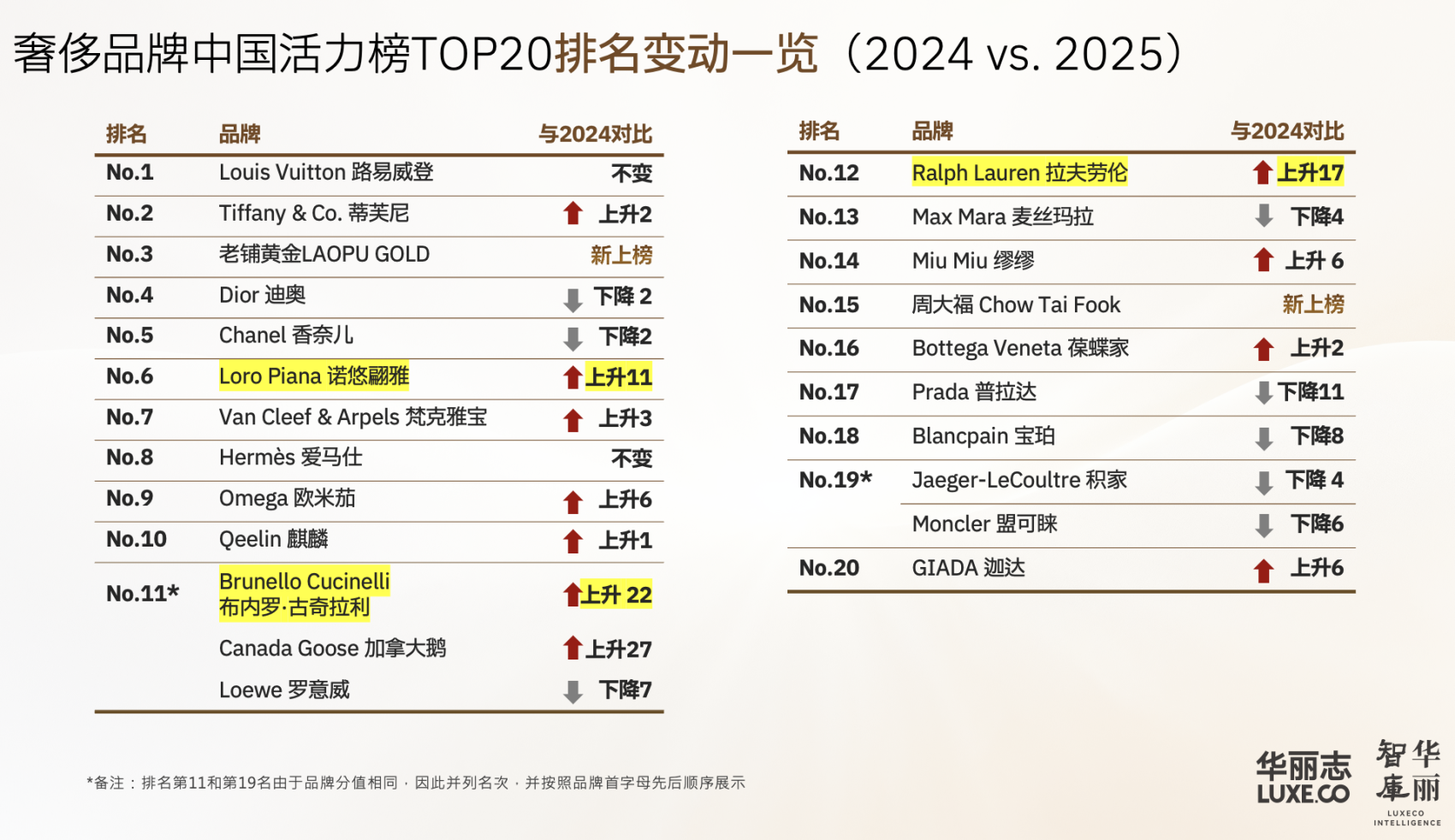
Among them, Loro Piana entered the annual “Vitality Ranking” Top 10 for the first time in 2025.
In March 2025, to celebrate the brand's 100th anniversary, Loro Piana opened its first-ever global exhibition, “A Century of Touch,” in Shanghai. It was the brand's first exhibition ever, on a considerable scale, spanning three halls and 15 rooms with a total area of more than 1,000 square meters. That year, the brand opened/renovated 7 stores in China, 2 of which were multi-level stores.
Compared with 2024, Brunello Cucinelli (No. 11) rose 22 places in the “Vitality Ranking.” In 2025, the brand clearly stepped up channel expansion in the Chinese market, opening/renovating a total of 9 stores, far higher than in previous years.
Ralph Lauren (No. 12) also rose 17 places. In 2025, the brand held its first show in Asia in Shanghai and staged 10 events in Hong Kong, Beijing, Shenyang, Wuhan, Hangzhou, Nanjing, Guangzhou and other cities.
Vitality Ranking Insight 8:
Chinese culture and Eastern aesthetics have become key elements in winning over local high-end consumers
The revival of traditional culture is an unstoppable wave, and Chinese cultural elements and Eastern aesthetics are becoming important assets for luxury brands in winning over Chinese consumers.
Laopu Gold, which jumped to No. 3 on its first inclusion, has revived “Chinese ancient-method gold,” carrying elements and concepts of “classic culture” throughout, from brand philosophy and product development to in-store experience.
Since 2017, Chow Tai Fook has launched jewelry collections rich in traditional cultural connotations and Eastern aesthetics, such as Heritage, Chuan Fu, Chuan Xi and the Forbidden City series. Among them, the Chuan Fu series and the Forbidden City series each achieved sales of approximately HK$4 billion in fiscal 2025.
Founded in Hong Kong and now part of France's Kering Group, Qeelin has also climbed the “Vitality Ranking” year by year and entered the TOP 10 for the first time in 2025. Its iconic Wulu (gourd) collection has become deeply ingrained in people's minds, and in 2025 it collaborated with a number of artists to create new works through traditional art forms such as intangible cultural heritage paper art and cloisonné enamel.
Brand CEO Christophe Artaux once told Luxe.Co: “Cultural relevance is very important. Customers feel strongly connected to our fine jewelry pieces; our designs are like telling familiar stories or symbols, which reconnects people with cultural moments — and that is very emotional.”
Vitality Ranking Insight 9:
Hong Kong and Beijing have become new hotspots for luxury brands' store layouts and events
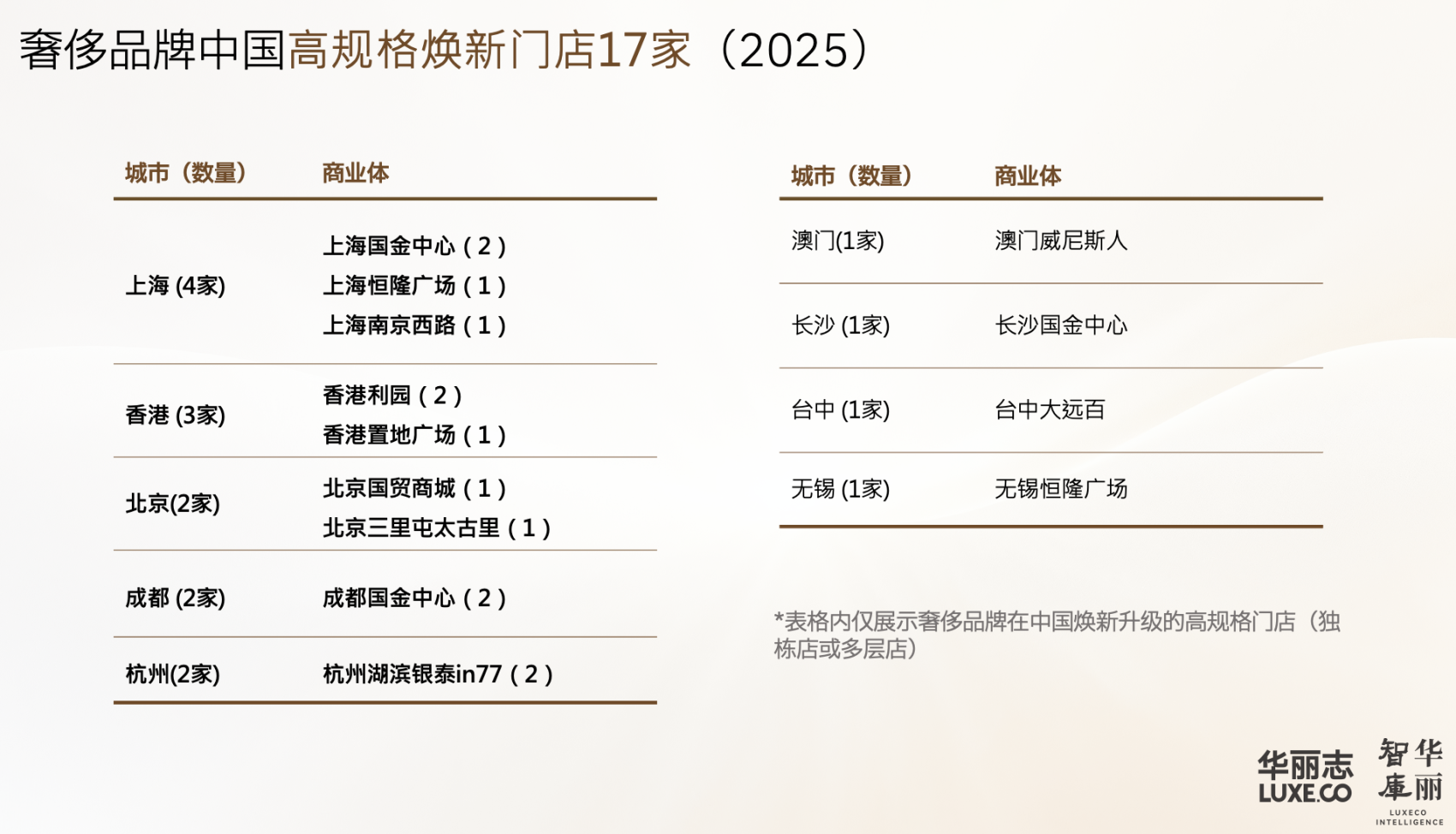
As mentioned earlier, luxury brands' store investment is tilting back toward first-tier cities.
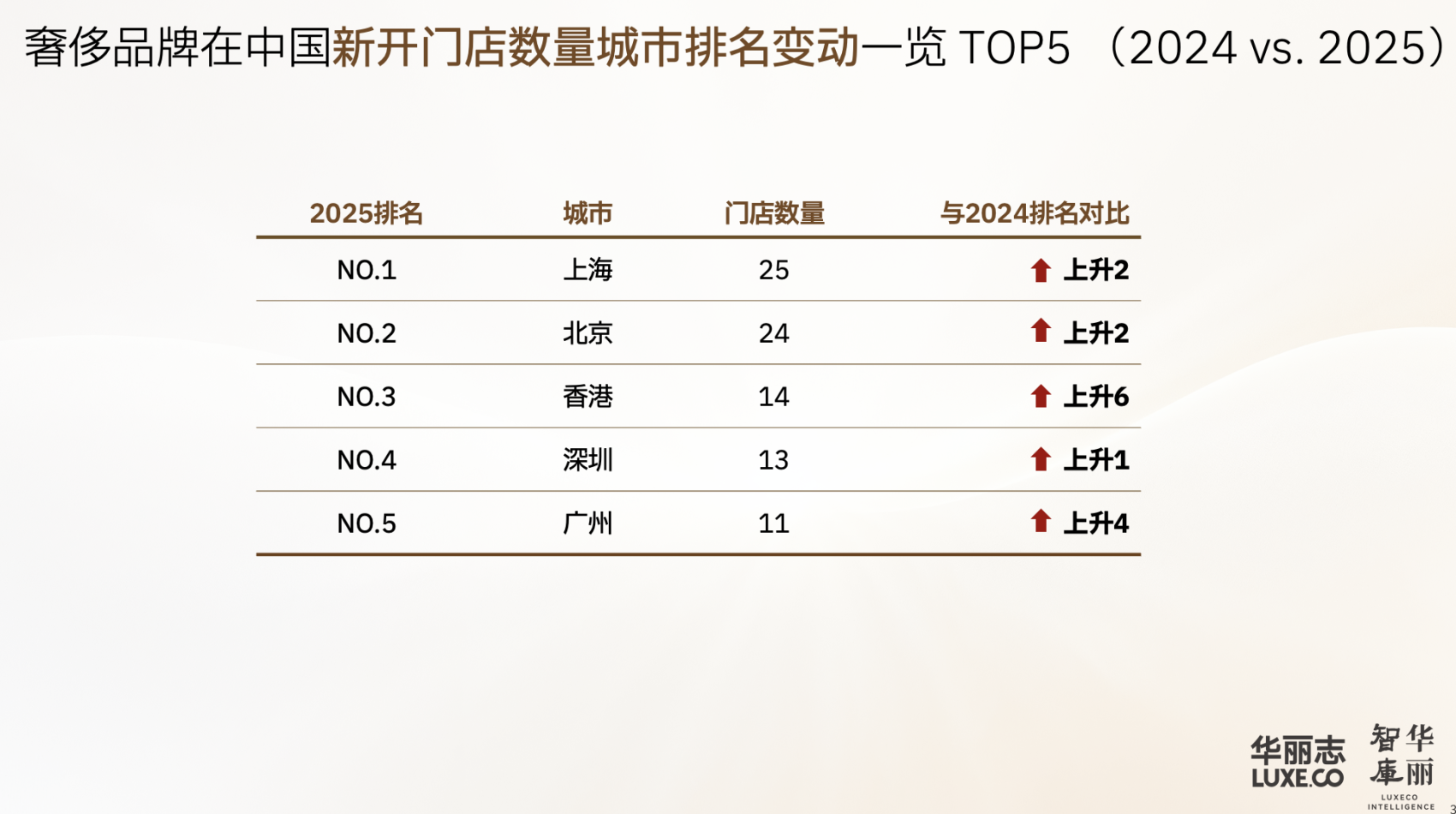
Among the Top 5 cities that opened the most new stores in 2025, the re-emergence of Hong Kong is particularly notable.
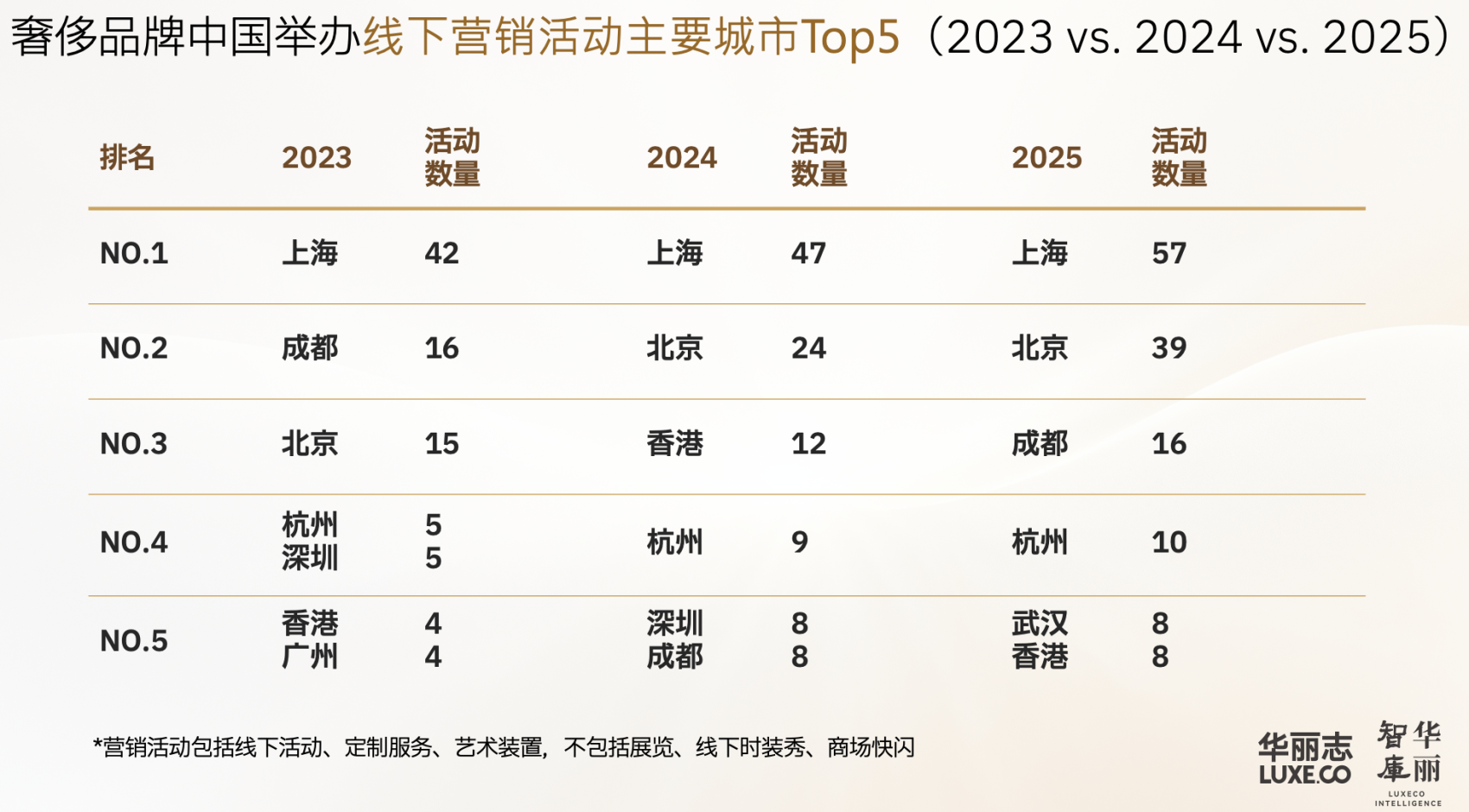
In terms of marketing events, we have noticed that the popularity of “Beijing” is increasing year by year, as more luxury brands begin to recognize the huge consumer potential of this political and cultural center. At the same time, the vast northern market that Beijing radiates to is also worth deep cultivation.
Vitality Ranking Insight 10:
Four “hard strengths” are the solid foundation for luxury brands to move against the wind
Whenever the Luxe.Co “Vitality Ranking” is unveiled, we can clearly feel the changes that have taken place in the Chinese luxury market over the past year — and in 2025, those changes were especially dramatic.
As the luxury industry enters a cyclical trough, and especially as the Chinese market no longer expands extensively as it once did, the gap between brands may quietly widen. Through the data and facts behind the “Vitality Ranking,” we find that the following four long-cultivated “hard strengths” are the solid foundation for luxury brands to move against the wind:
- The brand's own awareness and reputation
- The operational and financial strength of the brand and its parent group
- The sense of value and investment attributes embodied in the brand's core products
- Deeper understanding of the Chinese market and more proactive strategies on the part of global management
— Conclusion —
Looking ahead, LVMH Group's Bernard Arnault recently said: “One thing I am certain of is that the desire for high-quality products goes hand in hand with the improvement of living standards around the world, and this is bound to continue. Although there may be ups and downs in certain countries, the global trend is there. So in the long run, we can remain optimistic.”
Bain & Company and Italy's Fondazione Altagamma recently jointly released the “2025 China Personal Luxury Market Report,” which expects the Chinese luxury market to continue its recovery in 2026.
Luxe.Co and our loyal readers are witnessing the Chinese luxury market go through its first full cycle: boom — slowdown — stabilization — recovery. And the continued evolution of Chinese consumers and the rise of Chinese local brands are placing higher demands on international luxury brands' local management capabilities.
As Luxe.Co founder Yu Yan pointed out: “As represented by the Luxe.Co Vitality Ranking, data-driven brand and industry research is growing ever more important. Only by continuously clearing up cognitive blind spots and actively thinking and exploring can luxury practitioners keep pace with the times and strive for the top. I hope everyone can hone their internal strengths during the industry trough and adjust their strategies more wisely and proactively, so as to seize the initiative when the next growth cycle of China's high-end consumer market arrives.”
| Image source: Produced by Luxe.Co
| Editor: Elisa