Founded in 1851, the America's Cup predates the first modern Olympic Games by 45 years. The AC75 racing yachts designated for the finals are equipped with "foils" on their hulls that work like airplane wings, lifting the entire boat out of the water to fly at record speeds exceeding 100 km/h, making it nothing short of a Formula One race on the sea. And the unpredictable wind speed and direction between sea and land make this ancient sport forever full of unknown challenges.
On September 24, in the Bay of Naples, Italy, within sight of Mount Vesuvius, foiling yacht teams from around the world gathered for the America's Cup preliminary regatta. (The 38th America's Cup champion will be decided here in July 2027.)
Just before the preliminary regatta began, Swiss fine watchmaking brand RICHARD MILLE announced it had become the official timing partner of the British challenger GB1. This team's predecessor was precisely the creator of the AC75 speed record. Next year, GB1 helmsman Dylan Fletcher and core team members will wear Richard Mille watches as they go head-to-head with top competitors in the Gulf of Naples.

In fact, RICHARD MILLE not only enjoys the reputation of "Formula One on the wrist" but is also active across a series of the world's most elite competitions — from the Formula One (F1) racetrack and Grand Slam tennis courts to the Masters golf course and the America's Cup racecourse. Luxe.CO observed that, unlike other luxury brands that sponsor various sports events, RICHARD MILLE watches are not merely displayed glamorously on billboards at the venue; they are genuinely worn on the wrists of top athletes, racing alongside them at the very front line of the world's highest level of competition.
1. Deeply Tied to F1 Racing: Building a Complete "Extreme" Watchmaking Methodology
In 2004, Brazilian F1 driver Felipe Massa wanted to find a watch brand to collaborate with. His manager saw a RICHARD MILLE advertisement in a magazine and made the call — unexpectedly, the person who answered was Mr. Richard Mille himself.
The founder was himself an F1 fan. He was developing the RM 006 at the time and set only one condition: Massa had to wear the watch during races. He also made things clear upfront: "We don't have much money (for marketing); our money goes into watchmaking." From then until he left F1, Massa always wore a RICHARD MILLE watch while racing and became the brand's long-term exclusive test driver. The brand's signature carbon nanofiber base plate was first put to the test on the RM 006.

Wearing a fine watch in an F1 cockpit is not something to be taken for granted. There are only about twenty-plus official F1 drivers in the world; cars exceed 300 km/h, and drivers must drive continuously for over an hour amid violent vibration and enormous centrifugal force. A race car consists of a huge number of precision components, and any single error can lose the race. It demands not just speed but the reliable operation of an entire system under extreme conditions — and that is exactly what Mr. Richard Mille demands of a mechanical watch.
Materials are the starting point of this requirement. In 1981, McLaren brought the carbon-fiber monocoque into F1, subsequently transforming the entire sport. Mr. Richard Mille still remembers that scene; years later, he applied the same material to watches: carbon fiber is lighter than metal, yet more wear-resistant and more impact-resistant.
The partnership with Ferrari brought racing's design language directly into the watchmaking workshop. Since 2021, RICHARD MILLE has been Ferrari's official watch partner, with the collaboration covering F1, the World Endurance Championship, GT racing and the Ferrari Driver Academy.
In February this year, the brand also announced sponsorship of Ferrari's Hypersail offshore sailing project. Their first co-branded watch, the RM UP-01 Ferrari, is only 1.75 mm thick — thinner than a one-yuan coin — yet can withstand impacts of 5,000 g (g is the unit of gravitational acceleration; 5,000 g means that at the instant of impact, the force on the watch equals 5,000 times its own weight), setting the record at the time for the thinnest mechanical watch at 1.75 mm.
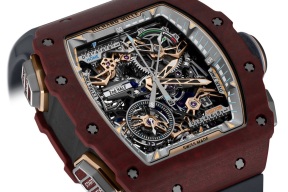
In 2025, the second co-branded watch, the RM 43-01 Ferrari, was developed by engineers from both sides over three years: the movement presents the three-dimensional geometry of an engine block and crankcase, the micro-blasted bridges evoke the sturdy matte surface of a Ferrari engine cover, and the torque indicator is as intuitive as a car dashboard. Julien Boillat, Technical Director of RICHARD MILLE cases, said: "Both brands firmly believe one thing: functional objects carry an inherent beauty of simplicity."
Materials come from racing, design draws on racing, and the watch is worn on the driver's wrist. For RICHARD MILLE, "Formula One on the wrist" has never been merely a figure of speech.

2. Facing the Test of Top Golf and Tennis: Letting the Most Precise Watches Endure the Most Violent Impacts
Wearing a tourbillon watch on a golf course sounds like bringing porcelain into a boxing ring.
A tourbillon is a complicated device in fine watchmaking: it places the core timekeeping component of the movement inside a small, constantly rotating cage to offset timing errors caused by gravity; the structure is exquisite and delicate.
A golf swing, from backswing to follow-through, takes just over a second, and the wrist must complete rapid acceleration and sudden stop in an instant. American golfer Bubba Watson is known for his astonishing driving distance; in 2007 his average drive was 288.2 meters, and his ball speed once reached 312 km/h.
When Watson began his professional career in 2003, he wore a sports wristband while playing. After joining RICHARD MILLE in 2011, the brand made several tourbillon watches for him. In Mr. Richard Mille's view, "Every sport can be a testing ground for a watch. The more physical and mechanical constraints a sport involves, the more it proves how challenging it is."
In April 2012, Watson won the Masters wearing the RM 038. Two years later the brand launched the RM 38-01, adding a gravity sensor to the movement that can record accelerations of up to 20 g; pressing the button at 9 o'clock on the case resets it to zero, allowing golfers to understand the force of each swing.

If golf tests momentary explosions of power, tennis tests hundreds and thousands of repetitions. A Grand Slam match often lasts three or four hours, and with every shot, impact travels from the racket to the wrist.
Spanish tennis star Rafael Nadal had always refused to wear a watch before meeting Mr. Richard Mille in 2008, let alone imagined wearing one in competition. It took a long time to persuade him, and development was equally long: during testing, Nadal broke five or six prototype watches. In 2010, wearing the RM 027, he won the French Open, Wimbledon and the US Open in succession; together with the Australian Open title he had won the previous year, he completed a career Grand Slam representing the highest honor in tennis.
Nadal described what he shares with Mr. Richard Mille: "He pursues excellence, and I admire that; in tennis, I too always strive to be better."
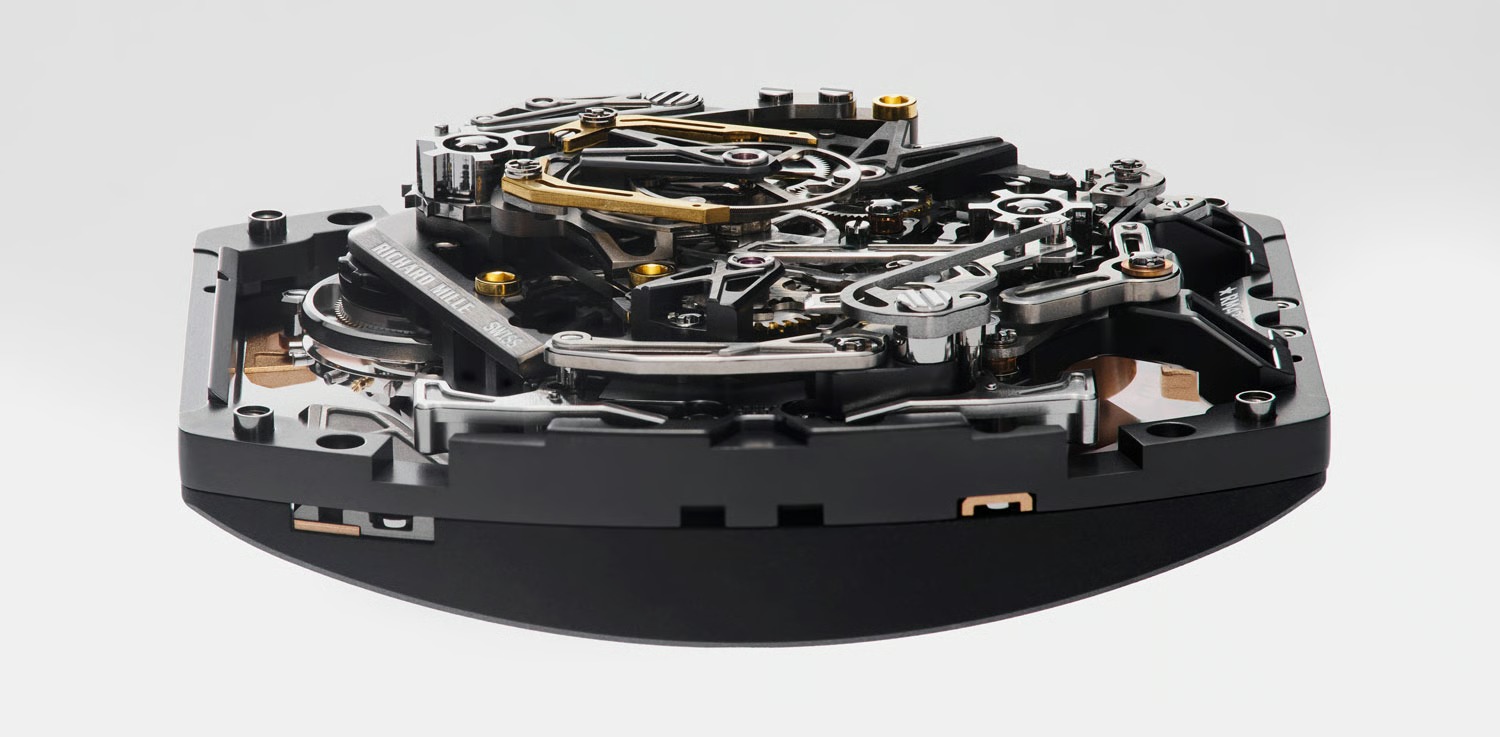
More than a decade later, the RM 27-05 took the pursuit of excellence even further. The entire watch weighs 11.5 grams — less than two one-yuan coins — with the movement alone weighing just 3.79 grams; the movement is not fixed with screws but embedded directly into a one-piece carbon-fiber case, bearing loads as a single unit with the case. It can withstand impacts of over 14,000 g. In other words, at the instant of impact, the force on this 11.5-gram watch is equivalent to more than 160 kilograms pressing down on it.

3. From the Richard Mille Cup to the America's Cup: Building Precision Systems Operating at High Speed Under Extreme Conditions
Before participating in the America's Cup, RICHARD MILLE had already extended its battlefield to the sea.
In 2023, the brand founded the Richard Mille Cup sailing regatta, held by invitation and with unusually strict conditions: only yachts built before 1939 with a waterline length of at least 10 meters may compete. This summer, it moved from the south coast of England to the Firth of Clyde in Scotland, where 12 classic yachts competed across four classes; the wooden yacht Kismet, launched in 1898, won the fourth class.
Mr. Richard Mille explained his fondness for these old boats: "These early 20th-century yachts were designed and built for speed... even the smallest details are extraordinary — because every detail is functional... In fact, these boats have enormous similarities with our watches. Admittedly, they do not come from the same era, but they were born from the same philosophy."

More than a century later, the speed of sailing has been pushed to another order of magnitude. The America's Cup AC75 has no engine yet can exceed 100 km/h, relying entirely on sails, mast, hull and foils to turn wind into thrust; the huge sails block the view, leaving the helmsman only 180 degrees of visibility, and every judgment must be made in an instant. Like an F1 car, it is a precision system operating at high speed under extreme conditions.
Peter Harrison, CEO of the brand's Europe, Middle East and Africa region, said sailing is "at the heart of one of the oldest and most demanding arenas in sport." According to plan, the British challenger GB1 will complete preparations for the launch of its reconfigured AC75 by the end of this year: the new boat retains the core hull structure used in the 2024 event, with the interior redesigned into five crew cockpits.
There is another important connection between RICHARD MILLE and sailing:
The brand's signature Carbon TPT® is made by layering hundreds of parallel carbon threads no more than 50 microns in diameter, with layers crossing at fixed angles, then pressing and heating to form. This "thin-ply layering" technology was originally used to make sails lighter and stronger. It is said that the brand's first batch of Carbon TPT® came from the 2003 America's Cup-winning Alinghi. For years, this material has been manufactured exclusively for the brand by Swiss company NTPT.

Now it has returned to the sea. The Swiss team SP80, supported by the brand, uses Carbon TPT® to build its hull, aiming to reach 80 knots — about 150 km/h — using wind alone, challenging the world sailing speed record. SP80 co-founder Mayeul van den Broek said the two sides' "manufacturing processes are even identical": the same carbon fiber is used on one side for watches and on the other for sailboats.
From wooden yachts a century ago to foiling yachts that can "fly," more than a century separates them, yet RICHARD MILLE values the same thing: carrying extraordinary standards through to every smallest detail.
Conclusion
F1 driver Massa once recalled that Mr. Richard Mille told him: "Watchmaking and racing share the same spirit. Building watches at a high level inevitably means facing technical challenges that must constantly be overcome... Not even a millisecond of complacency is allowed."
More than twenty years later, the word "racing" in that sentence can already be replaced by golf, tennis and sailing. What they share is this: high technical difficulty, intense competition, white-hot rivalry, and only athletes and equipment in relentless pursuit of excellence can stand on the highest podium.
In Luxe.CO's view, for RICHARD MILLE, whether a sport is worth deep investment does not depend on how much exposure and traffic it brings, but on whether it can let a watch be worn into the highest level of competition and endure the harshest tests alongside top athletes.
Being able to stay on the wrist is only half of it; the other half is RICHARD MILLE's genuine appreciation for these athletes. What the brand values is their fighting spirit — regardless of ups and downs in results, whether they leave the field or continue to compete, it is willing to stand by them all the way. Massa left F1 in 2017 and remains a member of the brand family to this day; Nadal retired in 2024, and his collaboration with the brand has spanned more than a decade. Mr. Richard Mille said: "Rafael and I made a lifelong commitment: through storm and sunshine, we always support each other. He is not just a friend of the brand, but a lifelong friend!"
As GB1 helmsman Dylan Fletcher said when announcing the partnership, the two sides share "a true resonance in common values and in pushing limits and exploring more possibilities."
Those who push limits are often lonely, but for RICHARD MILLE's outstanding friends, on the track, on the court and in the wind and waves, they can always trust that such a watch will accompany them to face the next challenge.

丨Image source: Provided by RICHARD MILLE, official website
丨Editor: Elisa